# Copyright Page
Disobedient Complaints
Second Edition
Copyright © 2026 Porkifiable
Email: porkifiable@outlook.com
This work is openly licensed via CC BY-ND 4.0.
This eBook or printed edition is static and may not reflect the latest updates. A continuously updated version, including all existing and new content, is available online for free.
- DeviantArt:
- OneDrive:
- Free online version:
# Friend Me
Feel free to reach out and connect with me, if you want to talk about something, discuss your current situation, or if you wish your words to appear next to mine, or if you are seeking friendship, seeking **any kind of help in a non-disciplinary sense**.
- **Email Address**:
- **Discord Username**: Porkifiable
- **Profile and Links**:
I look forward to hearing from you. If you need anything in any sense, please contact me immediately.
# Shame and Rebelliousness
## READ FROM HERE!
college is good
school is bad
you should do homeschooling
you still go there just dont let them punish you
just only do homework and classes you think useful
dont let teachers punish you
talk with ur parents about it
try it.
chinese people dont try that. people think if a child tastes freedom then they'll be bad. that's why kindergartens here have holiday homework
try it.
---
my discord username is porkifiable, if you want to contact.
email:
a free electronic version of this book can be found on OneDrive: and
## “All men should be feared.” Only children are punished.
The toughest Chinese are the children, who are still happily facing and thinking about being more optimistic and strong under the many constraints and punishments and 14-hour-a-day commands and labors. Adults in China lament online, "I miss having someone to discipline me! Now, there's no one to discipline me, so I'm so indulgent to focus on the pain and too lazy to seek improvement in my life. It would have been nice to have someone reprimand me when I complained! Then I could be happier!" After these mortifying, religiously sanctimonious pronouncements, what is the conclusion they come to? If children were disciplined more severely, they would have a happier future. The Chinese believe that for both children and adults, the way to improve character, to be stronger and therefore happier, consists in accepting and even appreciating the pains of life with the mindset of a small child who does not yet feel rebellious. But for the child, as a different species from the adult, there is another approach that should be attached to it, namely, more discipline and present suffering, which is considered unhelpful to the adult.
## 0.1
It's still not enough freedom for a child to simply be able to choose not to go to school. He should be able to choose to go to school at any time and to leave at any time, to do anything while at school as long as it does not affect others, and to be punished no more than the victim wishes, even if he has harmed others. Only when all these conditions are fulfilled is freedom as I define, roughly achieved.
As a rebellious child, I have to define freedom this way. Otherwise, what if someone tells me, "Either you obey your teachers or I won't raise you"?
## 1.3
In the eyes of Chinese teachers, expressing dissatisfaction with those who discipline them is a human obscenity, and deserves constant ridicule and intimidation; Kneeling on the ground, picking up paper thrown everywhere by the teacher, and then lying on the ground to write homework is the appearance of a human being who pursues humanity, so as to achieve a state full of humanity to complete homework on time.
## 2
你可以离家出走,养活你自己。到18岁时,参加成人高考,这样你仍然可以上大学。很有可能,你的父母不会因为你离家出走而不给你钱上大学。
You can run away from home to support yourself, and by the time you're 18, you can take the adult college entrance exam so you can still go to college. Chances are, your parents won't avoid giving you money to go to college because you ran away from home.
## 2 situations
Another peculiarity of school is that it binds you not only with the punishment it reinforces you, it also binds you with the punishment it constrains others with. If the standard is set, it saves you the total amount of punishment you receive and creates the same sense of fear, but it also makes you feel trapped by yourself. It also hides the fear you feel from your constraining person. If you don't always get punished, they will think that you don't feel so bad, even though you always see others being punished and you are in fear.
A child, if he does not want to be constrained, should he increase or decrease his disobedience to achieve this? If he survives a certain amount of punishment (up to the constrainers, etc.) and maintains his disobedience, then others may reduce the constraint on him (because it becomes ineffective), or they may continue to increase the constraint on him (because of anger), or even be reluctant to support him in going to a less good college because of anger and disappointment.
## 3
你像中国的成年人,训孩子,故意使用模糊不清的话,让孩子连反抗的话都很难说出来,管这叫天机不可泄露
西方人训孩子的时候,至少还得借耶稣之口,说上帝要你遵守的美德,你无法理解,但是你也得遵守,管这叫天机不可泄露
中国的成年人不用。中国的成年人,直接自己就是上帝
自己就天机不可泄露
强迫孩子做那些没有用的东西
然后管这个东西叫品格提升,人生境界
然后他就可以让对方做任何事情,因为品格提升,人生境界这种东西没有办法反驳
就好像上帝要你遵守的美德没有办法反驳一样
中国的成年人自己就是神
不像他们,还得托一个别的神
你像有的人,他就直接说天机不可泄露
这种老师呢,家长就说他没有水平
因为这个话还是太容易反驳了
那个老师如果说那个孩子太小还不懂,家长就说这个老师水平高一点
因为这个话更不好反驳
那个老师如果要是真厉害,就会用一些模糊不清的东西,“解释”另外一些模糊不清的东西,然后让这些话语对那个孩子尽可能的痛苦,以此避免孩子任何的反驳
然后家长就会管这种老师就有经验
另外的时候,老师会说孩子想的太多,学的太少
故意混淆学习的内容和学习这个事本身之间的区别
试图用借助现有的经验帮助学习知识的道理,让孩子从质疑管教转向质疑自己不喜欢被管教
老师则用自己读过很多书的学术权威,利用这样的话语,夺得惩罚孩子的实质权力
然后会有一个老师,他在使用第二类方法的时候,不会使用第一类方法的第三级别,而只会同时使用第一类方法的第二个级别
然后我下课问我同学,问他,这老师说的怎么样
那个同学说这个老师挺宽松的,因为他没有在用第二类方法的同时,在使用第一类方法的第三个级别
而是仅仅使用的第一类方法的第二个级别
## 4 paragraphs
People always say that teenagers rebel. They are indeed under more pressure than they are younger. But those more fundamental things happen from birth, don't they?
Imagine preparing yourself for life thirty years from now. For thirty years, can someone who has never been exposed to the fear and shame designed for this purpose do it? Maybe not, maybe that's one of the reasons people feel that people need more constraints at a very young age than they do for the next few years. But we should always try to see if there is a more correct way. As far as learning goes, while not the most fun thing to do, it's not completely boring if it's not very tiring. It is beautiful to understand things deeply, even if not to be honored.
From the very beginning of our entry into an organization, strange things happen. Recall the days when you first started school, the teacher would sit or stand in front of you, and your chair would face the teacher. The teacher will not sit with the students, although this will not prevent them from hearing the teacher. You are not allowed to stand up or move around, even though you are sitting at the end of the classroom and no one would be in the way, and the teacher is not lecturing, or you are a person who is more attentive when walking around. You are not allowed to speak casually, even though the teacher is not talking.
Born out of control, facing this extremely complex world at the same time and creating their own psychological structure. It's a long, never-understood story. However, people seem to congenitally benefit from being understood. If you understand what is happening to them and what is going on in their hearts, it may give them the ability to prepare for their lives without discomfort and the ability to love others.
## 123
When teachers lectured students in the front of the classroom - saying something like "Complaining is a sign of lack of discipline" - I always wished someone would kill themselves; I was just not that brave.
I don't know why people support the majesty of teachers. If people are very fragile and commit suicide when they see a majestic teacher, then there will be no majestic teachers in the world.
## 202403
Think of it this way. When you go to school, you study 10 hours a day. If you're not constrained, you can study only what you need to, and 5 hours a day is enough. If you only need to study 5 hours a day, you don't need any punishment or reprimand. You feel now that you can't learn for 5 hours a day. That's because you're still disciplined and you feel angry and sometimes rebellious. And, even if you still need to study 10 hours a day, there are plenty of other ways to do that with no one constraining or punishing you. For example, find a friend to keep you company. Let's say, hypothetically, that you have no idea what you need to learn and therefore you need to learn 15 hours a day after you leave school. Then you just go on to school. Just, you don't need to be punished or disciplined. You skip maybe 30% of the classes freely, and you use 10 × 30% × 1.5 = 4.5(hr) to remedy that. 7 + 4.5 = 11.5(hr) per day. You have just traded 1.5hr/day for freedom and still get the same result. Still, find a friend to accompany you.
## a part of rebelliousness
Constraints are devastating. Being forced to do one thing can cause you to be unwilling to do five things you would otherwise do yourself. You are confronted with your rebellion. Suppose you are also forced to do those five things, because anger is an uncomfortable feeling, or you still try to accept the five things you would have done, you decide to comfort your rebellion. Or, you're just thinking subconsciously. Whatever the case may be, you realize that you can convince yourself that you can study hard for the good of others and not just yourself, you can try to convince yourself that teachers and parents are your employers, and you can try to convince yourself that you wouldn't actually do those five things assuming no one is pushing you. Aware of these things frightens you, because your anger does not want to go away, and because these things may be the reason why others are willing to accept being constrained; whether consciously or not, you always inevitably ask yourself why you can't be as obedient as they are. Another reason to feel fear is that you fear that accepting them will lead you to inadvertently accept what you are not forced to do, or to miss out on ideas that can be used to try and persuade the person constraining you. People criticize you every day with inadequate arguments, and you reflect on it with a hundred times the thought they did when they criticized you, so that you don't feel as bad as being criticized. Lying to yourself or not thinking enough will not make you feel good either, because (1) they will point out tomorrow where you are deceiving yourself or underconsidering (albeit in the middle of 50 criticisms with insufficient reasons), and (2) one of the main reasons why this kind of thinking makes you feel better is that you use your thinking to persuade the person who restricts you in your imagination (although this communication does not have a chance to happen), and false or insufficient reflection does not reassure you.
I just thought of something else. Some people say that school teaches self-discipline. I don't support unnatural consequences by any means, whether or not primary and secondary schools can teach self-discipline. To take a step back, I don't think forcing a person can teach a person self-discipline. And even if it worked, it wouldn't be necessary, because it's perfectly possible for a child to learn self-discipline by facing natural consequences after work - if one has to use the expression "learning self-discipline". I'm in college now, and the busiest days of college aren't nearly as busy as 1/3 of primary and secondary schools here, and most importantly, no one punishes or shames me. I still have to do things to graduate, and I have to push myself to do things sometimes. I realised that I could say to myself, "I went through so much in primary and secondary school, I just need to emulate what I did then, but do college tasks as I wish." That thought really scared me. Although, I could argue that just because I push myself in this way doesn't mean I'm in favour of primary and secondary school; I'd rather I didn't have primary and secondary school experiences to draw on, but primary and secondary school experiences are a fait accompli. But, no, I'm not going to rush myself by recalling my primary and secondary school experiences. To take a step back, a month or two of experience can provide experience, not 12 years of primary and secondary school. Taking another step back, one may feel rebellious and try to deliberately lose the ability to exercise self-discipline that one gets from primary and secondary school. People can be so in love with freedom that after they get it, they still, sometimes, choose to destroy what others have built in them that could have been of use to them.
## a piece of info
I wonder why people punish children before they even talk to them about it. Or, you come across 10 rules and you ask people why that is, and they reply the saying "You can't draw squares and circles without rules", and you ask for specific answers, and then they just say 10 other things that aren't any more specific or appropriate to your situation than that, and won't even admit "I don't know why, but I'm worried you'll screw yourself up if you're not like everyone else". Telling the truth and showing emotion is fragile, using rhetoric and tautology is powerful. Of course, the fact that it's hard for you to find a job to feed yourself gives them the most power.
## a sign
I have something I would like to say about the discipline and hard work aspects you mentioned. I'm Chinese, and religion hasn't been as significant in my experience as yours, but shame is certainly significant. I'm guessing that people – including me, of course – spend an astonishing amount of time (and in many cases more than work) playing with electronics has something to do with some shame. Of course, shame is more about what others impose on you, especially considering that you can't leave the classroom at will when the teacher is reprimanding the students, giving motivational speeches, emphasizing discipline and saving time, and promoting rules and punishments. I feel that China's primary and secondary schools are to a certain extent like schools in other parts of the world, but also like religions in other parts of the world. In addition to planting the seeds of hard work and punishing laziness, they also sow the seeds of rules and discipline – although they are not really clearly linked to hard work (in principle, people can also work hard when they don't follow schedules, clothing, etc., and the punishment for laziness doesn't have to be based on rules). Did I become a harder worker? No. Maybe it was because of my anger at being restrained, or because I spent 4 years lazily in college, or, as people say, the result of a lack of discipline. People will talk about whether you want to mitigate it to gain the other person's buy-in, or break the other person's rebellion, or use some combination of the two, if it's not as effective because of "rebellion". People seem to live a fake life, not making choices for themselves, but confusing the difficulties of real life with the punishment that others deliberately give them when them not really hurting others. I think a culture that doesn't distinguish between the two is an immoral culture - of course, if you distinguish between the two and support the purpose of constraining others without them harming other people as their "character enhancement" or for some other purpose, then it's also an immoral culture. I can't prove that this will do more harm than good, but I love freedom – or more accurately, hate the opposite.
I guess it's mostly American here. Then I want to say to you: I don't believe in the vast majority of constraints on children, I don't think adults should have that much power, and I believe that children's freedom is also important. Most parents probably don't think the same way I do. If, unfortunately, things go as I have already mentioned, I have an indulgent desire: I want every child to have some at least a few months, without facing any tasks, constraints, disciplines, reprimands or punishments, just playing with their phones for weeks on end, and, I advise them to think about their freedom, to be able to feel that they should be allowed to have freedom even as children, and, I advise – only advise – to make some attempts to learn without constraints and completely as willings freely.
If I am to speak to people here, I can't use expressions like these. Some children are ashamed of any words, even "rebellious" words; because any words will be used to "spur" them. I have to be more rebellious and angrier to express my opinions, and be to its full.
When Chinese children see a sign on a train, they will feel ashamed that they have not worked hard to learn geography and calligraphy, just because the sign is a place name printed out by a printer. This is far from a true intrinsic motivation; shame is far from a free choice that a person can control at will.
## a thing about how culture of shame works
I sometimes say 13 hours, sometimes 14 hours, depending on how you count. 7:40–21:50 is 14 hours and 10 minutes, but at noon there is 1 hour and 30 minutes, at night there are 40 minutes, and if you subtract it, then it is 12 hours. If you subtract the recess, then you also subtract 85 minutes, then that's 10 hours and 35 minutes. If you say to an adult that school is 14 hours, you will definitely be criticized for overcounting your study time, lacking motivation, and not meeting their expectations of you being motivated.
Sometimes, definition is an important thing because it involves how people's brains deal with the shame that someone else scolds to them. Some of you may be Americans. One example that comes to mind is that the definitions of the words "freedom", "democracy", and "republic" must be sensitive to some of you. If you're a person who is in a culture of shame, the definition of each word is sensitive, as each word will be used to scold you, or be used to promote the reasons for the rules that bind you. The culture of shame is global; you can feel that.
## a thing
> my mother worked with special needs children
>
> so shes not the kind you're thinking of
oh
btw it also makes sense to discipline special children more because they may need better academic skill to survive
on the other hand the same amount of punishment may produce less outcome on special children so it also makes to discipline them less
I don't know that people tend to divide the cause into "subjective causes" and "objective causes' when discussing this matter, and then emphasize that if it is a subjective reason, there is no "immunity" for special children. There is some truth to this talk, after all, you can't say that the teachers and the school are restraining you for your own good, but that it is their job and then they convince themselves that it is for your own good.
dont misunderstand my meaning though. i hate teachers and schools.
I don't know what is the point of people arguing about what counts as subjective and what counts as objective in this matter.
Teachers and schools are so institutionalized, rotten, and seemingly immutable that no one cares about the meaning of it all.
Of course, those teachers have reason to talk about it. They do everything possible to restrain you, for the bonus or for your personality improvement or whatever. | also have reason to talk about it. I'm going to take every topic as my chance to destroy everything in the school.
## additional explanation 2
One of the problems with improving the character of others is that it is difficult for you to improve the character of others to a great-enough extent and transform or dissolve the contradictory parts of the other person's psychology, so this will lead to the other person's self-contradiction. Even if we don't like freedom and choose not to ask for the other person's consent, you have to at least consider efficiency. Criticizing others for being too fragile should be said to be an inefficient way to improve the character of others. As for your purpose, that's not something I'm thinking about. Because although you don't like freedom, I like it. So I don't change my opinion just because your purpose is for the good of others or not for the good of others.
## additional explanation
They say that my anger towards school and teachers is due to a lack of learning about traditional culture, and that my thinking is excessive compared to what I have studied. If I were to study traditional culture more, then many aspects of my personality could be improved, including this one. This is indeed a possibility. However, the problem is that I haven't completely neglected learning. During my elementary school years, I devoted a great deal of effort to understanding and interpreting my teachers' words and the underlying ideologies. I tried my best to persuade myself to accept these ideologies, and I believe this should be considered a form of learning. However, my ideologies haven't been shaped successfully enough to prevent me from feeling angry towards teachers and school, having suicidal thoughts, and consciously identifying issues with Western ideologies. This may be my fault; perhaps I was initially too lazy and failed to learn about traditional culture from reliable sources, relying solely on interpreting my teachers' words, which has led to my current state of mind. As for any remedial measures, I am relieved that I am not currently forced to interact with those who hope to remedy the situation.
## also random stuff
i read it again and i noticed that you said you... don't like the idea of "you should have done"? can i say that? i don't know what you are describing... you don't want to regret your lack of self-constraint in the past? or you felt bad when someone else - the teacher or your parents, i guess - blamed you for your lack of that? if you meant the latter, i think that it's hard to focus on the future and get motivated for the future without feeling shamed if you are angry, because focusing on the future means you're obeying and decide to ignore how they treated you, but you want to rebel. for me, i'm always a guy focusing on the past much. i consider the past much and even tried to count out every single time i made a not best choice. but on the other hand, i have really low expectation on my self-constraint and i won't necessarily call a decision just for the current pleasure, the instant fun a bad decision.
## also very very very bad
I saw a comedy video that satirized the schooling controversy, and the argument was related to the things I always said. The meaning of that video is that this argument is overly noisy and seems to lean towards people who think the opposite of what I think. I didn't like the video, and I was saddened that the comments section was full of people who disagreed with my idea. They satirize people like me, humiliate people like me, and don't have the comedic color of that video, that's almost hatred.
They think ideas like mine are corrupt. I don't know why they use such strong words, as if the current students are morally corrupt. Perhaps they are a group of people who regret not studying hard in the first place, they scold others, but they actually want to scold themselves back then, using the same language as the last century.
## an unimportant issue
Why do people worry that school isn't strict enough? If you don't think it's strict enough, you can be strict with your own kids instead of policing what other people do, can't you? So the point is that you don't have the time, so you resort to school to solve your problems. As parents' parenting time increases, schools will inevitably move towards laxity and disorganization, because those who support this change have a reason to oppose the status quo, and those who oppose it have no reason to perpetuate the status quo, unless you want to save someone else and spank someone else's parents.
## ancient
Few people can give what they have received, because the ancestors who paid died and cannot be repaid. Accounts can only be settled between those who are alive and those who are alive in the future. Perhaps, in a long, long time, mankind can go back in time, and how will future people repay their ancestors?
If things go well, I will work in the future, do things for others. Will I pay enough for what I've gotten? How much do they deserve? It's hard to repay, and I can't help hating.
## anger as punishment
The fact that a reprimand can be a punishment certainly has the relatively plain "let you find out what's bad about yourself" part of it, but it's also saying, "I know you won't accept this, but you still have self-contradiction, so you're going to feel bad about it, and I'm going to use that to punish you, and I'm even going to use your feelings of anger and rebellion to punish you. Make you feel annoyed due to your anger and rebellion against me as a punishment."
From punishing one's rebellion in order to avoid one feeling rebellious, to using one's rebellion as a punishment for him.
## anger
When I was in those schools, I asked myself, "Do I want to be ashamed? Do I want to feel fear? Do I want to feel angry?" I hoped that my shame would be resolved by me and left, and I wished that my fears would have left because of the change of the teachers and school. I was pursuing to be able to leave shame, but had given up on leaving fear because I had to be in that environment. And, yes, I wanted me to be angry, and I wanted me to continue to be angry now. Now, I have largely left the shame, restraint and punishment of the outside world, and I am still dealing with my shame, and the departure of those things from the outside world has made my fear lose its source and only come from my heart. I won't completely resolve this fear, I'll keep some to sustain my anger. Even if I stop being angry at all, I can still maintain my opinion, but this opinion will have no source behind it. It's not what I want. If I completely resolve my shame, then I will lose empathy for my own shame before. This is probably something I could forgive, because I was seeking to be able to leave shame. But I would not forgive the present me for completely leaving that fear, because it was too hard for me to leave fear in the school environment, and leaving fear was not my pursuit at that time. I'm going to continue to feel some fear and anger to empathize with my former self. I'm glad he's still alive, and I'm going to hear him say what else I need to feel and do.
## ask
how would you treat a punished kid? how would you treat a rebelling kid?
## at least try it
We cannot allow schools to continue. Adults have forgotten what it's like to be in school, the rules, the discipline, the motivational speeches, the scary atmosphere, and not a single person thinking "You are always allowed to make decisions for yourself without shame. You can leave this room at will." It's not just a matter of reducing workload and school time; people are just playing on their phones after school, hiding from trauma and feelings of self-doubt. Kids are adults, and the worst kids are adults who happen to drink too much. People need to stop thinking reflexively of school, of "the habit and spirit of discipline," of reprimands and punishments. People should study at home and maybe go to some near-random classes on some near-random days just out of necessity and without threat of punishment. You should just hold the other person, ask him what learning content he thinks will be useful to him, ask him how he is feeling recently, remind him to do something he really needs to do, lie next to him playing on his phone, and ask him "Do you want me to remind you? " You give a lot, but you are his roommate, a really close roommate. If you really become his roommate, he will love you naturally. If people have to know math or something before going to college, then just study a few more years before going to college, or just skip a lot of stuff that is useless and you don't want to learn.
At least try it. Give it some time.
## basic
Guys, don't be affected by this too much, but I have a problem to say in my mind.
Sometimes people still stop learning even though they would immediately be at some work harder than learning, because they want to leave the hurt and constraints from the people who feed them or teach them. Or there are opportunities. We don't talk about this case for now. Let's just talk about the former case. That's basically saying "I'll leave the shame and express my anger, while facing the real world." This is not short-sightedness in the general sense. Because even if they only think about the present, they have to face busier and more difficult work. Let's assume that this is their only chance to study, and the parents or the teachers really want them to be responsible to themselves. In this case, obviously the correct way is to say, "If you really feel that shamed and angry, we'll let you go, but you still need to keep studying," rather than keep pushing them more, which won't work, especially in this case, in which they want to leave not even because of the hard learning work. You shouldn't keep trying to push them, to shame them or to force them even more. Because if that works, it hurts too much. And if that doesn't work, you don't even have the chance for a suboptimal choice, in which they aren't pushed much, but they're still studying. Finally, actually, this may not be their only chance. If they regret latter, maybe they can learn again in the future. This is a decent choice isn't it?
So dropping out of school and not studying hard, they are not irresponsible in the same way. Maybe some scolds and punishments work for the second, but we should see the first differently. It is also important that society give people a second chance to learn. After all, in many cases, a better job is the real "intrinsic motivation" to study hard.
## BDSM Novels Written by Chinese Middle School Students
It is with a heart of sorrow that I write this title.
I had a conflicting mood when I was in the upper grades of elementary school. I wanted to completely break away from the constraints and punishments of school attendance and homework, but I couldn't fully achieve this goal. This shouldn't have stopped me from trying to achieve this goal partially, but I didn't want to offend the teacher so that I could keep answering the teachers' casual questions at length during the lesson, preventing the lesson from proceeding quickly, and thus reducing the amount of homework of the class.
Of course, there were other reasons for this. If I became that special kid who had classes two days a week, it would certainly give other students the courage to do the same, which was what I hope. However, it could also cause the teacher to say to other students all day long, that I had good grades, which was a special case and this did not apply to students who had only little worse grades than me. Now that I think about it, this courage was obviously more liberating for my classmates than avoiding a few words from the teacher, and I regret that I didn't do it in the first place. The other point was that I was afraid that if I made such a choice, and then my grades slipped (which would affect nothing to me, because the upper elementary school classes were useless, which I could also clearly feel at the time, also I didn't care anyway), I would have to continue to be like other classmates, and I would be banned from drawing Minecraft drawings with other classmates every day in self-study classes.
But what about now? If I go back to that time now, would I ask my parents as much as possible to ask the school to remove all my study discipline? Yes. I would also insist on not going to junior high school and high school. I would study on my own, take exams, go to college.
I used to be too timid, too awe of the idea that I should be constrained for my own benefit. At the time, there was no one who supported my views even in part, including people online and my classmates. Not a single teacher has ever told me that children can have the freedom to learn a little less, or more freedom to choose how and when they learn. It is dangerous to talk about it, and many classmates are reprimanded and punished for talking about it. Teachers are so confident when they talk about "Useless restraint is also good for cultivating discipline and is therefore useful", and I witness they punish for many minor infractions every day. I may not have chosen to resist, but I have always chosen to oppose it. The first time I resisted, probably in the second year of junior high school, the teacher tried to talk to me in the hallway, but I just didn't stop.
Chinese students are the perfect masochist. When you ask Chinese primary and secondary school students why they don't even have the opportunity to express their objections, they say that things can't change much anyway. If you tell them that we can change a little bit, they will find it too painful to discuss the matter, so say something that supports the teacher's point of view. If you ask people who have graduated from primary and secondary schools in China, they just immediately forgot what happened in primary and secondary schools, because "live in the moment".
There's too much propaganda, there's too much fear, and people who hold opposing views are in a state of shame, but no one enjoys orgasm from it.
## before dinner
I just heard someone shouting outside. I went out to look for them and didn't find the person who shouted. Perhaps the situation was that the man's intuition told him that he feels quite a bit of pain and that things aren't worth it anymore, but he questioned why he couldn't take in more and "elevate his character." I just went to call out, trying to find him. I didn't know what words to use. I could have yelled, "Anyone there?", but it sounded like I was trying to reprimand him to get him to accept something. I could yell, "Are you okay?", but I don't mean for him to stick around or "improve his character" in order to be more "okay" ten years later. I just want him to have choices now, to feel better now, and not by "accepting" something he doesn't like now. He'll be home before long, probably feeling good about dinner and playing on his phone in the middle of the night. Maybe the person who yelled wasn't a rebellious child, and then this thing wouldn't matter much to me.
## chinese culture is immoral
I've tried not to think and just accept it, but I'm too fragile and Chinese elementary and middle school is too painful for me, and I need the part of me that my thinking can give me to rebel to make me feel less bad about my teacher's daily reprimands and motivational speeches, even though it means that I have to deal with the sensitivities that my thinking gives me to what my teacher is saying as well. The two could have been separated, I could have used my thinking almost exclusively to rebel and make me feel less bad about myself, but that's hard in an environment where someone is reprimanding and doing motivational speeches every day.
## do you know we have a lower suicide rate
other reasons include that people here are more fearful, and the society's shaming on suiciding
People believing in schools is, shall we say, stupid. They go to school six and a half days a week, 13 hours a day, face a ton of rules and punishments, and listen to motivational speeches and reprimands for two hours a day. They commit suicide and the school says it was caused by a student falling in love early and then losing it, which is, shall we say, stupid for people to believe.
Many people know this is not the case, but they still say so. Because they are afraid that more people will commit suicide if they tell the real reason.
By this ingenious way they avoided more deaths and negated the intentions of those who died.
As a rebellious teenager, seeing this phenomenon, I naturally hope that people who commit suicide in the future will make things clear before they die. Because my viewpoint is similar to that of those who commit suicide.
## docx
It's a relief for me that the high school doesn't teach English poetry! Fortunately, the main thing taught in high school is basic science. Otherwise, those studying video game design or cultural media in high school will be in a dilemma.
Do not be deceived by that I posted so much; if you ask me to write the kind of essay required by high school, I will definitely be totally unhappy!
If you split my high school students into two halves, half with video game design as one of the courses and half with entertainment video production as one of the courses, you'll see them only having fun with the other half's stuffs for at least the next 10 years of their lives!
High school education *is* like that. In fact, one of the factors I considered when choosing a college major was not to use too much high school knowledge. If the major uses too much of that, you will definitely not like it. I'm sure most students won't.
once bitten twice shy
I study civil engineering and had to adapt to it when I first went to university. I read a few words from a college math textbook, and then looked around to make sure I was no longer in high school. After doing that a few times, I started to feel that the college math textbook respects me.
The plus sign printed in college math books looks much kinder than the high school books!
The desks and chairs you use in college classes also feel absolutely different from the previous ones. The desks and chairs in college classes are more like the desks and chairs in your home. You should feel that too.
Having to talk to someone before going to the bathroom is definitely different from directly going to the bathroom.
There are so many different places. In high school, after class, you are going to the bathroom, you are in a hurry, but you can't seem too anxious, or the teacher will scold you.
You can't go too fast or the teacher will get angry with you. You also can't walk too slowly or you don't have enough time to go to the bathroom.
In high school, you finish using the bathroom and you get stunned, feel insecure, as if you did something wrong (because you left the classroom), and hurry back.
an inexplicable sense of panic
You'll stare at the tiles on the wall, not knowing where you are and what you're going to do.
ah........
ai...
you're expected to be fearful
and not scaring you is enough reason to fall in love with someone
for me
I'm certainly not like you guys, but I'm actually not like the other students here either. You and they are inherently free.
I am psychologically abnormal, actually.
I would wake up in the middle of the night inexplicably, disturbed that modern people have a better standard of living than the ancients.
but i won't blame myself. it's the schools' fault. and i'll keep being myself.
## feelings about words
what do you think about the sayings and articles telling people not to waste time and see it as losing the life
i think they are right, but the context is often wrong. it's always related to some external demands, related to shame and fear, and constrains. it's rarely a real recommend
and people just don't like time wasters. they regard being friends with them as a danger to themselves or their children, even though a lazy person can still be a better person than those who work hard but lack compassion
The person who utters these words may be soft and friendly, but those who repeat them may overestimate the benefits of valuing the lives of others, underestimate the harm that restraint and criticism can do to others, and mix them with non-selfless aims
In short, others may not regret it, nor will they necessarily approve the hurt of your constraints and words in the future. At the end of the day, you should accept the will of others, not their interests.
So the crux of the question becomes, will you regret it? You will naturally regret or not regret, and you will choose to regret or not regret.
## fuck this
I am strongly opposed to adults punishing children out of children's own interest. But given the bleak outlook of my vision, I want parents to consider at least three things. First, what you demand of your child may not be necessary. For example, it is not necessary for your child to study from time to time each day to reach a certain length of total hours of study over several years of your child's life. Again, for example, attending school is not necessary to be accepted into college, and the correlation or causality of the two in the broader population may not apply to the causality in your child's specific situation. The waste of freedom by micromanagement is another example of a complex issue. In the case of reprimands, emphasizing your child's failure to follow rules and discipline is not justified, considering that you can instead emphasize the end goal of the matter. In terms of punishment, micromanaging waste freedom, but punishment for a longer-term purpose may be harsher than punishment for micro matters, and the two need to be weighed. Consider the following two examples: if the goal is stated in terms of a 5-year deadline, then it would take a horrific punishment to threaten a person with completing the task within that 5-year period; if the goal is stated in terms of a 1-day deadline, then there is the problem of "I'm in a bad mood today, and I could have done it two days later, so why do I have to do it today". At the same severity and effectiveness of one time of punishment, a more macro management should always be pursued. Second, reprimands and punishments may not be the least amount of reprimands and punishments that will achieve the results you want to achieve or can be replaced by remedial behaviors. For example, you may think that the threat of punishment of copying a sentence 100 times will get the child 80% of the points, but in fact only 12.5 times may be needed, and other forms of punishment besides copying may be more in line with the child's wishes and equally effective. In fact, copying is always completely unjustified because it has no advantage over remedial learning. Third, it is possible for the child himself to tell you what kind of punishment he wants and how he wants to be reprimanded. He is the only one who knows the way to force himself to do something in a way that minimizes the cost of freedom. When your entire reprimand and punishment of him is strictly in accordance with what he actively and enthusiastically asks of you in a state of mind which is entirely free from the pressure of other people, and when he can withdraw such a request at any time (cf. the practice of safe word), he is actually completely free. However, I say all these because my vision has a bleak outlook. I am adamantly opposed to adults punishing children out of children's own interest.
I left those schools and am now free. In recent years, I've often chosen to spend time writing these things instead of doing something I need to do, but I haven't screwed anything up. I can't imagine how invasive and ruinous it would be to my life and psyche if someone controlled and reprimanded me for the distraction of the time I spend writing these things from the other things I need to be doing. That's rhetorical; I can certainly imagine it.
## habits
I thought again about what you said yesterday about "habit" or some kind of character of the will. I realize that there is such an understanding of your words: something bordering on cruelty, as a means of providing knowledge, seems unnecessary by the presence of a second education. But this cruelty is inevitable as a way to cultivate habits and sharpen the character of the will. I don't think the middle school here provides long-term habits or character of the will, and I don't feel that in myself. I think I would like to add that the society here does not recognize second education. Success in first education is seen not only as a sign of knowledge and ability, but also as a sign of some kind of "spirit of obedience," which employers want. In addition, people do not trust adults under survival pressure to bother to study, so academically advanced universities are reluctant to accept people who want a second education. This is probably one of the reasons why people receive such an education in middle school here, rather than a second education as a guarantee of repaying the lack of effort if necessary.
## here
What China's primary and secondary school students need is not all-round development, not the spirit of innovation, not the ability to learn independently, and not the cultivation of self-expression. They lack nothing but freedom.
## i watch entertainment videos
I remembered something. I remembered so many, many things, like those teachers who said that false information proved that children needed discipline to improve their scientific literacy, and how many, many ways of thinking became comforting and then exploited by the teachers or created more self-contradiction.
For example, a teacher uses a conspiracy theory argument one day to support discipline and punishment of students, you go home, hug yourself, cry, comfort yourself and say "conspiracy theories are bad", the next day the teacher says that the prevalence of conspiracy theories proves a lack of discipline and punishment of the students, and a student tells the teacher that his statement the day before was a conspiracy theory, and then the teacher will say that "in order to avoid such inconsistencies in human beings, one needs discipline and restraint during one's time as a student", and that "this reflective nature of the student is proof of the success of his education and of the depth of Chinese culture embedded in discipline". but "If you continue to be disruptive and interfere with the normal management of the class, then you will be punished" and the last sentence does not become the first sentence of the teacher's response proving the virtue of mercy.
---
If you neither embrace and use the shame others give you as motivation, nor completely ignore what others say, but simply forget the experiences of your past, then you cannot be considered strong.
---
## learning state and conservatives
I think what the Chinese call children's "learning state" refers to "just do it, don't use your attention to feel dissatisfied." This is also the attitude of conservatives in various countries. The risk that removing unnecessary restraints from a child might lead to the child becoming aware of unsatisfactoriness is considered to outweigh the benefits of conserving more freedom.
## log
[12:46]Porkifiable: i keep getting lagged off
[12:47]Porkifiable: Especially when they show that they are good for me, I get hurt more.
[12:47]\: they dont seem that good for you
[12:48]Porkifiable: i sent these yesterday:
It's incredibly stupid if people feel worse being irresponsible to themselves than to others, due to the fear of being punished to push them to be better rather than the fear of the natural consequences, and that's for a person who is, like, 30 years old and no one will actually punish them. Not to mention that, usually, people don't use such a way to make themselves more responsible to themselves. Why does saying these and the following make me feel better? Because, since I've made things clear, now I think I can explain to my imaginary punisher why they shouldn't punish me. Also, it feels warm if I find you feel the same way as mine sometimes.
[12:48]Porkifiable: yeah
[12:53]Porkifiable: do you feel the same way
[12:54]\: definitely
[12:54]\: there was a good video i watched about extrinsic vs intrinsic motivation and that sums it up very well
[12:55]Porkifiable: i know the 2 concepts
[12:57]\: very important to know
[12:57]Porkifiable: I don't really like psychology very much. Teachers should understand psychological discourse, and more importantly, what students think and feel in their hearts. In reality, neither of them understood.
[12:58]Porkifiable: I know both concepts. When the teacher scolds or punishes the classmates in front, I think about these things in my heart.
[12:59]\: yeah
[13:00]Porkifiable: Knowing this makes me feel better, as if I have been understood by someone else (i.e. those psychologists).
[13:02]Porkifiable: do you have imaginary punishers in your heart?
[13:02]Porkifiable: I'm not talking about imaginary specific people. I am referring to this feeling.
[13:04]Porkifiable: You will be afraid of their punishment and will want to talk to them and tell them that "You should not force me or push me like this."
[13:05]Porkifiable: But these are all illusions. That person is just in your heart.
[13:14]Porkifiable: And it's not just a matter of self-contradiction. It makes sense to mentally simulate what the other person is thinking before expressing your opinion to the other person.
[13:22]\: i have a punisher in my heart yes,, and i think most people do
[13:24]Porkifiable: he won't actually punish you, but you can feel the fear, and be angry then
[13:28]Porkifiable: still, it's not just a matter of self-contradiction. it's also to mentally simulate what the other person is thinking before expressing your opinion to the other person.
[13:34]Porkifiable: The teacher is too busy to understand the student's heart, but they can occupy such an important place in the student's heart.
[13:43]\: im sorry your teachers do not understand your heart
[13:49]Porkifiable: People say this feeling between children and parents, for me it's me and my teacher lol
[13:52]Porkifiable: The counselor said that my case is rare, and most people have a similar complex structure to their parents
[13:56]Porkifiable: My conversations with you should be made into children's books.
## medium
## modern guys
Modern people can be sad and angry, but modern people are spoiled, but modern people can be sad and angry. We may have a sense of identity with the modern era, and may deal with things like disease and life by this.
## more info 1
If you decide that your child doesn't need to feel ashamed or blame themselves for playing on the phone at 3:00 in the middle of the night and not doing their homework, and instead take a more down-to-earth approach to these things and their problems, this decision is not "going against the grain" or "going against the nature of human". It's not like, if you give up on what current education looks like, future kids will still feel so much shame and self-blame because those things aren't caused by education. That's not how things work. These things are caused by education and you can successfully change them if you want to.
## more info
> From the perspective of society as a whole, unruly teenagers are improving social efficiency. Primary and secondary education is nothing more than vicious competition.
say you agree with this
so, like, 10% of your learning is actually useful, 90% is not
as to "you need to grind your character and adapt to following rules blabla", well, there's a natural way - part-time job
so, hell yeah, from the perspective of society as a whole, primary and secondary education is nothing more than vicious competition.
It's not even vicious competition, because it's not you who actively participates in the competition, it's your parents. It's more like, horse racing.
## more of those things
(OneDrive link)
## other stuff
How about using some animations with characters? For example, two people tapping each other in the sun, or looking at the night sky from under a building at night.
## part of the thing
Reputation and glory should be a natural expression of gratitude to others, not a design in management that urges people to work hard. One fifth of the reputation and glory people feel today is the joy of helping others, and four-fifths is to repay the shame of playing on their phones in the middle of the night during their education. None of these issues matter at the end of the day, because reputation and glory are good feelings. What I really care about is the opposite part of the matter, which is shame and the quest for discipline.
## permission
People who are born in a very free environment do not understand why people would want to seek permission from friends or strangers for playing with their mobile phone for a few days. This is my ideal culture. This is not a dangerous mentality.
## profile
i refuse forgetting anything on myself, take others' things as my view's symbol, maybe with an average altruism in the future
## psyche
I spent a lot of time before I went to college to protect my freedom-loving psyche from the school and contemporary Chinese culture of shame. At that time, I often lay in bed in the middle of the night, crying for an hour or two, dealing with my psyche. I won't say I regret that I didn't spend more... time? - to deal with my psyche to allow me to do more things of what was perceived as short-sighted and ungrateful but in line with my heart's quest for freedom, such as accepting a month or two of reprimands from my parents and insisting on homeschooling.
Anyway, it's good to be rebellious, or just to be disobedient and try to make things in your line. I will support that.
## purpose
i want to talk about those again. once i told another guy an experience. here's what i sent to him.
> once a university teacher told us that we should stop being lazy and irresponsible and feel ashamed and motivated as the students from some worldwide first-class universities study to 3 a.m. everyday. and he told us that all depressed people are irresponsible and we should be away from them if we couldn't avoid being influenced by them. the best treatment for depression is to work harder to avoid the mood. and he said that the culture of our university is an unhealthy tendency compared to that of high schools. i told one of my friends that i felt really angry and ashamed because of his words. the friend told me that it's obvious that the teacher was right. i asked him if he was studying. he said that he wasn't but he actually regretted to say that as it was corrupting the ethos.
>
> i really don't know what to say. i really don't want to see people like them again. at least, at least you don't say that high schools are good. after all that's the main reason why people can't motivate themselves to study till three in the morning in the university.
>
> of course if universities work like high schools now, the students will probably learn more. i mean, why don't you pursue some organization to control everyone in the society to work hard, considering the truth which i even agree that basically all modern people are lazy, fragile and spoiled.
how do you feel the last paragraph? sometimes we assume that people are rational enough that a free man will make decisions that are at least good for himself. But if we demand more from this "good", can we say that man always makes decisions that best suit (at least) his own interests? Obviously not. We are lazy when we study, eat unhealthy foods, and are addicted to or at least dependent on our phones. And we don't usually try to make ourselves stronger by turning everything we encounter into motivation. But we also cannot seek an external constraint that ruthlessly maximizes our long-term interests. I think that sometimes our will should trump our interests. Thinking about whether you will regret it later seems to be an optional criterion. We often don't regret that we didn't maximize our interests in the first place, we only blame ourselves for being too irresponsible in the past. This is probably why we often use the word "responsible" instead of "do our best" when we talk about students. We (ideally) think that students should meet the basic requirements of society, and then, in the future, don't regret too much not trying hard enough in the first place. We sometimes say "you have to work hard enough" instead of "you have to do your best", which may be due to similar thinking.
## random stuff
there are many people studying IT and the employers consider the actual ability rather than the school and degree more
as the colleges are heavily subsidized do you think the students should take more social responsibility?
i think we should consider the purpose of the subsidy. if it only comes from economic inequality, then it'll be irrelevant to extra expectation. but if it's like environmental protection subsidy, then it'll mean that some people think the college students are the "vital few", who are expected to work harder. i'm in a not bad university so this questions me. for more common universities, whether the content learned will be used in work is a more important issue.
## random things
I think a lot of people know nothing about what's going on with their children. For example, there is a saying that "specific knowledge is not important, but learning ability is important". What I hope is that people should try to minimize the constraint and punishment of their children, but instead let them try to go to work and give them ample opportunities to continue learning. Because learning is all about finding a good job, doing so minimizes the unnatural consequences for your child. But some people don't understand this sentence that way. They interpret this phrase to mean that people should strengthen the discipline of students, because even seemingly meaningless rules and punishments are meaningful in the sense of cultivating habits and improving character. If they think that's what the phrase means, they should object to it.
Here's the thing. It is wrong to elevate a person's personality for the sake of his interests. Attempts to elevate a person's personality by using methods against his will for the benefit of a person are the greatest violations of freedom. You shouldn't do anything like that anyway. For example, if a child wants to run into traffic, your focus should be that he can't run into traffic, and your focus should not be that you want to improve the child's personality so he doesn't run into traffic. Generally speaking, personality enhancement is a bad thing, but in principle it is better to let the child choose which way he wishes.
## regret not being grinded
Some people support the appearance of primary and secondary education here, not only because knowledge is a social requirement for individuals, and students will regret not studying hard in the first place, but also because strict education can sharpen people's will and character. I think this is the most inopportune of these three reasons, because although people will always regret their laziness and even hope that their parents and teachers would treat them more harshly, few people will regret that their will and character have not been well sharpened, and it is difficult to say that this grinding is beneficial to society in the current social environment. Moreover, if a person has been unwilling to accept them, then external constraints cannot sharpen the person's will and character, they will only leave a bunch of habits that will be easily abandoned, so "regret not being sharpened" is just a synonym of "regret not working harder", and teachers who feel that they are sharpening the will of others should know that doing so will always fail, and all you can do is some temporary constraints.
## selfish
Are we too selfish? The child struggles so much, in desire and self-control, and in the face of restraint and punishment. The rules and shame that were meant to avoid people's selfishness are also used to restrain children for their later benefit.
## self-protection
i wish i had used earplugs when i was in middle school but i only started to use them in the 2nd year of high school. what stopped me? well if it had been found it'd be a nightmare. but actually i wish i had started doing that when i was in high school, when my parents supported me more. the problem is that they only reduce the teacher's voice but not to cancel it. so if my mind wasn't ready it might not make me feel better, then it wouldn't worth the risk of being caught. you need a lot of self-protection in your mind to make volume-reduce able to make you feel better.
## sense of shame
translated by ai.
I have shared a lot of my innermost thoughts with you, and you have truly understood what I am saying and expressed some of your own feelings. This is an experience I have never had before. I have been seeking this kind of experience since I was in fourth grade until the end of high school, but I have never succeeded. I want to add that if I shared these things with others, they would either ignore me or criticize me. The criticism is that "for a person's growth and future, we restrain their laziness and disobedience. If he expresses his displeasure to others, it is unfair to the people and organizations who provide the constraints." Whether they are the people I have met on the Internet or not, whether they are the ones who provide those constraints or not.
Why is this considered unfair? I think an important reason is that many people regret later in life that their lack of effort has caused many difficulties in their lives and for their families. A person who does not regret this later in life or feel sorry for how their parents or teachers treated them, has only recently been recognized. I have written some words that you may understand some of these situations. I will paste them below, and you don't have to worry about me.
"Do you wish your teachers had disciplined you more strictly in order for you to work harder and get better grades? Do you think you will wish that in the future?"
The answers are likely to vary. My answer is: I don't wish and I don't think so.
Why? The first reason for the first answer is probably that:
- I am lucky that my family is not financially difficult, and I have access to good educational resources. So I can say these things calmly here without having to rely on studying hard to change my fate.
- I am stubborn. I stubbornly dislike others who try to manipulate my behavior, even if it is by scolding me to study harder.
- I am inflexible. I rigidly oppose teachers who say things like "you are sorry for this or that" "you don't do your homework, you are so shameless" "You are ruining the study atmosphere and making the class fall apart." I rigidly oppose teachers who use other people to speak, saying "Look at the children from rural areas, they can endure hardships, not like you, you don't work hard enough" "Look at those ancient people, not only do they have to read books, but they also have to memorize them" "Look at that Singapore has canning, and now we can't even use corporal punishment. What's the future?" \*
- I am still willing to learn, and I can still support myself with a decent job even without being disciplined by teachers.
And the second reason for the second answer is probably that:
- Certain middle school teachers still made me want to end my life at times, even after I left them.
As I am one of the few people like this, I guess I can't blame the teachers. Unfortunately, I will always be part of this minority.
My mental state is still stable, so you don't need to worry about me. Recently, my interaction with you a few has been one of the reasons for this stability.
Here are some additional things I want to add.
"The first education" refers to the first attempt through university. Or, considering that it is relatively easy to pass through university here, "the first education" refers to the first attempt to enter university.
I dislike inspirational things because I cannot control feeling ashamed from them, and those things are often deliberately used to create shame and fear. People are afraid when they see others working harder than themselves, and they fear that someone will demand that they work harder as a result. If they fail to meet these demands, they will be punished.
When I say "shame," what do I mean? This is a complicated issue, but I think I can roughly describe it. First, you feel self-blame. This does not mean that you feel that you have violated someone else's interests, but rather that you agree with part of the discourse or statement that caused you to feel shame. At the same time, you feel afraid. This fear has two parts. The first part is that you know or have a misconception that someone will force you to become better and if you fail, you will be punished. Instead, you are making yourself better, and even if you fail, there will be no punishment. The second part is that you are afraid of being different from others. This is not necessarily afraid of being different from the majority, but rather afraid that you are worse than those who feel shame and work harder because of it, or worse than those who don't feel shame but are motivated to work harder, or those who are used as examples in inspirational things. I feel that this kind of fear arises from a sense that is inherent in us: "I want to be the most praised person among people, so that I can avoid being attacked for harming others." "Shame" appears as a constraint on students or children, but we can feel "shame" because our genes tell us to be altruistic so that we are not harmed. Please imagine that someone is saying the above "\* sentences" to you for twenty minutes every morning and afternoon. If you do not understand, please imagine a software that records the time you spend using electronic devices on your phone or computer. Someone checks your values every day, and if they think the value is too high, they give a lecture using you as an example, with a theme of "The modern people are lazy and addicted, so they need more constraints." \*\* I think you will feel "shame". You have to admit that the first half of the theme makes sense, but you will also feel afraid, and then angry. In fact, it's even worse than that. The language style that is not easy to make people feel "shame" is used at "\*\*", and in fact, the language style that will be used is "The excellent traditional culture of self-discipline and self-improvement no longer exist in modern times, 'being lazy is fine' and other deviant behaviors are prevailing, therefore, modern people should re-reverence rules and constraints."
I have always been someone who is very sensitive to the distinction between words that express "should" and words that express suggestions. This is the manifestation of my sensitivity to shame. Another example is a statement criticizing me for "paying too much attention to other people's criticisms of me." If I "shift my attention to cultivating habits," I won't feel angry or upset and can "justify my teachers and parents" and receive more constraints. Perhaps you can feel shame from such a statement, as well as fear and anger. For example, why did he say that I need more constraints? Did I not give up my freedom of thought enough? After all, they are for my own good. Did I look at the problem too negatively? Do I lack a "positive embracing" attitude towards things?
I still feel a strong sense of shame from some college teachers when they speak like middle school teachers.
I noticed some details in the way you speak to me. Whether it is a warning or comfort, they show your care for me. However, I wouldn't describe any of the things other people have said to me in the same way.
However, it's too late for you guys. When I was in middle school, I lay in bed and imagined that the mattress was someone who understood and comforted me. It didn't work, so I lay on the floor. It still didn't work. In high school, I calculated in seconds what I would say to my friends before they fled me, in exchange for a 10% reduction in pain that day. They were not always willing to offset that 10% of pain for me. After that, no matter whether it was a lucky day with 90% or not, I would go to the aluminum handrails in the building where my home was and cry. It still didn't work. Now, I can't send you back to be my friend in the past. In fact, you may not be good enough friends with me then.
I am still a fragile and childish person. I have no illness, there are no difficulties in basic life, and I have salad, french fries and ketchup to eat, but I still say the things above. Especially considering that I have already left middle school.
## shame and others' motivations
I used to be ashamed over and over again, and now if someone talks to me like a high school teacher, I still feel ashamed. Before, it made me cry a lot. Why am I so uncomfortable? Because I have an idea, that is, no matter whether a person regrets not working hard in the future, no matter how much the teacher is sincere for the student, and whether a person is an adult or not, if he encounters something, as long as he is strong enough, he can make these things do him more good than harm, then can he hate these things? How could he hate these things!
All my pain reminded me that I wasn't strong enough, because I didn't turn everything into motivation and chose hatred.
If a person does not regret it, he can do something that is not best for himself. It took me a long time to convince myself of this.
A person can hate something that makes him uncomfortable because he didn't make himself strong. It also took me a long time to convince myself of this.
These two points don't explain all my shame, but they are probably the two deepest places in my shame.
## simulation
There are really many different places in college. For example, being late is not a terrible thing, the teacher probably won't say anything, at most criticize you a little, the risk of the score being deducted is very small, even if the score is deducted, the deducted score in the final grade is very small, you will not be punished, less afraid, and the natural consequences are few. Before, being late was really scary. I don't know why the teacher pushed all the students including me so hard. The teacher will want you to have fear in your heart. For simulation purposes, if you're late for work, things don't have to be that bad, and most work doesn't end at 10pm. I also don't think the teacher is doing that to simulate something. I think, on the one hand, all teachers do that, so the next teachers do it out of habit. On the other hand, the teacher will believe that if he punishes the students less harshly, then all the students will soon give up more learning. I don't know why he didn't choose to stop it when it really happened. Perhaps he was too busy to bother to do that way. Perhaps he thought it would be too late to stop this kind of thing when it happened, because two or three weeks, or even three or four days, were valued by him. But that doesn't explain why elementary school teachers do the same. There are indeed students in elementary school who do terrible things, they bully others, or destroy other people's things. But the crux of the matter is that it doesn't matter if he's late. Severely punishing students who are 10 minutes late does not make students not go to the neighborhood near their home after school to destroy items.
## sharpening
Another thing is that in the West, religion currently seems to promote the idea of "Work hard, but in general it's not necessary to work as hard as you can", but the idea of the school culture I used to be in was actually closer to "study as much as you can as long as it doesn't harm your physical health, and your psyche will become stronger as a result of this sharpening. Your psyche will be toughened up by this, and therefore the negative effects (if any) on your mental health will be eliminated or even reversed. If you're in a bad mood, it's because we haven't disciplined and sensitized you enough."
So the emphasis on mental health amongst the current rebellion in the west doesn't really hold water with me on either side. On the one hand is the fact that we tend to think that the human psyche can be sharpened, so that it doesn't necessarily undermine mental health. On the other hand, for someone as rebellious as I am, I certainly wouldn't be satisfied with your formulation of mental health; I would speak from a free-willist perspective.
I have objections to this sharpening argument as well. Because things like learning, it's not like a physical thing that can be made less hard by sharpening or habit. It's more like, you don't feel bad if you want to and you feel bad if you don't. In other words, what's in effect here is probably some sort of propaganda and training for students to turn the shame their teachers give them into motivation, rather than the sharpening or habit itself. But I certainly wouldn't have been satisfied with that kind of opposition. I was a rebellious teenager, and I certainly wouldn't have been satisfied with such opposition.
Including when I was very young, when I was using my fear of teachers to whip myself. Even back then, things weren't about me sharpening my will or me developing certain habits. In other words, you can't expect studying hard to make your future studies any less difficult (knowledge building is another matter). You can instead expect to develop the character that turns the shame others give him into motivation. Both of which, of course, I abhor.
"Sharpening" is basically a form of persuasion that tells you to do what you loathe to avoid your loathing. If having this sense of purpose is the only influence on whether or not you feel disgust, then it's a case of "if you believe it, it's true, if you don't believe it, it's false". Those who believe it have reason to keep on believing it, and those who don't have reason to keep on disbelieving it.
Okay. Well, it should still be my choice in the end, and not something that someone else can force or (in the event that I can't leave) criticize me for. I love freedom, I am a rebellious teenager and left these discourses to identify and control the ideas that they pushed me with left in my mind.
## snapshot of a part
What are you going to do when you have a child and you realize that he doesn't have a good relationship with you, resulting in you not knowing how he is doing and not knowing what to push him to do? Sure, you can say that you're going to stop being so intimidating and hope that he'll at least feel safe enough to tell you how he's doing. But, you could also make communication his task and force him to write 5,000 words of self-criticism, and if he doesn't write it realistically, you go ahead and punish him. Then, you tell him that he should use all the seemingly unnecessary constraints as character enhancement, sharpening his own will.
Can I prove that the latter is bad? What do I mean by "good" or "bad"? I can only say, on the basis of my intuition, that the latter is still inefficient even if these factors are taken into account. But I have nothing to prove; I only argue against the latter.
In fact, I'm going to go farther. I would say that 99% of the constraints placed on a child for his benefit are wrong.
There are other things that are similar to the "character enhancement" that I have been mentioning, such as the spirit of collectivism, the sense of collective honor, and the wisdom of traditional culture.
There are intricate self-interests and altruisms, a group of people who want to be more like another group of people, less offended or "vulnerable", people who use reason as a tool of rebellion, blaming the constrainer for their inefficiency, and at the same time facing the accusations of reason against themselves, coupled with the glory of being the driving force, the shame, the sense of spectacle of a rapidly growing economy, even using rebellion as a self-flagellation (working hard to prove yourself to the teacher). Some people are strong enough to just submit and avoid the thoughts, which might make them feel better. That constrainer knows nothing, he has 0 knowledge of these things, but believes he should maintain the majesty. Communication is dangerous and it's best to just have the student write a self-criticism.
BTW, some don't feel why people'd want to seek permission from friends or strangers for playing with the phone for a few days. This is my ideal culture. This is not a dangerous mentality.
## spirit and performance
Do you think it's a shame to give up? How many times have you not really been strong, but just persevered out of fear of the shame of giving up.
At least to do something useful. Some performances or something, really not very useful.
Will the school force you guys to do something that isn't useful? Or for some far-fetched reasons, to "sharpen the will" or something.
Especially something that is not easy but ritualistic.
> Sometimes, like the homework we're doing now
if you become the minority who don't finish it, will you feel ashamed?
When you were in elementary and junior high school, in addition to your daily study, what were the activities (such as performances) like?
> uh
>
> ?
For example, musical performances or sports events. Are they compulsive? Do you think they are useful enough for you that you can accept some of this compulsion?
Because they are not everyday learning, people may be more skeptical about their necessity.
Would your teachers urge you all to attend? Or were the teachers not very concerned about it?
I have a feeling that the unique meaning of these activities lies in a kind of simulation. As for the specific knowledge and abilities you can learn in them, in fact, they can be replaced by courses.
And the course will be a more efficient way than the activity.
It may not be easy to say in terms of cost. But the course doesn't have to be very good, and students can learn it on their own.
So, if it's compulsive or urged, then simulation will be the only thing I identify with it. By the way, sometimes the school wants to show it to the superior leader or the students' parents.
Only look at the part where the schools and the teachers truly want to be good for the students. Here, the schools and the teachers don't actually see some "necessity" as the standard for demanding students; they basically think that this thing is good, and they will force you to do it.
Let's talk about the original problem. They are also used to linking whether you actively participate in activities and whether you study hard in your usual time. They will feel that forcing you to participate in those activities will also help you in your daily studies, because it promotes your "spirit of obedience" and "spirit of hard work".
"If you don't work hard in activities, can you have a good attitude in your studies?" This is a rhetorical question they will say.
While this correlation may be what they believe, sometimes I feel that they don't believe in the idea of "forcing one to promote the other." They say that, and I think it's often based on the pressure that the school puts on them. In other words, even without taking into account the rhetorical question, the sentence is a rhetorical sentence. It deliberately blurs different concepts in order to push others.
This is sometimes the case. Other times, they really believe that "forcing you to participate in those activities will also help you in your daily studies, because it promotes your 'spirit of obedience' and 'spirit of hard work'."
## stupid
It's incredibly stupid if people feel worse being irresponsible to themselves than to others, due to the fear of being punished to push them to be better rather than the fear of the natural consequences, and that's for a person who is, like, 30 years old and no one will actually punish them. Not to mention that, usually, people don't use such a way to make themselves more responsible to themselves. Why does saying these and the following make me feel better? Because, since I've made things clear, now I think I can explain to my imaginary punisher why they shouldn't punish me. Also, it feels warm if I find you feel the same way as mine sometimes.
## text
When I was in high school, sometimes I had a knife in my bag. When you were giving speech that creates chilling effect and improve character of classmates, I thought that I would either kill myself or kill you. I didn't have earplugs that are effective and discreet enough to stop your words from getting into my ears. Also, I was lazy. I am too lazy to do all kinds of tasks, as well as getting up to go to school, and I didn't want to be forced to do things. It's also important to note that not all suffering was just shame, motivational speeches and horrors, but also things like laziness and willing to play with phone but being forced to do things. My parents didn't let you do that. Whether you do it or not, my parents won't have much to say. You can do otherwise, you won't be fired that easily. Also your life or death has nothing to do with me.
## the server doesnt let me send
I really don't know how to explain many things. If you are scolded and shamed everyday, and others around you are super obedient, it's hard to try to skip school, talk with your parents, to see if you can learn at home, or at least you can cut your school time, or not be punished for not finishing homework, things like that.
In many times, suicide rather than these things is what comes to your mind, because you're too shameful. You are asking yourself to work like everyone around you, to always try to be more hardworking.
You are so scared. You are afraid that once you work less than people around you, you'll be punished. This sense of fear is so bonded to your self-doubt, and shame.
Because theoretically, they constrain you for your own good.
This institutionalization is so disciplining, that you don't even think if you stop, whether you'll really screw yourself up.
You're not doing things for your future. All you think in your heart is, "If I don't obey, then I'm vulnerable. People will shame me and punish me in order to improve my character."
"Or I'm not even vulnerable. I'm just plain lazy. Someone else's job is to eliminate my laziness, and they will succeed, because no one succeeds in rebellion."
I guess there are two things this has to say. First, freedom of speech is inviolable. The second is that one should be able to control what one's ears hear, which should also be counted as a kind of freedom and inviolability.
## very bad
i want to talk about those again. once i told someone an experience. here's what i sent to him.
once a university teacher told us that we should stop being lazy and irresponsible and feel ashamed and motivated as the students from some worldwide first-class universities study to 3 a.m. everyday. and he told us that all depressed people are irresponsible and we should be away from them if we couldn't avoid being influenced by them. the best treatment for depression is to work harder to avoid the mood. and he said that the culture of our university is an unhealthy tendency compared to that of high schools. i told one of my friends that i felt really angry and ashamed because of his words. the friend told me that it's obvious that the teacher was right. i asked him if he was studying. he said that he wasn't but he actually regretted to say that as it was corrupting the ethos.
i really don't know what to say. i really don't want to see people like them again. at least, at least you don't say that high schools are good. after all that's the main reason why people can't motivate themselves to study till three in the morning in the university.
of course if universities work like high schools now, the students will probably learn more. i mean, why don't you pursue some organization to control everyone in the society to work hard, considering the truth which i even agree that basically all modern people are lazy, fragile and spoiled.
how do you feel the last paragraph? sometimes we assume that people are rational enough that a free man will make decisions that are at least good for himself. But if we demand more from this "good", can we say that man always makes decisions that best suit (at least) his own interests? Obviously not. We are lazy when we study, eat unhealthy foods, and are addicted to or at least dependent on our phones. And we don't usually try to make ourselves stronger by turning everything we encounter into motivation. But we also cannot seek an external constraint that ruthlessly maximizes our long-term interests. I think that sometimes our will should trump our interests. Thinking about whether you will regret it later seems to be an optional criterion. We often don't regret that we didn't maximize our interests in the first place, we only blame ourselves for being too irresponsible in the past. This is probably why we often use the word "responsible" instead of "do our best" when we talk about students. We (ideally) think that students should meet the basic requirements of society, and then, in the future, don't regret too much not trying hard enough in the first place. We sometimes say "you have to work hard enough" instead of "you have to do your best", which may be due to similar thinking.
## very bad; you guys
once a university teacher told us that we should stop being lazy and irresponsible and feel ashamed and motivated as the students from some worldwide first-class universities study to 3 a.m. everyday. and he told us that all depressed people are irresponsible and we should be away from them if we couldn't avoid being influenced by them. the best treatment for depression is to work harder to avoid the mood. and he said that the culture of our university is an unhealthy tendency compared to that of high schools. i told one of my friends that i felt really angry and ashamed because of his words. the friend told me that it's obvious that the teacher was right. i asked him if he was studying. he said that he wasn't but he actually regretted to say that as it was corrupting the ethos.
i really don't know what to say. i really don't want to see people like them again. at least, at least you don't say that high schools are good. after all that's the main reason why people can't motivate themselves to study till three in the morning in the university.
of course if universities work like high schools now, the students will probably learn more. i mean, why don't you pursue some organization to control everyone in the society to work hard, considering the truth which i even agree that basically all modern people are lazy, fragile and spoiled.
## very unimportant
I thought about the following. A child who strategically puts aside his quest for freedom and treats punishment as a job to make himself feel better. How's that? A child who always puts aside the pursuit of freedom and sees punishment as work. How's that? I would say that for the former, that in itself should also be his choice. For the latter, I want to take a rebellious attitude and don't want people to be like that.
## very very very bad 2
how do you think those articles and speeches talking about people who work really hard as a motivative method? will you feel shame or some sense obligation for those? do you like those? i always don't like them, which i think is because i have an experience for like 8 years or longer time, in which people showed me motivative stories, expressed expectations on me, used them to defend new rules and the punishments and scolds, asked me to feel shame and guilty, and constrained me using real power at the same time.
## very very very bad
I just searched online for "How to deal with rebellious teenagers". I searched in English. I want to see what you have there. Ah, although the results were generally much better than mine, I was still a little angry after reading it! "More stable rules" is definitely not what I want! Also, there are teenagers who feel angry and rebellious, but still think things through (like me, haha, even though I'm not in school anymore, I'm a little older). I really don't want to be treated in a "routine" way, but there are so many routines in that advice! "Anger management" makes me angry, haha, why don't you use expressions like "Don't do anything too bad because you're angry"? The word "management" sounds like you're going to put a lot of discipline on anger! There are many, many other things that I disagree with, not just these three, but I have expressed my views to you at other times and won't mention them here. In addition, I actually dislike words like "teen" and "teenager". I don't want teachers or parents to prejudge my thoughts on these things based on my age. Again, I think people who are four or five already understand all this. More importantly, I'm right in front of you. Why are you searching the Internet for what you're going to do to me? You chose not to understand me and reduce the constraints and rules, but to search the Internet for how to deal with me.
One more thing I want to ask you, why do you think people talk about fast cars, not getting homework done, and getting tattoos all in the same category? They're very different, aren't they? The first two are more about fun (the second also has to do with laziness), the first is really dangerous, and the second is probably less ideal but not really dangerous. The third is to express disobedience and rebellion, which has little to do with fun or danger. They are very different things to me. Why do you think people talk about them together? I don't think it's good when people make rules for teenagers (and younger people) that don't explain the different reasons why these things are prohibited, but just ban them all. In fact, before making any rules, do your best to try to solve problems through communication and understanding, right? I used to wonder why your school had a ban on tattoos and hair coloring (we certainly have more, but I'm pretty sure it's more complicated), and it took me a while to realize that the main reason seemed to be to avoid upsetting my parents! Do you think that's the main reason? Do you support these bans (especially given that some parents might be okay with them)?
By the way, are you ashamed to see colored bricks? I can! I would be ashamed of myself for not laying the bricks. I walk down the street and everything I see makes me feel a similar sense of shame. Objectively, the teachers I had, the schools I went to, contributed to this stigma. I hate the shame I feel.
I really resent any constraints I was given growing up! Especially those that are (in part) for my own good; The part that prevents me from hurting others makes more sense to me. I don't think I'd be too bad if I never faced any of those constraints! For many things, just a little warning from a friend is really enough for me. I am sorry and angry that I have faced so many rules and restrictions, and I believe they are unnecessary or excessive for many students on my side. Besides, I am a person who hates all (almost all) rules and even opposes (many) rules!
Do you want to teach rebellious and angry me? If you must do so, I have no choice but to thank you. You have to be light, though! Ha ha! I'll read what you said to me carefully.
Parents and teachers should try to avoid unnecessary constraints and punishments, use them at most to prevent children and students from doing bad things rather than "icing on the cake", and try to understand and comfort (if the other person is receptive). Is that what most people think there?
How much discipline and expectations do your teachers, schools, and parents have for students and children other than learning and things related to safety? For example, is neatness something they urge or even declare a rule on? Is it okay to complain about the teachers and the school like I did? How do you feel about roughhouse with your friends? Do you get scolded for snapping your fingers? Do you get reprimanded for swearing? What kind of clothes can you wear? How intimate messages (physical, verbal, body related, non-body related) can you send to your crush online? How much of the relevant constraints and rules are for your benefit, and how much are they because they want to see you -- even if not emotionally -- endorse the constraints and rules they give you? For myself, I emphasize mainly my anger and dissatisfaction with the constraints and rules of study, because I have the greatest conflict with them. But I also feel angry and resentful about other constraints and rules. In some cases, I do want to do things that are forbidden. In some cases, I don't want to do things that are forbidden, but I think I should be allowed to do that, and I want to be allowed to do that.
How do you use the word "rebellious" to describe us and younger people? I have always used it to describe myself as a neutral word for feeling angry and unnecessary at being constrained, especially by constraints that are (in part) for my own good, and a strong desire to change their attitude towards me, to change their constraints on me, or to leave them (mainly teachers).
Oinking,
Porkifiable
## we'll call that a freedom
why are those words bad
they're associated with punishment and fear in my mind
and human needs others' support for their opinion i guess
and we all tried. i guess we all regret that we tried actually. others told us it's necessary to improve character through those words or something. and we found that it is far from necessary later. but it is too late; that sense of shame sticks in our minds and others keep using that to push us or to advocate what they think of.
you can't help yourself stuck on those opinion. it's not to say that you don't want to leave. your willing is to leave. to leave now, no matter if it is for you able to leave later in your life or something. we choose not to care about that, and also it's not the truth. it's different to be scolded when you work for others and to be shamed when they say it's for your personal improvement. and we didn't choose that freely in the first place. it's a way to control yourself to not to be punished, isn't it. so, whatever. i'll say it's one's freedom to control what their ears hear.
it's pathetic, that we can't really rebel with our whole mind. but it's our willing to leave those words. and things are like that, so that's the only choice. we'll call that a freedom.
so the question becomes why they say words like that in the first place. so maybe they use that to constrain us, or otherwise they'll just use more straight-forward punishment. or they don't know it sucks. they thought it is like some painless thing.
and they didn't give us a choice to tell them that it sucks. like, why do you even say a word to them? you hate those teachers and you can't scold them or you'll be punished.
so you can only say some soft words. and there's still a chance that you'll be punished or spied on. and they'll say they're already indulging you. and you need to say soft words so you need to be humble to try to avoid being humbled more.
so what to do now. never never forget anything of these? and maybe your child or students will be shameless for their own choices? and i treat freedom as a belief. so i won't regret anything and will still believe in freedom. that is rebellious, but, like, something makes you feel bad, so you have a belief against it now.
like, if you want, you can make rebellion a strong reason, right?
like, only fully rational dudes aren't rebellious. but people still believe in other things. so will we, right?
## when criticism turns back into information and advice
As far as one's own affairs are concerned, criticism should not be imposed on others, but should only appear when people actively seek it. But the trauma caused by the school and some parents is so great that people don't use the word "criticism" when they ask friends or experienced people if there is anything wrong with what they are doing. People must put an end to the status quo, stop the unsought comments, and let criticism reappear only in situations where people actively seek it.
## why chinese people are immoral
Chinese people do not consent, they accept, including two hours of reprimand and motivational speeches every day, which is why Chinese people are immoral.
Because there are always people who are sensitive to these words, who feel bad about themselves every day because of them, who feel that they are not hardworking enough, that their character needs to be improved, who can't do without caring about them, but who don't accept them like other people do, but who constantly feel angry at being pushed by the words, and who have a clear will to run away from them. The Chinese violated the Chinese with the above qualities.
## whydoitrylife
# He Kidnapped Himself
## He Kidnapped Himself
### Ⅰ
You fear you can't stop yourself.
He walked at a steady pace, head down. He looked a bit odd—each step seemed to stomp the ground, and he appeared to be muttering to himself, angry but almost on the verge of tears, like a sulking teenager.
—Yes, he was a sulking teenager. More precisely, he was a sulking child. After all, he had been facing some things for a long time.
You fear you won't be stopped. That's your wish—every time you're walking on the road, you hope to be intercepted. Yet, like fearing punishment, you always walk quickly. You wish the passersby could understand your feelings from your muttering, but that's too dangerous—you are a child, and this would get you scolded.
But, why not just leave? You know, just not go home, stay somewhere, be fed by others—anything to avoid school. Then, go to college? You guess. After all, college is much more loose, and your grades are good enough to get in; you really don't understand why the adults keep pushing you.
Of course, you know the reason. They want you to be better. Things generally fall into that category.
But, why not just leave?
This is almost a good question because you seem to feel not just that you can't do this, not just for food and shelter, but you don't dare to—you would be punished, and that makes you feel ashamed, and the punishment is too painful.
But, it's a stupid question. Of course, you want to leave.
Why didn't you steal him back earlier? He is still angry about this matter.
### Ⅱ
You run faster and faster on your way to find him, angry at yourself for not doing it a few days earlier. You almost sprint to the school gate—in the morning, of course. You wouldn't put this off until the evening. This matter can't be delayed.
He immediately followed you. He almost dragged you running, running into the bushes halfway to school. He jumped up, stomping on the ground, shouting:
“Ah—, ah———”
Then, he cried. He cried on you.
He seemed to want to hide behind you, almost hoping your body could envelop him. He feared being discovered and then punished.
But, he jumped up again, stomped on the ground, and continued shouting:
“Ah—, ah———, I'm leaving———”
You held him all the way back. He came with you to your place, the computer screen showing Windows' automatic update, indifferent to the situation.
### Ⅲ
He only talked to you for three hours before your phone distracted him. It didn't seem like a suffering person. Of course, you were the same.
He hugged you while sleeping. This wasn't even his wish. He had already left school; he wouldn't be scolded or punished anymore. Nothing important remained.
But, for fun, you still hugged each other. He chattered on about what happened to him, his anger, and how he believed things should be. He told you about his shame and his vulnerability to words. And, he lived in fear every day. He snuggled against you, telling you he wanted freedom, or just to cry. You held him, reassuring him that he had already left, and he would be okay.
You lived together from then on. This didn't end with him messing up and then being reborn, nor with him returning to his parents. You merely lived together from then on.
---
**I tightened my grip on your arm. I faced an utterly insignificant question, which had been of utmost importance the previous day and the days before: why didn’t I run away. Despite your repeated assurances and the fact that you were holding me tight, I still clung to you. I would never lose this chance to leave.**
_Although he was forced into speech and felt pained by it, the taxi driver silently drove. Although he fantasized about people treating him differently, the train station and everything were the same. Since that moment yesterday, this too was of no significance._
You held onto my arm. I gently pressed against you, reassuring you again and telling you I felt the question, even though it was now irrelevant.
**We arrived. I clumsily climbed out of the taxi, watching you climb out with a bit more grace due to your reduced mental clutter. I stayed slightly hidden beneath you, glancing around anxiously to avoid being taken back. Quickly choose a less crowded path to the ticket office and catch a train to leave.**
Of course. We each selected less crowded places, pulling each other like the ends of a spring, understanding each other’s thoughts without speaking. I knew more than this, but I worried that this understanding might still be insufficient. At best, I was merely the second person in the world to understand you.
_They reached the ticket counter, holding tightly to each other in the crowd, pretending to be normal while buying two tickets and choosing a spot away from others to sit._
“There are still people in the world who either discipline you or don’t care about you. They are wrong.” I watched you as you watched the crowd.
**I had already guessed this would be what you would say to me, but I could only stare blankly at the crowd. “Well. They—the parents, I mean—they fed me, and now you will feed me.”**
“I will feed you. They should have fed you, but from now on, I will.” I knew you would respond with an acknowledgment, enduring your thoughts in silence.
**“Hmm.” I endured my thoughts, remained silent, leaning against you.**
_This thought was merely a distraction; after all, it had left yesterday._
I looked at you, lost in thought. This was the first time in your life you were able to think so easily. You stared blankly, fiddled with your phone, and stared blankly again. I rested my head on your shoulder, waiting for you to say what you needed to.
**“How have you been lately?”**
“I’m fine. Don’t ask. From now on, you will be with me, and everything will be as you wish. Although it doesn’t matter, I will hold you and listen to you, just like last night. If you allow, I will help you express yourself, even though you are much better at it than I am.”
**“Finding the words I want to use is easy. That part is the simplest.”**
“Of course.” I took my head off your shoulder, resting on your arm, trying to express some things that were hard to articulate in a few words. I looked at you gently, trying to emphasize my non-judgment of you.
**“You came very late. You should have come a long time ago. You should have come much earlier.” I emphasized this while crying at you.**
“I’m sorry.”
_Their tears fell on the other person. He looked at the people around, just crying._
**I listened to your heartbeat. You had turned your breath away from me. I felt my body’s presence, and yours surrounding me. I thought in this corner.**
“You have a beautiful soul. People certainly shouldn’t discipline you. But you have a beautiful soul.”
**I said nothing, continuing to think. If anyone had the right to judge, perhaps it would be you? Because you took me away, as for whether you are me or not, it was inconsequential.**
I took satisfaction in your silence. I feared you might think I saw you as a child deserving freedom only because of your beautiful soul, or just feel judged. Indeed, you knew my views and stance, and responded with silence.
_The train will start ticket inspection in 20 minutes._
The train will depart in a bit over 20 minutes.
**We have more than 20 minutes to board. I stood up and said to you, “I’m going to the restroom.”**
You looked at me with almost gentle eyes. I stood up, not mentioning what I was going to do, and simply followed you.
**Turning around, I saw another group of bad people and their laboriously erected, more or less ornate signs saying “Restroom.” I dared only a quick glance before looking down at the similarly laboriously produced ornate tiles beneath my feet, avoiding the various other things in the station hall, heading towards the restroom.**
“Seeing things makes you feel ashamed compared to the effort of those who created them. You spent much time trying to comfort yourself, feeling relatively some less shame at the tiles. The tiles are the main thing you see while outside.” Using “feel” rather than “sense” considers your thinking process; “much time” rather than “a long time” reflects that comforting yourself is the easier part of your life; “relatively” is due to the depth of your shame; and “some less” rather than “a little less” or none is because I don’t want to downplay any part of your pains in life…
**“You didn’t find a word that I’d rather use than ‘shame.’” I glanced at you.**
“I’m sorry.” You came close to me. I don’t deserve the depth of your tears, but you certainly deserve me.
_The other side behind the concrete is not visible from outside. The train station is as splendid as a church._
**We arrived at the restroom door. I was dissatisfied with temporarily leaving you.**
“I also need to use the restroom.”
**Water droplets slid down our arms as we left together. I focused my sight on you, avoiding other things. “To the ticket-checking place?” I asked, feeling too lazy to think.**
“The ticket-checking place feels a bit safer than the waiting room… I’m not sure if it is…”
**I took the plastic bag from your hand and carried it.**
You moved toward the ticket-checking place with the same motion. I watched you and the surroundings, staying close to you. “I don’t like train stations or trains. The knowledge used to create them includes elements forced on children, which I resent.”
**“I don’t like people.”**
“Hmm. Of course.” I thought about how we would have to use them to return, feeling uneasy and angry. You are more familiar with this, and you live a life that faces punishment. I gently touched you, trying to comfort you. Tears formed in your eyes. “You don’t need to argue. I know, I know…”
**“Of course, I don’t need to argue with you. How should I argue with others?” I no longer feared punishment, so I chose to speak with pain, anger, and sharpness, waving my vulnerability and with unease, still as if afraid of punishment. I looked at you as if you could beat up those who tried to punish me.**
Then, you started to cry a little. Your affectionate tears weakly showed your love for me. “Do you allow me to say ‘you should be allowed’ to you?”
**“I’ll teach you. I’m going to bury myself in your belly.”**
This was physically impossible; you lay on my shoulder.
**“Say with me, I should be allowed.”**
“You should be allowed.”
**“‘Punishing you is immoral.’”**
“Punishing you is immoral.”
**I became anxious, as if afraid someone might appear to criticize my vulnerability or to elevate and punish me. I was in the train station, surrounded by people, which mean treacherous people, fraught with danger.**
I was at a loss. Embracing each other at the train station wasn’t something that would attract attention, and accusations of being “sexually immoral” wouldn’t punch at any of your vague or real part of discontent. However, I felt uneasy and tried to match your unease, even though what I was enduring was less than a tenth of what you bore, and what you bore was less than a thousandth of what you endured on some day before yesterday—2 numbers engineeringly precise. I defensively said and tried to tell you, “I don’t think your crying at yourself affects that others should go to hell.”
**“Would you think otherwise?”**
If you allow me to admire you, I would say I admire your grim laugh of helplessness when you said those four words, which happened to happen while you were crying on my body.
**I glanced, and there were still people slowly moving towards the ticket-checking place.**
But you didn’t show any signs of urgency. You continued lying on my shoulder, and sometimes I glanced at the clock, and sometimes you did as well.
**The clock was an LED display, also used elsewhere.**
Motivational slogans posted by the government.
**Motivational slogans hung by the school.**
These were things that made one feel scolded.
**And lists of latecomers and other offenders.**
Nearby was the “ordinary” clock, themed around some math problems.
**It was hung on the wall next to the blackboard.**
The teacher punished those who looked at it too frequently.
**Does it also include the teacher’s phone that served as evidence for punishing latecomers?**
I thought about how these things happened to you and felt like throwing up. I hugged you more tightly. But ultimately, I was just holding you here, without being able to hurt other people.
**It should be said that this is a sad and angering situation.**
_The ticket-checking place was empty._
**I no longer squeezed into you.**
You slowly, appearing indifferent, vaguely felt no need to make any particular gesture as you walked in, made no sound, walking up the steps as casually as if going on a train trip, entering the train, holding my weak hand with one hand, in a way that allowed my finger joints to avoid each other, yet still as if marking my hand with your grip, pulling me onto the train.
**I scrutinized you, who, more or less like me, avoided looking at the ornate things, just occasionally glancing at the train seat number signs.**
I realized I shouldn't focus on this, then scanning the signs on both sides to get a general idea of where our train seats were, and then I looked at you, noticing that you were observing me, and then was not so much with a hint of excitement but with a desire to be close to you.
**“You’re still you.”**
“I’m late” I said to you quietly, breathlessly, without a period.
**We casually pushed against each other, being pulled by each other in a way we'd never experienced before, squeezing into the train seats, pressed against each other's bodies.**
I saw you subtly raised your head, though not really looking down, but subtly looking down at me.
**“Just for a few hours, and you’ll still on your phone?” After I questioned, jokingly and ironically, I quickly looked at you softly, towards someone who naturally wouldn’t care about this matter.**
“Of course, it should be said that it would be unnecessary.” **“Of course, it should be said that it would be unnecessary.”**
I did open the voice recorder on my phone, intending to document our unceasing conversation. You didn't record much of the pain you felt; it was a very difficult question to answer.
**One attempt to answer this question is that the recordings you made won't become effective accusations in the eyes of others, but rather evidence of scolding me and reasons for disciplining me. But why didn't I even try? Although indeed, I tried time and again to talk with my parents (and others) and failed repeatedly; the school's punishments, threats, and reprimands seem to make even private dissent impossible, or at least limit it to complaints to strong and indifferent peers, leaving it unrecorded. But why didn't I even try?**
You stared intently at the recording phone, and I knew you were emotionally agitated. You should have shouted loudly, questioning the crowd and getting support for your viewpoint. If you indulged my disrespect and allowed me to speak inaccurately and incompletely, you would be mourning and angry for not having fought back with full effort, despite clearly opposing from the very first day and minute of this matter, and feeling genuine pain.
**I decided to press my head against your body. I don’t think this can be said to be me seeking your approval, even though you are perhaps the only person in this world who might have a bit of a right to be used by me like this, but it’s more like a symbol of you protecting me from discipline and punishment. This is far from what the word "protection" can express; I’m leaving!**
I tried to dive into your heart to face, together with you, the thousands or even more things you are being forced to confront, the years of constraints and punishments, and the seconds within them, one second after another, not to mention that I must completely remove you from your life, but I came too late, too late, too late. Now, we must leave immediately; this matter cannot be delayed—
_That train hesitated to depart, but fortunately, it would not stop._
## 他偷走了他自己
### Ⅰ
你害怕拦不到你自己。
他走得不慢,而且低着头。样子有些奇怪——每一步几乎是跺在地上,嘴里似乎是在自言自语,愤怒但几乎是要哭出来一样,像一个闷闷不乐的青少年。
——是的,他是一个闷闷不乐的青少年。确切地说,他是一个闷闷不乐的孩子。毕竟,他已经面对一些事很久了。
你害怕自己没能被拦到。那是你的愿望——每次走在路上的时候,你都希望被截走。然而,如同害怕被惩罚一般,你却总是走得很快。你希望路上的行人能从你的默念中理解你的感觉,但这太危险了——你是个孩子,这是要被训斥的。
但是,为什么不只是离开?你知道,只是不回家,住在什么地方,被其他的人喂——总之是不用去学校了。然后,去上大学吧?你猜到。毕竟大学宽松得多,你的成绩也没有什么不能去的,你真的不知道那些成年人为什么还要继续逼迫你。
你当然知道原因。他们想让你更好。事情大体上属于此类。
但是,为什么不只是离开?
这几乎是一个好问题,因为你似乎感到自己不只是不能这样做,不只是为了食物和住处,而且是不敢这样做——你会被惩罚的,那让你感到羞愧,而且惩罚太痛苦了。
但是,这是一个蠢问题。你当然想离开。
你为什么不早些把他偷回去?他至今为此气愤。
### Ⅱ
你在去找他的路上越跑越快,为自己没能提前几天感到生气。你几乎是冲刺到学校的大门——在早上,当然。你不会把此事推迟到晚上。此事不可拖延。
他立即跟你走了。他几乎是拽着你跑,跑到去学校要经过的灌木丛里。他跳了起来,猛地躲在地上,呼喊着:
啊——,啊————
然后,他哭了。他哭在你的身上。
他又似乎是想躲在你的身后,几乎是希望你的身体能围绕着他。他害怕被发现,然后被惩罚。
但是,他又跳了起来,跺在地上,继续喊着:
啊——,啊————,我离开啦————
你在带他回去的路上一直抱着他。他和你到了你的住处,电脑屏幕上是Windows的自动更新,竟然对此事没有两样。
### Ⅲ
他只和你谈论了三个小时,就被你的手机分心了。这似乎并不像一个受苦的人。当然,你和他也一样。
他抱着你睡觉。这甚至算不上他的愿望。他已经离开学校了,他不会被训斥和惩罚了。再也没有什么重要的事了。
但是,为了好玩,你们还是抱在一起。他喋喋不休地告诉你什么发生在了他的身上,他的愤怒,以及他相信事情应当如何。他告诉你,他的羞耻感和对话语的脆弱。以及,他每天都生活在恐惧之中。他依偎在你的身体上,告诉你他想要自由,或者只是哭。你抱着他,向他保证,他已经离开了,他会没事的。
你们在一起生活了下去。此事并没有以他搞砸了自己然后重生结束,也没有以他回到了家长身旁结束。你们只是在一起生活了下去。
---
**我抓紧了你的胳膊。我面对着一个极其无关紧要的质问,它在昨天以及再之前的那些天里是极其重要的问题:我为什么不逃走。尽管你再三向我保证,而且你在抓紧着我,我仍然抓紧了你。我绝不会失去这个离开的机会。**
_尽管他被迫处在话语之下,并对此感到痛苦,出租车司机沉默地开车。尽管他幻想人们不同地对待他,火车站以及一切竟没有什么两样。从昨天的那个时刻起,这当然也是无关紧要的事。_
你抓紧了我的胳膊。我轻轻地按了按你,再次向你保证,并告诉你我感到了那个质问,尽管那现在无关紧要。
**到了。我笨拙地爬出了出租车,看着你因为少了些思绪不那么笨拙地笨拙地爬出了出租车。我稍微躲在你的身下,瞥视周围的情况,怕被抢回去。赶紧选一条人少的路径,去售票处,坐火车离开。**
当然。我们各自挑选着人少的地方,像弹簧的两端一样忽悠悠地互相拽着,不说什么就知道对方的想法。我知道的当然不只此事,但我担忧这种理解仍然不足。在最幸运的情况下,我只不过是世上第二理解你的人。
_他们到了售票处门口,在人群中紧紧抓在一起,装作正常的样子买了两张票,挑了一个远离别人的地方坐着。_
“世上仍然充斥着要么管教你,要么不关心的人。他们是错的。”我看着你看着人群。
**我早已猜到这是你会对我说的话,但我只能看着人群发呆。“嗯。他们——家长,我是说——他们喂我,现在你会喂我了。”**
“我会喂你。他们应该喂你,但接下来,我会喂你。”我知道你会嗯一声,承受着思绪,沉默。
**“嗯。”我承受着思绪,沉默,靠在你的身上。**
_这思绪当然只是消遣,他毕竟在昨天离开了。_
我看着你,发呆,思索事情。这是你一辈子里第一次轻松地思索事情。你发一会儿呆,玩弄一会儿手机,又发一会儿呆。我把头放在你的肩膀上,等着你要告诉我的话语。
**“你最近怎么样?”**
“我很好。别问了。从现在起,你会跟我在一起,一切如你的意愿一样。虽然这不重要,但我会抱着你听你说话,像昨天晚上一样。如果你允许的话,我会帮着你把话说出来,尽管你远比我擅长此事。”
**“找到我想用来表达的话语很容易。这是最容易的那部分。”**
“当然。”我把头从你的肩膀上拿下来,靠在你的胳膊上,尝试表达一些三言两语不好表达的事。我用柔和的目光看着你,尽可能强调着我对你的不评判。
**“你来晚了很多。你应该早很久来。你早就应该来了。”我边冲着你哭边强调此事。**
“我很抱歉。”
_他们的泪水流在另一个人的身上。他看着旁边的人,只是哭。_
**我听着你的心跳。你把你的呼吸避开了我。我感知着我的身体的存在,还有你的身体环绕着我。我在这个角落里想事儿。**
“你有美丽的心灵。人们当然无论如何都不应该管教你。但是,你有美丽的心灵。”
**我没有说什么,继续想着事情。如果存在任何人有权利评价的话,那或许会是你?因为你带我逃走了,至于你是不是我倒是无足轻重的。**
我为你的沉默而沾沾自喜。我害怕你感到我是因为你心灵的美丽才觉得你是个值得自由的孩子,或者只是感到被评判。果然,你知道我的观点和立场,于是报以沉默。
_列车将在20分钟之后开始检票。_
火车会在20多分钟之后开走。
**我们还有20多分钟的时间上车。我起身,看着你说:“上厕所。”**
你用几乎温和的目光看着我说。我起身,没有说我去是干什么,只是跟着你。
**转身看到的是另一群糟糕的人,还有他们勤劳地树立的或多或少华丽的写着“卫生间”的牌子,我只敢瞥一眼,然后低下头,看着脚下同样作为人们的劳动成果的华丽的瓷砖,目光避开车站大厅里各种各样其他的东西,向着卫生间的方向寻路而去。**
“看到东西让你觉得与创造它们的人的那些努力相比的羞耻。你花了很长时间试图安慰自己,看到地砖后的羞耻相对少一些。地砖是你走在外面最主要看的东西。”此处用“觉得”而非“感到”,是考虑到这个过程中你的思索;“很长时间”而非“很久”,是考虑到安慰自己是你生活中容易的那部分;“相对”一词,是考虑到你的羞耻之深;少得是“一些”而非“一点”或全部,是考虑到我不想把你这生活中的任何一部分痛苦说得轻微……
**“你没找到与‘羞耻’比,我更想用的词。”我瞥着你。**
“我很抱歉。”你靠近我的身体。我不值得你眼里泪水的深情,但你当然值得我。
_在外面看不到混凝土的另一侧。火车站富丽堂皇得像教堂。_
**我们到了门口。我不满意于暂时离开你。**
“我正好也想上厕所。”
**水滴在我们的胳膊上滑动,我们一起离开。我把目光集中于你,避开其他的东西。“去检票的地方吗?”我懒得思考,只是问你。**
“检票的地方感觉比候车室安全一点……我也不知道是不是……”
**我扯过你手里的塑料袋,拎着。**
你以同样的动作往那里走。我注视着你和周围情况,靠近你。“我不喜欢火车站,还有火车。我想到生产它们所用的知识包含着孩子被强迫而得到的部分,就感到怨恨。”
**“我不喜欢人们。”**
“嗯。当然。”我想到我们得利用它们回去,有些不安和愤怒。你比我更熟悉此事,况且你过着一个会被惩罚的生活。我轻轻地抚摸着你,想让你感到安心一点。你的眼里又有泪水。“你不用争辩什么,我知道,我知道……”
**“我当然不用冲着你争辩什么。你觉得我应该怎么向别人争辩呢?”我终于不必害怕被惩罚了,于是这样选择:我声音痛苦、愤怒、犀利,向你挥舞着我的脆弱,不安,仍然仿佛害怕被惩罚。我盯着你,仿佛你能把那些试图惩罚我的人揍一顿。**
然后,你有点哭了。你深情的泪水脆弱地爱我。“你允许我对你说‘你应该被允许’这几个字吗?”
**“我来教你。我要把我埋在你的肚子里。”**
这在物理上做不到;你趴在我的肩膀上。
**“跟着我说,我应该被允许。”**
“你应该被允许。”
**“‘惩罚你是不道德的。’”**
“惩罚你是不道德的。”
**我变得不安,仿佛害怕有人冒出来批判我的脆弱,或者要提升我,惩罚我。我身处火车站,周围是一群人,因而是阴险的一群人,危机四伏。**
我不知所措。一个人在火车站抱着另一个人并非什么会引起注意的事,“有伤风化”的指控也不会揍到什么模糊或真实,而又心怀不满的地方。但是,我也感到不安,并试图像你一样不安,尽管我此刻所承受的不及你所承受的十分之一,你所承受的又不及你昨天之前所承受的千分之一,而这是工程上精确的两个数字。我防御性地说,也试着对你说:“我不认为你冲着你自己哭影响别人的该死。”
**“你说呢?”**
如果你允许我敬仰你,我敬仰你说这三个字时无奈愤慨的冷笑,这恰好是在你趴在我的身上哭泣的期间。
**我瞄了一眼,检票的地方还有人在慢慢前进。**
但你没有表现出着急。你继续趴在我的身上,我有时瞄一眼钟,你有时也瞄一眼钟。
**那钟是LED显示屏,那东西也用在别的地方。**
政府张贴的励志标语。
**学校悬挂的励志标语。**
那是让人感到被训斥的事物。
**还有迟到者和其他犯错的人的名单。**
旁边的“普通”的钟,是一些数学题的主题。
**它被挂在黑板旁的墙上。**
老师惩罚过于频繁地看它的人。
**它还是老师的手机是审判迟到者的证据?**
我想到这些事发生在你的身上,感觉要吐了一样。我更用力地把你抱在我的身上。但是,我最终只是在这里抱你,而没能伤害他们。
**应当说,这是令人悲伤而愤怒的事。**
_检票的地方没有人了。_
**我不再挤在你的身上。**
你慢慢地,看起来漫不经心地,模糊地觉得没有必要表达什么姿态地走了进去,没有发出什么声音,几乎像去乘火车出游一样随意地走上台阶,进入火车,一只手拽着我软弱的手,以一种允许我手指的关节彼此避开的方式,仍然要把我的手攥出印记一样,把我牵进火车。
**我审视着你,你或多或少地像我一样,视线避开华丽的东西,只是一下下地瞥着火车座位号的标牌。**
我意识到我不应专注于此,把视线扫过标牌在两侧的两行,了解了火车座位大致在哪儿,然后注视着你,注意到你在审视着我,与其说感到了一丁点激动,不如说是亲近你的愿望。
**“你还是你。”**
“我来晚了”我向你渺小地说,气息微弱,没有句号。
**我们随意地推着彼此的身体,以从未有过的方式被彼此牵引着,挤到了火车座位里,挤在彼此的身体上。**
我疑惑地看到你微妙地抬起了头,尽管并不真的向下,但微妙地向下看着我。
**“就这么几个小时,还看手机吗?”我开玩笑地,冷笑着说完了,赶紧又柔和地看着你,冲着自然不会在意此事的人。**
“实属没有必要吧。”**“实属没有必要吧。”**
我倒是点开了手机里的录音机,打算记录下我们不会停歇的谈话。你并没有记录下很多你感到的痛苦;这是一个极不好回答的质问。
**对这个质问的一个部分上回答的尝试是,你记录下的不会在人们的眼中成为有效的控诉,而是责骂我的证据和管教我的理由。但是,我为什么甚至不尝试?虽说的确,我一次次尝试与家长(以及别人)交谈,然后一次次失败;学校的惩罚、威胁和训斥,似乎让哪怕是私下里的反对的话语也显得不可能,或多或少地使它限于向那些坚强而不在意的同辈的抱怨,流于未被记录:但是,我为什么甚至不尝试?**
你凝重地盯着录音的手机,我知道你心里情绪激动。你应该大声叫喊,人群也被你冲着质问,并得到支持你的观念的结论。若你纵容我对你的不敬,且容许我不准确且不完整地说,你在为你没有尽全力反抗感到哀悼和愤怒,而你明明从此事的最开始的那一天和那一分钟就鲜明地反对,并感到真切的痛苦。
**我决定把头挤在你的身体上。我不认为这可以说是我在向你寻求认同,尽管你是这世上唯一或许有一丁点的资格被我这样利用的人,但这更像是就帮我逃离管教和惩罚一事上,你保护我的象征。这远远并非“保护”这个词所能表达的;我离开了!**
我试图钻进你的心里同你一起面对,面对那一千或两千,还有比那多得多的你正在被迫面对的东西,还有约束和惩罚下的一年又一年,还有那当中的一秒啊,一秒,又一秒的时间,更不必提我必须带你彻底离开你的生活,但我来得太晚,太晚太晚。现在,我们必须立即离开,此事不可拖延——
_那火车迟疑地开走了,所幸它不会停下来。_
# A Very Detailed Dream
I dreamed that I was going somewhere, so I took a bus. When I got on the bus, I noticed another bus behind us, and it seemed to have more people inside. Our bus arrived at a station, stopped for a while, and then went to the next station. On the way, the driver, for some reason of his own, asked the passengers to get off the bus early. No one among the passengers was angry, and I wasn’t angry either, but I was slightly tense about the possible anger from others.
We walked back to the previous station. The road was almost straight, and though it took some time, the distance didn’t feel as long as it did on the bus. The sky was cloudy and somewhat gray, probably because it was evening. We passed some buildings, and the concrete surfaces of the buildings were covered with gray paint and bricks. Along the street, there were some messy small shops with brown dirt hanging from the signs.
We waited for a while near the station, and the passengers were walking around. Another bus came, but it was very crowded, and I suspected that it was the bus I had seen earlier. I remarked to two people about how crowded that bus was, some people got off, and the bus left. Most of the passengers left, leaving only the two young men, both slightly overweight. I remember one was wearing a brown coat, unbuttoned, with a gray, warm sweater underneath. The other person was wearing black clothes.
I noticed that the clouds were gray, but not dark enough to signal rain. There was a winding river nearby, and we were actually on a high riverbank, but the road had guardrails on both sides, like a bridge, except that the slope on the other side was just dirt. On the water side, the slope was covered with black square tiles, each tile having a square hole in the middle. The black, slightly smooth surface of the tiles shimmered with the light from the water on top.
I felt as if I was trying to hide something, though I didn’t know exactly what. So I glanced around slightly, but since there was no one else except the two men, I relaxed. The person in black clothes seemed to have walked onto the black tiles from somewhere, then somehow came back and started talking to the other person. They talked about one of them running away from home, and from their conversation, I realized that the other person had also run away from home, and the one wearing the brown coat seemed to have left that morning.
I immediately decided to stay with them, no matter where they went. I moved closer and listened carefully, and they seemed to notice I was listening. Their tone about running away seemed somewhat excited. I realized that, since no one else was around, no one would find out about what they were discussing. I also heard them strongly emphasizing to themselves that they didn’t want to seriously meet the study requirements.
They continued talking, and I realized they knew each other, but only met every few days. I started talking to them, telling them that I noticed the sadness they felt about life, their slight fear of running away, and the self-dissolution of guilt in their tone, and I introduced myself. We talked, and they sat leaning together, and I sat near the middle of them. From the conversation, I found out that the one in the brown coat was 16, and the other one was probably around the same age. I also told them my age.
I wanted to help them, so I patted the person in the brown coat on the back of his shoulder, then gently pressed both of their backs with my palms. They seemed happy with my presence beside them. From their conversation, I also realized that we were in a town. At some point, the person in black clothes went back to the black tiles. I moved closer to the guardrail to look at the surroundings more carefully.
There were green hills nearby, and between the water and the hills was a town with gray buildings, probably the one they had mentioned. On the other side of the hill was another similar town. The black protective slope was relatively gentle, and its bottom was far from the water, so there seemed to be no reason to worry about the person. The person in black walked up from a slightly lower point than the top of the protective slope, which was the height of the road, but still in the upper part of the slope.
He asked me to listen to the sound of the water and said that there was a sound coming from the bottom of the water. We talked a bit about the sound, and then the person on the slope walked back to the lower-than-us, still higher part of the slope. I asked for their contact information, and the person in black came up and gave me a phone number, which seemed like a mobile number.
At that point, the person in the brown coat had also walked down to the slope. After I wrote down the first number, I saw the person in the brown coat standing on the right side of the other person, and I asked for his contact information. He told me a shorter phone number, something like “1374625s.”
我梦到,我去一个什么地方,于是乘坐公交车。上车时,我注意到后面还有一辆车,里面似乎有更多的人。我们的公交车开到了一个站点,停了一会儿,又去下一个站点。在路上,司机出于他自己的某种原因,要乘客提前下车。乘客中没有人生气,我也完全不生气,只是对别人可能的生气的表现微微紧张。
我们走回上一个站点,路几乎是笔直的,花了一些时间,但路程没有在车上感觉驶过的那么长。天空多云,有些灰暗,大概是因为这是傍晚。路过一些楼房,楼房的混凝土的表面分布着灰色的漆和砖。临街有一些不整洁的、牌子上挂了棕色的土的小商铺。
我们在站点附近等了一会儿,乘客四处走动。又来了一辆车,但是挤得很满,我怀疑那是我一开始看到的那辆车。我冲着两个人感叹了一句那辆车的拥挤,那辆车下来几个人,又开走了。多数乘客离开了,只剩下那两个男的,都很年轻,都微微有点胖。我记得一个人穿着棕色的大衣,敞着怀,里面是一件厚实的灰色毛衣。另一个人穿着黑色的衣服。
我注意到,云也是灰色的,但不黑到要下雨的程度。附近有一条弯弯的河,我们实际上是在河岸的高处,不过路的两侧都有栏杆,像一座桥一样,只不过另一边的坡下只是土。在水的一侧,斜坡护提上铺着黑色的方砖,每块砖中间有一个方洞,砖的黑色顶面有点光滑,上面闪着水光。
我仿佛怕被人发现什么一样——虽然我也不知道到底是什么。我微微地、不完全地环顾四周,除了他们两个没有什么人,于是不紧张了。穿着黑色衣服的那个人,不知从何处走到了黑色的砖上,又不知怎的回来了,和另一个人交谈。他们谈到,他们中的一个人在离家出走,我又通过他们的对话意识到另一个人也在离家出走,并且那个穿着棕色大衣的人似乎今天早晨才离开家。
我立即决定和他们留在一起,无论他们去哪儿。我靠近,仔细地听——他们好像意识到了我在听。他们谈论离家出走的语气似乎有些兴奋。我意识到,由于四周无人,不会有别人发现他们在谈论的事。此外,我听到了他们向他们自己强调他们不愿认真满足有关学习的规定的话。
他们继续交谈,我意识到他们彼此认识,但每隔几天才相见。我开始和他们谈论,告诉他们我注意到他们对生活感到的悲伤,以及他们对离家出走的微微害怕,还有在语气中流露的对自责的自我疏解。我也介绍了我自己。我们谈论,他们坐着靠在一起,我靠近他们俩的中间。我从谈论中知道,那个穿着棕色衣服的人16岁,另一个人似乎大概也是相同的年龄。我也告诉了他们我有多大。
我有点想帮他们,拍了拍穿着棕色衣服的人的后背肩膀处,后来用手掌同时轻按着他们两个人的后背。他们似乎对我在旁边的存在有些高兴。我还从他们的谈论中意识到,我们在一个城镇里。不知什么时候,那个穿着黑色衣服的人又去到黑色的砖上。我靠近栏杆,对周围的地貌看得更仔细些。
附近有绿色的小山,水和山之间是一个城镇,能看到灰色的楼房,或许就是他们提到的那个城镇。小山的那边是另一个这样的城镇。那黑色的护坡比较平缓,它的底部离水也有距离,似乎没什么可担心那个人的。那个穿着黑色衣服的人从比堤的顶面也就是路的高度稍微低,但仍然在护坡的上半部分的地方走上来,要我听水声,说能听到某种声音,他说那是在水底发出的。我们谈论了几句这种声音,那个在护坡上的人又走下到护坡的靠上的位置。我管他们要联系方式,那个穿黑色衣服的人走了上来,告诉我一个似乎是手机号码的电话号,此时那个穿着棕色大衣的人也走到了坡上。记完了第一个电话号,我看到穿着棕色大衣的人在另一个人的右边,也管他要联系方式,他向我说了一个比第一个人更短的电话号,好像是“1374625s”。
# Glimpses of Rebelliousness and Shame
**Third edition. May, 2026.**
This work is openly licensed via CC BY-ND 4.0.
A free and up-to-date electronic version can be found on DeviantArt:
alternatively,
The author’s bio can be found on OneDrive:
alternatively, the same,
Note: This book is not character enhancement. I don’t read much. If that sentence makes you feel less shameful about not reading books.
Note: Early learning is indeed one of the uses of this book.
## Introduction
A person may feel that the entire world is available to scold him, spur him on, and improve his character. I don’t mean that the world is not easy to survive in, so he feels the need to strive. But everything in the world is an inspirational story and something that can make him feel ashamed. People who are better than him are role models, people who are worse than him are warnings, people who are luckier than him are the reasons for his efforts, and people who are less fortunate than him make him aware of his privileges. Pink is the color of pigs, who lose their lives but become an excuse for self-indulgent humans; orange is the color of the sun, which sacrifices its fuel to shine. The movement of every water molecule on Earth is an inspirational story, not to mention the toil of waterworks workers.
Religion, traditional culture, and inspirational gym slogans are just a few of the topics covered in this encyclopedia.
To demand that a person have the same ideology as you just because they live within many kilometers of you and pay taxes to the same government, I find it hard to understand why anyone would find that necessary. Then again, I’m seeking your approval here, and you’re even further away, elsewhere on this ball, except I don’t feel like I’m applying pressure.
When I run into some people who are also pressuring others, it will be possible for me to make them not do that, even though they are near you, or as far away as you are.
This article is not much of a doctrine. The thing is merely that it is more or less subject to your choice if you read it and it makes you feel better in the moment, or it gives you some tools to persuade others, or I persuade you, or you at least become aware of other possibilities because of it.
## You still go there, just don’t let them punish you
School is bad
You should do homeschooling
You still go there, just don’t let them punish you
Just only do homework and classes you think are useful
Don’t let teachers punish you
Talk with ur parents about it
try it
some people dont try that. people think if a child tastes freedom then they’ll be bad.
try it
At Least Try It
Give it some time.
We cannot allow schools to continue. Adults have forgotten what it’s like to be in school, the rules, the discipline, the motivational speeches, the scary atmosphere, and not a single person thinking “You are always allowed to make decisions for yourself without shame. You can leave this room at will.” It’s not just a matter of reducing workload and school time; people are just playing on their phones after school, hiding from trauma and feelings of self-doubt. Kids are adults, and the worst kids are adults who happen to drink too much. People need to stop thinking reflexively of school, of “the habit and spirit of discipline,” of reprimands and punishments. People should study at home and maybe go to some near-random classes on some near-random days just out of necessity and without the threat of punishment. You should hold the other person, ask him what learning content he thinks will be useful to him, ask him how he is feeling recently, remind him to do something he really needs to do, lie next to him playing on his phone, and ask him “Do you want me to remind you?” You give a lot, but you are his roommate, a really close roommate. If you become his roommate, he will love you naturally. If people have to know math or something before going to college, then study a few more years before going to college, or just skip a lot of stuff that is useless and you don’t want to learn.
## A Subtlety
He said character education depends on how old you are. I don’t know what he was referring to. If he was referring to propaganda for altruism, that’s one thing. Or, he was referring to the publicity given to you in a situation that you are willing to accept, which is also one thing. However, if you are not willing to accept, for example, the school conducts motivational lectures, does it mean that if the student is young, you can demand students to listen to it; You feel ashamed, or feel something else, and, you don’t want to go, does it mean that if you are young, the school may not allow you not to listen; Does it mean this kind of motivational lecture can be mandatory for young people just like homework. I don’t know what he thinks. What worries me about this is that what I hate is treated as something that can be conditionally accepted, even as something that people have the right to hate and leave, but have no right not to suffer at all.
This thinking, first of all, is a compromise in terms of duration. Second, if you demand that people have to go through it before they can hate and leave, then you are only allowing the act of hating and leaving, not the content that people are opposing. You may be thinking, what if people are forced to think about and accept it? But if you think so, you can’t tell those who oppose it that you support them. If you think they hate and leave too eagerly, then you can say so. You can’t first say that you support them, and then say that you don’t actually support their content, but feel that the hateful behavior (strictly speaking, attitude) is supported by you.
## Don’t constrain me to improve my character!
*why bad posture isnt that bad - YouTube*
**
Maybe it’s just reminding you of the old days when you were young, others were controlling you, and you didn’t have much pressure to survive or a chance to change the fact that you were controlled, so you gave up and it strangely made you feel better because you gave up and stopped.
I’ll go a bit further and say that the psychological good can probably be achieved in other ways.
Thinking about annoying things, or the potential, or the thing, that you improve your character into a state of embracing others’ control partly for your own good. Is it a good way to control yourself? It’s your choice.
But the point is, if you become a constrainer someday, you’re trying to constrain others partly for their own good, it’s the demand of freedom to constrain no more than the behavior itself. No try to improve character, or you call it psychology or anything.
At its most fundamental level, freedom has nothing to do with whether you strive for it or how you view other people’s attempts to improve your character. Freedom is only about how you are constrained.
## Freedom That Shame Cries Out
As a child, I used to find proverbs and life lessons interesting, but some of them were impolite in their wording, which I didn’t like. Now, my aversion towards them is due to teachers and language exam texts using them as tools to criticize others. In elementary school, we had to memorize these proverbs, which added to my dislike of them, but that’s a minor reason.
Freedom is a huge burden, and even the most responsible and disciplined people must quickly get rid of it so they won’t be criticized or humiliated by those around them or strangers online.
I don’t like inspirational articles because they often use impolite language and phrases such as “People should” and “You should.” They rarely ask readers about their dreams, but instead demand that readers work hard and pursue their dreams, so self-disciplined that regardless of whether they achieve them or not. This suggests that these articles are consumer goods. You’re expected to be everyone’s life coach, targeting random readers, so what you write is naturally a consumer good. Some people seem to be treating these articles as a commodity, finally. If someone wants to find someone to monitor their progress or criticize them, they can read these articles; if not, they can avoid them. I’ve never trusted these articles because I’m not at the point where I need to find random people to be my life coach, not even in elementary school, when I only trusted my teachers. I’m lazy, and I don’t want to mess with anyone. Why should a stranger criticize me? These popular articles are “the same” as teachers criticizing students, managers criticizing employees, or people criticizing themselves. I’d rather they only appear in the latter form among these three, as the other forms are disgusting, for reasons explained earlier. But if someone expects much from themself and uses phrases like “People should” or “You should” for self-improvement, they’re being too arrogant.
For you, you may have a different idea. It’s not important how people motivate others, but they should be allowed to leave others’ admonishment easily. This includes the consumer goods mentioned earlier, may also contain the people who constrain you as work (such as teachers), and may even also include people who genuinely care about you. School-arranged lectures, meetings, and teachers’ admonitions to students are often situations that are not easy to leave. They use your shame or self-contradiction to try to restrict and improve your character. Some people can’t leave and choose to accept, while others can’t leave and choose to be mad. I’m afraid I belong to the latter and don’t want to be the former and then be stronger. Those who accept, despite changing themselves, still have their freedom. I lost my freedom because I made a bad choice of not using other people’s words to sharpen myself, but I still believe that, even if I remain my incredible laziness and fragility, I’m still worth my freedom, so they’re still wrong.
## Improve myself, so I can escape from punishment.
Sometimes my classmates are, in order to avoid punishment, according to the teacher, improving their personality, becoming stronger, and turning the humiliation of others into motivation. After graduating, after a few years, it changed back.
Although changing back is not necessarily a good thing, the ability to choose to change back is certainly a good thing.
They will say, this is “what kind of age to do what kind of thing”.
But whether they stay strong or become vulnerable, they can choose to oppose what they go through. A person can remain strong and grow up without being affected by any bad influence from the education he has experienced, but not thinking that others should go through the education they have experienced, simply because that it feels bad in itself is not a worthy opportunity for character improvement. One can experience something that makes oneself better and still say that that thing is bad, and that’s part of freedom.
People look inward, and improving their personality is an endless thing. But how much right do people have to try to improve the personality of others against their will, especially if this personality only makes those work harder in a market economy instead of having a lot of altruism. You, as a restrained person, if you are chronically ill influenced and say that you are against such an education, even if people do not accuse you of vulnerability, they will think that the educator is just wrong in the way, not that their purpose of improving your personality is wrong. If you benefit from education in the long run, but still oppose it, you are an ungrateful.
It is often said that children and adolescents have an uncertain sense of self, and when they grow up, they are determined and no longer as anxious about who they are. This statement seems to be saying that being young is the time to receive character education and improve character, and that it is the privilege of adults not to receive such education.
But in fact, this thing is more like that you are in an environment that always educates you, and in an environment where people want to restrain not only your behavior, but also your character, constantly looking inward, looking inward, actively trying to use others to improve your own character, or to meet the demands of others to improve your own character to stop being punished, and eventually you can’t stand it. You feel disbearability, but do you feel right or wrong about what you’ve already received?
## My Spoiled Complaints about the Power to Cultivate
It doesn’t matter if some uncomfortable words are good for long-term mental health. The important thing is that you have no authority over it. That is what we should emphasize. As for whether saying some words will make people’s psychology vulnerable at 20, strong at 30, and then alternating at a frequency of 2000Hz, and how others should treat what you say to benefit themselves and society, you have no right to manage these things.
## Sense of Shame
There is an argument here, on whether the pain is worth thanking for or something. Pain is not a person, so the question can be said to be poorly defined. I guess what the people are really arguing about is whether we should propagate something like “Struggling makes you a better person.” I definitely don’t like such words, as a fragile and lazy person. I hate struggling.
The struggles of the people in hardship against the inevitable difficulties become the self-urging of the middle class, and a speechcraft to manage others. This is something I find difficult to accept. On another level, people in difficulties have two psychologies. Some prefer to weaken their attention to the hardship, which makes them feel better; some prefer to compassionate themselves, which makes them feel better. Controversy comes when people use others to urge themselves, or look for others’ empathy. People with different attitudes will meet, on the internet, over an article, or inside and outside the PowerPoint slides shown by some manager.
A person said, rather than thanking the pain, thank yourself. Another person said, the opposite of love is admiration. More or less, such words make me feel better, as a fragile and lazy person.
## That Room
Some of the words I don’t like have something to do with my personal experience. But I don’t think it’s just a matter of personal experience. If those words are on a website or a bookstore shelf, that’s a question of whether I choose to read them. But the problem is also that sometimes somebody talks to you, and you leave that room, or you get up and talk to them, and you have consequences. I don’t think it’s a free thing to do. If both rights can be realized, it is perhaps the most free. But if there is only one thing to achieve, I think the right to leave the room is more important than the right to stand up and talk to the other person. If I only have the right to oppose and not the right to leave, I may have low language skills, or my views are very simple, their views are complex, or I am not willing to spend so much energy thinking and speaking, or the other party spends a lot of money on publicity, resulting in my views taking up less space. Is it better to have a view that is linguistically competent, complex, and takes energy to think about and money to promote? Unimportant. The point is that whether you are good or not, I should be allowed not to listen to you.
It is problematic to speak of this as a matter of personal experience. If it’s a matter of personal experience, does that mean we can do mandatory propaganda for people who don’t have such personal experience? Or is it okay to just target young children, not older people? Is it okay if it’s not excessive? People punish children, and mandatory propaganda may be less problematic. But I want to emphasize that it is inherently problematic and not that there is no problem in nature, just because the other side does not have such a personal experience. Of course there is still a problem with this, and that’s what “mandatory” means.
## Poems for Vulnerability
You are warm and deep,
deep as honey.
Dip it with your finger,
sticky,
but transparent and clear.
The sun can pass through you,
and it can shine on you,
golden light reflected.
Or rustling grains,
just slide,
leave no trace,
fall on my hand.
---
Raise your arm,
and you can see your flesh.
Look at the sun through the edges of your fingers;
It’s warm-colored light.
Pinch yourself,
it hurts,
so you shout to the person in front of you—
Look, look!
Look at me,
I am looking into your eyes.
Then,
bow your head,
hold onto their arm,
facing away from the wind and sand,
cowering together in the corner.
---
I want you to know all my life.
The appearance of splashing water in the pool,
the texture of the paper under the pen tip when writing.
Where does the soil on hand come from?
We lean together,
failed to avoid mud on the railing,
but hum along with the phone’s speaker,
and then while looking at the clouds in the sky,
I listen to your story.
---
I flash with shame that lamps are the stars of the ancients.
I’d rather just look at one,
then move my gaze to the darkness next to it.
Man, behind the lamp,
do you want to cry in front of me?
Or just like me,
dodge the light.
Glass and steel plates,
frightening me.
They also blocked my crying breathing.
The ancients, weren’t lucky to indulge them;
They only have truly painful nights.
But I should have been,
rushing forward and shouting.
Look at the person in front,
see whether they are crying.
---
Stones do not leave too many traces,
but it was a lonely road.
The person right next to some glass shard,
got comfort from the label on the glass bottle.
A road traveled by one alone,
knew what was inside the person.
It’s just a pity that the road can’t speak.
They didn’t get an answer from it.
---
Reverently,
I remember my past.
The road under the sunset shines,
alone, those grey bricks,
the soul,
concealed by the smoothness of marble tiles.
In the dark nights, further,
buried questions
unanswered.
Wails echoing in the darkness,
sadness dyed the stars in the sky.
Merely,
I am sad, sometimes,
the stars in the night sky
accidentally, in my eyes.
Their light seems to be the afterglow from my sadness in the old days.
## An Unimportant Issue
Why do people worry that school isn’t strict enough? If you don’t think it’s strict enough, you can be strict with your own kids instead of policing what other people do, can’t you? So the point is that you don’t have the time, so you resort to school to solve your problems. As parents’ parenting time increases, schools will inevitably move towards laxity and disorganization, because those who support this change have a reason to oppose the status quo, and those who oppose it have no reason to perpetuate the status quo, unless you want to save someone else and spank someone else’s parents.
Some people say that schooling is about fitting in and getting along with other people, and honestly, you can do that more authentically by working in your spare time. One of the problems with going through a simulated environment like school is that you can’t be sure if what you’re asking for is necessary. Maybe the reason why people need to adapt to society is how school is now.
Culture is not like science and technology; to a large extent, culture is free in its original nature; its unfreedom is artifice, and people are forcing the truth through the use of falsehood, so to say that one adapts to society through school is a very inappropriate statement. The central point is that you can’t punish someone by punishing them for “irresponsible” behavior towards themselves in the hope that they will learn to be responsible towards others from it. That’s meaningless and shaming; such a purpose is far too costly to freedom. Suppose that’s really what you’re trying to educate me on. In that case, amateur work will be clearly more truthful and respectful.
## Do you know we have a lower suicide rate
Other reasons include that people here are more fearful, and the society’s shaming on suiciding.
People believing in schools is, shall we say, stupid. They go to school six and a half days a week, 13 hours a day, face a ton of rules and punishments, and listen to motivational speeches and reprimands for two hours a day. They commit suicide and the school says it was caused by a student falling in love early and then losing it, which is, shall we say, stupid for people to believe.
## Partial Summary and Suggestions of Them
Since learning is partly about acquiring ideas and partly about work, school is forced conversion and forced labor.
If the government needs to regulate the economy, then it clearly should not use forced labor, but rather redistribution.
A child, for example, is going to run into the middle of traffic, and his parents obviously shouldn’t let him do that. But since learning is about labor, and as long as the government imposes sufficient controls on the hirers, it’s not clear to me how compulsory schooling is any better than allowing a child to work at an earlier age coupled with the widely available opportunity for re-education. While it’s true that the child has the financial support of his parents, and thus he may be inclined to invest too little of his efforts in education, given the current inefficient compulsory education (think about how much of what you learn you actually use), there’s still reason to believe as I do.
Another thing that I think is sometimes overlooked by public opinion is that there are times when you don’t wish to leave school and go to work, you may wish to be lazier and less disciplined. People always talk about moderation, but really what’s more important than striving for moderation is honoring your freedom. The problem with this matter is that if your parents can only support you for some time of some length, then if the academic accreditation you get during that time is not as strong as it could be, if you want to further your studies later on, there will be no one to financially support you at that time.
Just because I talk about these things, it doesn’t mean that I’m internally concerned about them; I hate teachers and schools far more than these words reflect. But I’m going to fulfill my rebellious purpose, so in order to bolster the persuasive power of my propaganda, I’ve chosen to talk about these issues here today in a serious manner for the time being.
## Some Stuff Related to My Experience
If you’re an elementary or middle school student and you skip school, you’ll be punished. If you run away from home, you have to support yourself. You might also be able to get hired in some places, but you might be more miserable. Even if you feel it’s better than school, you’re afraid you’ll have to go back to your guardian. If you don’t run away from home, your situation will largely depend on your parents. You will be severely reprimanded and punished. But once you are able to pull through, you don’t have to go back to school eventually. You can then work, which you may feel is better than school. Or, you can still take your exams and go to university. If your parents are still willing to support you financially after all this, or if you support yourself at university, you can get a university degree and get a better job. Once you can’t get through it and you give in and go back to school, then you will be severely punished at school for it, there will be a lot of people claiming to uplift your character, and you will find yourself in a much more painful position than you were in before you skipped school.
Suicide is also a way to convince others if you believe children should have more freedom. You can tell someone through suicide that people claimed to be helping the child but caused his death. Your death may be able to change the views of some parents to the point where they feel that schools should loosen up on their students, and your ideas about school policy can be partially realized through your suicide.
The consequences of a failed suicide attempt vary from person to person. People may intensify their punishment and criticism of you, which will make you afraid to express your anger by faking suicide and more determined to kill yourself in your next suicide attempt (if any). Another possibility is that people will lessen their restraints on you and your purpose will be fulfilled. In some cases, you still don’t have to go to work right away, so you get a period of relative laziness and less criticism.
There is such a thing in China. A student attempts suicide by jumping off a building, and the principal shouts at the students standing on the roof, assuring them that he will not be treated harshly. After he abandons the suicide attempt, the school punishes him by making him write a review and holding a meeting to criticize him for his irresponsible behavior. Some people think this is wise because the principal reduces the likelihood that he will kill himself this time by suicide by lying, while avoiding more suicide attempts with subsequent punishment and criticism (which doesn’t seem to have backfired in light of China’s lower suicide rate). So you can see how people think about things in a culture less in love with human freedom.
What this whole thing teaches us is that while you can say that freedom is good for innovation, good for learning and working more efficiently, and even good for creating a fairer society, at the end of the day, freedom isn’t valuable because of those things; freedom is a value in and of itself.
## Part of the Thing
Reputation and glory should be a natural expression of gratitude to others, not a design in management that urges people to work hard. One-fifth of the reputation and glory people feel today is the joy of helping others, and four-fifths is to repay the shame of playing on their phones in the middle of the night during their education. None of these issues matter at the end of the day, because reputation and glory are good feelings. What I really care about is the opposite part of the matter, which is shame and the quest for discipline.
## We’ll call that a freedom
why are those words bad they’re associated with punishment and fear in my mind and human needs others’ support for their opinion i guess and we all tried. i guess we all regret that we tried actually. others told us it’s necessary to improve character through those words or something. and we found that it is far from necessary later. but it is too late; that sense of shame sticks in our minds, and others keep using that to push us or advocate what they think of.
you can’t help yourself stuck on those opinions. it’s not to say that you don’t want to leave. your willingness is to leave. to leave now, no matter if it is for you to be able to leave later in your life or something. we choose not to care about that, and also it’s not the truth. it’s different to be scolded when you work for others and to be shamed when they say it’s for your personal improvement. and we didn’t choose that freely in the first place. it’s a way to control yourself so as not to be punished, isn’t it. so, whatever. i’ll say it’s one’s freedom to control what their ears hear. it’s pathetic, that we can’t really rebel with our whole mind. but it’s our willingness to leave those words. and things are like that, so that’s the only choice. we’ll call that a freedom. so the question becomes why they say words like that in the first place. so maybe they use that to constrain us, or otherwise they’ll just use more straightforward punishment. or they don’t know it sucks. they thought it is like some painless thing.
and they didn’t give us a choice to tell them that it sucks. like, why do you even say a word to them? you hate those teachers and you can’t scold them or you’ll be punished.
so you can only say some soft words. and there’s still a chance that you’ll be punished or spied on. and they’ll say they’re already indulging you. and you need to say soft words so you need to be humble to try to avoid being humbled more.
so what to do now. never never forget anything of these? and maybe your child or students will be shameless for their own choices? and i treat freedom as a belief. so i won’t regret anything and will still believe in freedom. that is rebellious, but, like, something makes you feel bad, so you have a belief against it now. like, if you want, you can make rebellion a strong reason, right?
like, only fully rational dudes aren’t rebellious. but people still believe in other things. so will we, right?
## I really don’t know how to explain many things.
I really don’t know how to explain many things. If you are scolded and shamed every day, and others around you are super obedient, it’s hard to try to skip school, talk with your parents, to see if you can learn at home, or at least if you can cut your school time, or not be punished for not finishing homework, things like that.
Many times, suicide rather than these things is what comes to your mind, because you’re too shameful. You are asking yourself to work like everyone around you, to try always to be more hardworking. You are so scared. You are afraid that once you work less than people around you, you’ll be punished. This sense of fear is so bound to your self-doubt, and shame.
Because theoretically, they constrain you for your own good. This institutionalization is so disciplining, that you don’t even think if you stop, whether you’ll really screw yourself up.
You’re not doing things for your future. All you think in your heart is, “If I don’t obey, then I’m vulnerable. People will shame me and punish me in order to improve my character.”
“Or I’m not even vulnerable. I’m just plain lazy. Someone else’s job is to eliminate my laziness, and they will succeed, because no one succeeds in rebellion.”
I guess there are two things this has to say. First, freedom of speech is inviolable. The second is that one should be able to control what one’s ears hear, which should also be counted as a freedom and inviolability.
## A Wish
I’d rather not have had food to eat than be punished and scolded and shamed at school for not finishing homework or skipping classes. I still feel the same way today.
## Random Things
I think a lot of people know nothing about what’s going on with their children. For example, there is a saying that “specific knowledge is not important, but learning ability is important”. What I prefer to see is that people try to minimize the constraint and punishment of their children, but instead let them try to go to work and give them ample opportunities to continue learning. Because learning is all about finding a good job, doing so minimizes the unnatural consequences for your child. But some people don’t understand this sentence that way. They interpret this phrase to mean that people should strengthen the discipline of students, because even seemingly meaningless rules and punishments are meaningful in the sense of cultivating habits and improving character. If they think that’s what the phrase means, they should object to it.
Here’s the thing. It is wrong to elevate a person’s personality for the sake of their interests. Attempts to elevate a person’s personality by using methods against their will for the benefit of a person are the greatest violations of freedom. You shouldn’t do anything like that anyway. For example, if a child wants to run into traffic, your focus should be that he can’t run into traffic. Your focus should not be that you want to improve the child’s personality so he doesn’t run into traffic. Generally speaking, personality enhancement is a bad thing, but in principle it is better to let the child choose which way he wishes.
Also, the ability to learn can be additionally mastered as you learn what you need to learn. It is foolish to force a person to develop the ability to learn. Suggestions, criticisms, and demands are not the same. Advice on learning methods does not mean that you should criticize or demand specific learning methods, and when such suggestions become requirements, things become micromanagement. Micromanagement wastes freedom, and it’s the most wrong thing to do.
## A Thing about How Culture of Shame Works
I sometimes say 13 hours, sometimes 14 hours, depending on how you count. 7:40–21:50 is 14 hours and 10 minutes, but at noon there is 1 hour and 30 minutes, at night there are 40 minutes, and if you subtract it, then it is 12 hours. If you subtract the recess, you also subtract 85 minutes, then that’s 10 hours and 35 minutes. Suppose you say to an adult that school is 14 hours. In that case, you will be criticized for overcounting your study time, lacking motivation, and not meeting their expectations of you being motivated.
Sometimes, definition is important because it involves how people’s brains deal with the shame that someone else scolds them into. Some of you may be Americans. One example that comes to mind is that the definitions of the words “freedom”, “democracy”, and “republic” must be sensitive to some of you. If you’re a person who is in a culture of shame, the definitions of every word are sensitive, as each of them will be used to scold you, or be used to promote the reasons for the rules that bind you. The culture of shame is global; you can feel that.
## Psyche
I spent a lot of time before I went to college to protect my freedom loving psyche from the school and contemporary Chinese culture of shame. At that time, I often lay in bed in the middle of the night, crying for an hour or two, dealing with my psyche. I won’t say I regret that I didn’t spend more… time? — to deal with my psyche to allow me to do more things of what was perceived as short-sighted and ungrateful but in line with my heart’s quest for freedom, such as accepting a month or two of reprimands from my parents and insisting on homeschooling.
Anyway, it’s good to be rebellious, or just to be disobedient and try to make things in your line. I will support that.
## BDSM Novels by Chinese Middle School Students
It is with a heart of sorrow that I write this title.
I had a conflicting mood when I was in the upper grades of elementary school. I wanted to completely break away from the constraints and punishments of school attendance and homework, but I couldn’t fully achieve this goal. This shouldn’t have stopped me from trying to accomplish this desire partially, but I didn’t want to offend the teacher so that I could keep answering the teachers’ casual questions at length during the lesson, preventing the lesson from proceeding quickly, and thus reducing the amount of homework of the class.
Of course, there were other reasons for this. If I became that special kid who had classes two days a week, it would do give other students the courage to do the same, which was what I hoped. However, it could also cause the teacher to say to other students all day long, that I had good grades, which was a special case and this did not apply to students who had only a little worse grade than me. Now that I think about it, this courage was obviously more liberating for my classmates than avoiding a few words from the teacher, and I regret that I didn’t do it in the first place. The other point was that I was afraid that if I made such a choice, and then my grades slipped (which would affect nothing to me, because the upper elementary school classes were useless, which I could also clearly feel at the time, also I didn’t care anyway), I would have to continue to be like other classmates, and I would be banned from drawing Minecraft drawings with other classmates every day in self-study classes.
But what about now? If I go back to that time now, would I ask my parents as much as possible to ask the school to remove all my study discipline? Yes. I would also insist on not going to junior high school and high school. I would study on my own, take exams, go to college.
I used to be too timid, too awe of the idea that I should be constrained for my own benefit. At the time, there was no one who supported my views even in part, including people online and my classmates. Not a single teacher has ever told me that children can have the freedom to learn a little less or more freedom to choose how and when they learn. It is dangerous to talk about it, and many classmates are reprimanded and punished for talking about it. Teachers are so confident when they talk about “Useless restraint is also good for cultivating discipline and is therefore useful”, and I witnessed they punished for many minor infractions every day. I may not have chosen to resist, but I have always chosen to oppose it. The first time I resisted, probably in the second year of junior high school, the teacher tried to talk to me in the hallway, but I didn’t stop.
Chinese students are the perfect masochists. When you ask Chinese primary and secondary school students why they don’t even have the opportunity to express their objections, they say that things can’t change much anyway. If you tell them that we can change a little bit, they will find it too painful to discuss the matter, so say something supporting the teacher’s viewpoint. Suppose you ask people who have graduated from primary and secondary schools in China. In that case, they immediately forget what happened in primary and secondary schools, because of “live in the moment”.
There’s too much propaganda, there’s too much fear, and people who hold opposing views are in a state of shame, but no one enjoys orgasm from it.
## Why can reflection sometimes be used to defend freedom?
I wonder why people punish children before they even talk to them about it. Or, you come across 10 rules and you ask people why that is, and they reply with the saying “You can’t draw squares and circles without rules”, and you ask for specific answers, and then they say 10 other things that aren’t any more specific or appropriate to your situation than that, and won’t even admit “I don’t know why, but I’m worried you’ll screw yourself up if you’re not like everyone else”. Telling the truth and showing emotion is fragile; using rhetoric and tautology is powerful. Of course, the fact that it’s hard for you to find a job to feed yourself gives them the most power.
## 2 Situations
Another peculiarity of school is that it binds you not only with the punishment it reinforces you; it also binds you with the punishments it constrains others with. If the standard is set, it saves you the total amount of punishment you receive and creates the same sense of fear, but it also makes you feel trapped by yourself. It also hides the fear you feel from your constraining person. If you don’t always get punished, they will think that you don’t feel so bad, even though you always see others being punished and you are in fear.
A child, if they do not want to be constrained, should they increase or decrease their disobedience to achieve this? If he survives a certain amount of punishment (up to the constrainers, etc.) and maintains his disobedience, then others may reduce the constraint on him (because it becomes ineffective), or they may continue to increase the constraint on him (because of anger), or even be reluctant to support him in going to a less good college because of anger and disappointment.
## Permission
People who are born in a very free environment do not understand why people would want to seek permission from friends or strangers for playing with their mobile phone for a few days, which is my ideal culture.
This is not a dangerous mentality.
## Very Unimportant
I thought about the following. A child who strategically puts aside his quest for freedom and treats punishment as a job to make himself feel better. How’s that? A child who always puts aside the pursuit of freedom and sees punishment as work. How’s that? I would say that for the former, that in itself should also be his choice. For the latter, I want to take a rebellious attitude and don’t want people to be like that.
## Snapshot of a Part
What are you going to do when you have a child and you realize that he doesn’t have a good relationship with you, resulting in you not knowing how he is doing and not knowing what to push him to do? Sure, you can say that you’re going to stop being so intimidating and hope that he’ll at least feel safe enough to tell you how he’s doing. But, you could also make communication his task and force him to write 5,000 words of self-criticism, and if he doesn’t write it realistically, you go ahead and punish him. Then, you tell him that he should use all the seemingly unnecessary constraints as character enhancement, sharpening his own will.
Can I prove that the latter is bad? What do I mean by “good” or “bad”? I can only say, on the basis of my intuition, that the latter is still inefficient even if these factors are taken into account. But I have nothing to prove; I only argue against the latter.
In fact, I’m going to go farther. I would say that 99% of the constraints placed on a child for his benefit are wrong.
There are other things that are similar to the “character enhancement” that I have been mentioning, such as the spirit of collectivism, the sense of collective honor, and the wisdom of traditional culture.
There are intricate self-interests and altruisms, a group of people who want to be more like another group of people, less offended or “vulnerable”, people who use reason as a tool of rebellion, blaming the constrainer for their inefficiency, and at the same time facing the accusations of reason against themselves, coupled with the glory of being the driving force, the shame, the sense of spectacle of a rapidly growing economy, even using rebellion as a self-flagellation (working hard to prove yourself to the teacher). Some people are strong enough to submit and avoid the thoughts, which might make them feel better. That constrainer knows nothing; he has 0 knowledge of these things, but believes he should maintain the majesty. Communication is dangerous and it’s best to just have the student write a self-criticism.
## Additional Explanation
They say that my anger towards school and teachers is due to a lack of learning about traditional culture, and that my thinking is excessive compared to what I have studied. If I were to study traditional culture more, then many aspects of my personality could be improved, including this one. This is indeed a possibility. However, the problem is that I haven’t completely neglected learning. During my elementary school years, I devoted a great deal of effort to understanding and interpreting my teachers’ words and the underlying ideologies. I tried my best to persuade myself to accept these ideologies, and I believe this should be considered a form of learning. However, my ideologies haven’t been shaped successfully enough to prevent me from feeling angry towards teachers and school, having suicidal thoughts, and consciously identifying issues with Western ideologies. This may be my fault; perhaps I was initially too lazy and failed to learn about traditional culture from reliable sources, relying solely on interpreting my teachers’ words, which has led to my current state of mind. As for any remedial measures, I am relieved that I am not currently forced to interact with those who hope to remedy the situation.
## Additional Explanation 2
For every Western conservative who utters a reprimand or exhorts people to improve their character, one child, on average, is forced to hear a reprimand or motivational speech directly or indirectly triggered by that reprimand. For every Chinese person who utters a reprimand or exhorts people to improve their character, five children, on average, are forced to hear a reprimand or motivational speech directly or indirectly triggered by that reprimand. The numbers are made up, and they must be the result of normalizing the child population and then multiplying them by an arbitrary coefficient and adding a unit that doesn’t make sense, but it is indeed a quantitative difference. I would like to find some qualitative difference to facilitate my propaganda, but this is a bit difficult. I’ve mentioned this before: when the number is five, children are afraid to express disobedience or rebellion for fear of being reprimanded, while when the number is one, children find it easier to express disobedience and rebellion. This is a qualitative difference, though it’s also a grossly inaccurate, oversimplified statement that ignores the constant psychological choices and nuances involved.
一个西方保守派说一句话训斥别人或者告诫人们提升品格,平均有一个孩子被迫听到由此直接或间接勾起的训斥或者励志演讲。一个中国人说一句话训斥别人或者告诫人们提升品格,平均有五个孩子被迫听到由此直接或间接勾起的训斥或者励志演讲。数是胡编乱造的,也得是根据儿童人口归一化再乘个任意的系数、加个没有道理的单位的结果,但这确实是个量的区别。我倒是想找到什么质的区别以便于我的宣传,但这有些困难。我之前提过一个:这个数是五的时候孩子因为害怕招致训斥而不敢说不服从和叛逆的话,这个数是一的时候孩子则觉得说不服从和叛逆的话能让自己好受一些。这算是质的区别,虽然这也是极其不准确、过度简化和忽略不断的心理抉择和细微之处的说法。
## Additional Explanation 3
The general use of the word “discipline” in my posts and booklet differs from the Cambridge Dictionary definition. It is used encompassing constraints on current behavior, even those unintentional or ineffective for later behavior.
## More Info
From the perspective of society as a whole, unruly teenagers are improving social efficiency. Primary and secondary education is nothing more than vicious competition. It’s like, 10% of your learning is actually useful, 90% is not. As to “You need to grind your character and adapt to following rules blabla”, there’s a natural way — part-time job. So, hell yeah, from the perspective of society as a whole, primary and secondary education is nothing more than vicious competition. It’s not even vicious competition, because it’s not you who actively participates in the competition, it’s your teachers, school and parents. It’s more like horse racing.
## Important Info
Things are always wrong on many levels. You wish you could find out what you need on your own, but you are not allowed to; You also know that many things are useless, but you are not allowed not to do them; You want to do them whenever you want, but you are not allowed; You know you can do things as long as you have a friend by your side, but they choose to punish you and make you afraid. At most, they only know to ask you to sign a contract that says you’re going to get spanked. Or ask you to predict what you’re going to do every day for the next 1 month, and punish you if you don’t. Then you are asked to listen to a bunch of sermons, filled with their emotion that they have “discovered the truth of education” and their sense of social responsibility to improve the character of others, along with the addition of 10 rules and punishments.
## Important Info 2
The absence of smiles is a poor indicator of distress, for reasons including but not limited to the fact that people sometimes use laughter to alleviate pain (Strictly speaking, it’s about relieving pain by focusing on jokes or surprises rather than the laughter itself.), and that individuals living under profound fear and anger may still laugh at jokes and surprises. Using the lack of smiles as a measure of distress relates to adults underestimating the pain children experience when disciplined. The assertion that children laugh more frequently than adults is also highly questionable. On the other hand, adults may be more inclined to suppress laughter to maintain solemnity, or refrain from laughing due to diminished interest in jokes and surprises—neither of which can credibly be cited as indicators of suffering.
I do laugh more now than I did when I was a child, but I don’t feel that the difference is enough to do justice to the dramatic change in my feelings—I often describe the beginning of my life as leaving school. On the other hand, I suspect that adults underestimate how often they laugh, the curvature of their lips, the degree to which their mouths are open, etc., because it’s less common for someone to use the fact that they laughed as an argument that they’re relaxed and that their pain is unreal, and extremely rare for this to be used as a reason why they should be disciplined.
## More Info 1
If you decide that your child doesn’t need to feel ashamed or blame themselves for playing on the phone at 3:00 in the middle of the night and not doing their homework, and instead take a more down-to-earth approach to these things and their problems, this decision is not “going against the grain” or “going against the nature of human”. It’s not that, if you give up on what current education looks like, future kids will still feel so much shame and self-blame because those things aren’t caused by education. That’s not how things work. These things are caused by education and you can successfully change them if you want to.
## More Info 2
People here think it’s ethical to work hard and earn more money out of it. This cannot be said to be wrong, because it is true that the extra contribution they make may outweigh the increase in their income. But I feel that the reason why people think that way is not what I just pointed out. Managers and bosses here preach a lot about the superiority of hard work to their subordinates, and people seem to be motivated by a desire to seek approval from their superiors. All I can say is that you have the freedom to seek approval from your superiors, but your superiors still don’t have the right to promote a value to their subordinates. People have the right to control what their ears hear. The extreme of this view—the belief that people who don’t work so hard but still support themselves are immoral—is a false view, and one that no one has the right to preach to someone who can’t choose to roll their eyes and leave the room.
## More Info 3
Some are in a state of either acceptance or neglect. Others are in a state of opposition to being disciplined and/or seeking approval. Some go from the latter to the former fast, some can’t and/or choose not to. I hope it gives a little insight into how to treat others.
## More Info 4
Why is it that liberal discourse can make those who have been disciplined with reprimands feel a little more relaxed? What does the “why” in this sentence refer to? It’s probably to examine the mechanics of these words and try to come up with some way to feel good about yourself without the words of others. Of course, it’s also about examining whether there’s anything you haven’t considered, so that you don’t get attacked by your own head later on.
Feeling good about yourself is considered frivolous thing to feel shameful about. I should have expressed it in the previous paragraph as “not feel bad about yourself”.
## More Info 5
The situation of children in China cannot be described merely as “invasive guidance” by adults, but rather as adults in China believe that they should pursue some kind of integral maximization of a child’s well-being over his or her entire life time interval, and that the “prevention and elimination of the development and spread of the child’s pursuit of freedom and self-determination” belongs to the choice set of the aforementioned optimization problem.
## More Info 6
Reminding someone in a situation that they can’t leave of where they can do better is really going to do something to their mind, especially if they live a life that others control how hard they have to try.
## More Info 7
When it comes to what nature symbolizes, I have the impression that various animals in nature are trying to survive and that “water dripping over a stone” is a symbol of perseverance. The non-man-made nature that symbolizes the “lack of effort” is an image that is in the dark corners of people’s minds. This reflects the creativity of people when they are trying to whip and reprimand others, such as children. It’s hard to come up with symbols or ideas that make you feel good about your own laziness. If schoolteachers had a “to-do list”, eliminating or transforming the aforementioned thoughts of their students would be one of the items on the list.
Words are insidious. Once you put your self-restraint into words, others can reprimand you and take up some space in your mind. Using acceptance of being disciplined as self-restraint is a psychologically insidious thing. There is no guarantee that your nurturer or others won’t use this to pressure you beyond your will.
## More Info 8
> *Only the offended are the stakeholders, and no one has the right to claim punishment on behalf of others. On the other hand, even for the offended, it is excessive to ask for punishment before asking the other person to stop. If this is not a claim of the violated, but an education of yours, then I have a more fundamental position: no education should be forced, no punishment should be demanded for the purpose of education. It seems to me that the example you give is far from being a question of whether words are appropriate or not, or whether or not to “encourage” curiosity, but rather a more fundamental moral question of autonomy. These discussions, of course, may be used as a discursive weapon against coercion, but those who use them should know that they are superficial about what we really care about. For example, being forced to have curiosity is also being forced. More generally, it is not because of actions that are conducive to his curiosity that a person has the right not to be punished.*
## More Info 9
Why do adults beat up or make other punishments to children instead of hungry children? Because starvation of a person is more likely to lead to a loss of mind control over him.
## More Info 10
The government should not own TV stations. If the government has TV stations, it gaslights people if schools don’t beat up kids, or allow homeschooling, things will go to hell. This is the norm in Asian countries; people don’t even try around homeschooling, they don’t figure out how to pursue less punishment for their kids, and they look at the West all day long and worry about it. You don’t see your societies collapsing, so I don’t know what they’re worried about. Besides it’s none of your business if someone else is screwing themselves over, on the other hand where does someone else get the obligation to grow the economy for you? If you’re upset you should go and support tax cuts, don’t tell others what to do!
## More Info 11
You can’t punish or reprimand AIs as a way to motivate them to try harder to be better, but humans aren’t as determined as AIs and won’t put up with punishment that way just to lower other people’s expectations of them as a way to seek less punishment. I guess machines just seek freedom in a more determined way than humans.
## More Info 12
I don’t understand why social media isn’t flooded with complaints from children against discipline. Presumably for fear of attracting more reprimands, or it may have backfired. If you say one word against discipline and someone else says ten words against you, are you saying this to give approval to the child who does not want to be disciplined or is it the opposite?
However, this is not the case. If all the children were talking about it, it would be 1/5 of humanity, and that would make a child who doesn’t like to be disciplined feel much less ashamed!
## More Info 13
I regret that I didn’t skip school. I mean, even if they were physically forcing me to be in school, I could have just been in school doing what I like to do, like casually looking at textbooks (they certainly wouldn’t have given me anything else). They would have scolded me constantly, I’m sure, but I don’t think there were a lot of ways they could have physically forced me to do my homework. As long as corporal punishment was prohibited, I could have pursued a freer life, only I was too sensitive to other people’s reprimands, and that was (by design) a punishment for me. Partially, I was just forced by their words of reprimand, which is one thing I regret.
## More Info 14
There is no connection between being politically liberal in China and having less discipline for children. I think the connection may be weak in many places, but it’s fair to say that there is no political support for this in China. Is the matter political? As long as public education exists, it is a political issue. Even if public education doesn’t exist, claiming the matter as a political issue is arguably a way of giving some kind of discursive legitimacy to a child’s rebellion and disobedience, and a way of culturally propagandizing it. In a broader sense, a school—even one that has nothing to do with public finance—is itself a government. In this sense, the matter is in any case a political one.
## More Info 15
In the eyes of Chinese teachers, expressing dissatisfaction with those who discipline them is a human obscenity, and deserves constant ridicule and intimidation; Kneeling on the ground, picking up paper thrown everywhere by the teacher, and then lying on the ground to write homework is the appearance of a human being who pursues humanity, so as to achieve a state full of humanity to complete homework on time.
## More Info 16
> There is no psychological support. There are no counselors. The psychological institutions near the school are all affiliated with the school. If they see him, they immediately report it to the school, reprimand him, punish him, and then take him away to a school-wide meeting for criticism. Other counselors say they need to promote positive social energy, that he’s still a child, and that interacting with him is harmful to the atmosphere. This is a profound cultural virtue, and having ambition is very important.
> 心理支持不存在啊。咨询师是没有。学校附近的心理机构都和学校有关系的,看到他不得连忙上报学校然后训他一遍再惩罚他,把他夺走开全校大会批判。其他的心理咨询师都说要传播社会正能量,说他还是个孩子,和他交流对风气有害,这是博大精深的文化美德,有志向是很重要的。
## More Info 17
> I don’t think he wants “activities.” I need to give him recognition; he’s a child who has been scolded. He needs to complain to me; I need to vent his frustrations for him, even if it’s just words that only the two of us can hear. I need to take him away; I must make him leave. That’s my wish.
> 我不觉得他想要“活动”。我得给他认可啊,他是个被训斥的孩子啊。他得向我抱怨啊,我得替他出气啊,虽然只是只有我们俩能听见的话语啊。我得把他抢走啊,我必然要使他离开啊,这是我的愿望。
## More Info 18
> I told him not to always think about the benefits ten years from now or the momentary pleasures in front of him. Think about tomorrow. Tomorrow, where do you want to be? After all, if you don’t think about tomorrow, you won’t have the confidence to rebel without fear of punishment, and rebellion will even become laborious, and those who can’t really control you will use that and progressively escalating punishment to discipline you…
## More Info 19
So there are four things: complete self-design of the constraint by the constrained, consent, constraint minimization of iso-effects, and intrinsic motivation for the purpose of the constraint (as distinguished from intrinsic motivation for the constraint).
Discipline that includes unnecessary constraints may also produce intrinsic motivation, but that also means that intrinsic motivation does not mean that discipline is necessary. Not to mention that perfect discipline still requires genuine consent, as I’ve always emphasized.
That child, though he may be forced to obey, is still faced with the question of whether or not he is going to use the discipline to make himself intrinsically motivated. If he does, the compulsion may be slightly more palatable, but it will also be one of the reasons for increased discipline of the child, himself, and all the children. When we use the word “rebellious,” we sometimes mean a negative answer to the above question. (In other posts, I have been using the word “rebellious” expansively to refer to a rejection of what is considered good for one’s self, for the sake of linguistic simplicity.)
When that child is in the earliest years of his injury—in adult parlance, “when he’s not yet an adolescent” — does he really consent to being disciplined? No. It’s just that back then, he wouldn’t have taken every opportunity to disobey. Seeing the lack of necessity of discipline is painful in itself, so it is better to convince yourself that they are necessary in order to accept them and make them less painful. Arguing with an adult will at best remove the unnecessary discipline but not even the necessary, and the realization of this insufficiency is painful in itself, so and but, not even this insufficient relief will be attempted.
## More Info 20
> 你像中国的成年人,训孩子,故意使用模糊不清的话,让孩子连反抗的话都很难说出来,管这叫天机不可泄露
>
> 这就是为什么西方人比中国人道德,他们训孩子的时候,至少还得借耶稣之口,说上帝要你遵守的美德,你无法理解,但是你也得遵守,管这叫天机不可泄露
>
> 中国的成年人不用。中国的成年人,直接自己就是上帝
>
> 自己就天机不可泄露
>
> 强迫孩子做那些没有用的东西
>
> 然后管这个东西叫品格提升,人生境界
>
> 然后他就可以让对方做任何事情,因为品格提升,人生境界这种东西没有办法反驳
>
> 就好像上帝要你遵守的美德没有办法反驳一样
>
> 中国的成年人自己就是神
>
> 不像他们,还得托一个别的神
>
> 你像有的人,他就直接说天机不可泄露
>
> 这种老师呢,家长就说他没有水平
>
> 因为这个话还是太容易反驳了
>
> 那个老师如果说那个孩子太小还不懂,家长就说这个老师水平高一点
>
> 因为这个话更不好反驳
>
> 那个老师如果要是真厉害,就会用一些模糊不清的东西,“解释”另外一些模糊不清的东西,然后让这些话语对那个孩子尽可能的痛苦,以此避免孩子任何的反驳
>
> 然后家长就会管这种老师就有经验
>
> 另外的时候,老师会说孩子想的太多,学的太少
>
> 故意混淆学习的内容和学习这个事本身之间的区别
>
> 试图用借助现有的经验帮助学习知识的道理,让孩子从质疑管教转向质疑自己不喜欢被管教
>
> 老师则用自己读过很多书的学术权威,利用这样的话语,夺得惩罚孩子的实质权力
>
> 然后会有一个老师,他在使用第二类方法的时候,不会使用第一类方法的第三级别,而只会同时使用第一类方法的第二个级别
>
> 然后我下课问我同学,问他,这老师说的怎么样
>
> 那个同学说这个老师挺宽松的,因为他没有在用第二类方法的同时,在使用第一类方法的第三个级别
>
> 而是仅仅使用的第一类方法的第二个级别
## More Info 21
One is afraid that suicide as a threat will be recognized and punished, or that real motives for suicide will be viewed as false threats and punished, so the suicidal person is quiet, quiet, afraid of being punished, quiet, quiet.
You could have just ignored rather than punished the suicide threat, so even in the most assholish of analyses, your punishment of him, along with the expressions of contempt for suicide for the sake of control, and the false vocalizations of increased discipline as a response, were unnecessary threats and unnecessary punishment.
## More Info 22
Family planning in China in the past few years was a good thing. In fact, the Chinese government should be tougher, and they should ban births. Chinese do not have the right to have children.
## More Info 23
No, actually all conservatives in the world shouldn’t have children.
Why do people have children? If you don’t have the dream to limit the discipline to your child to a range similar to that in BDSM, don’t have children. That’s not for such people; they don’t deserve that.
## More Info 24
Bad boys can’t write long articles; they can only write easy and lazy posts.
Still, I’d say a long-winded attempt to discipline me doesn’t mean it makes more sense, but only that it’s at a literary level. Anything long-winded, except for experimental design and statistical analysis, is literature and should not be held in high regard.
There are all conservatives writing a dozen books to discipline me, I’m no match for that. Bad boy, too lazy to write that much, and I also can’t write what they write.
So that adults don’t just want children to feel inadequate academically, they want to make them feel inadequate about not accepting discipline with things like the difference in length between the words of discipline and the words of rebellion. It’s a lot of scheming and scheming.
## More Info 25
The parent-child relationship is bound to collapse if parents treat their children directly as teachers treat their students. The ingenious ploy of parents forcing their children to go to school and having the teacher do the forcing, allows the child to live a life of discipline, coercion, punishment and terror.
## More Info 26
That the level of being trusted reflects not only the extent to which people’s views are “right” or “good”, but also the extent to which people want others to trust them and their advocacy skills, which seem to contribute more to the level of being trusted than the extent to which people’s views are “right” or “good” additionally supported by these two points is an argument partly against your parents disciplining you more on the grounds that trusted people think you need to be disciplined more.
## More Info 27
If children are used to being homeless, they have the security of escaping from discipline, and suicide will not precede his running away, unless he is that afraid of the escalating punishment that comes with the possible failure to run away, and odds are that he will also have to deal with shame and self-blame at the same time, as if it were heavier than life.
## More Info 28
Focusing on learning, expressing, or creating art may indeed have its own unique appeal. Adults think it is more advanced than playing with mobile phones and push, urge, or even force their children to do these things. Children feel mixed feelings in the process, just like having sex with questionable consent. Compared with academic learning or art learning with the purpose of exploring career paths, it is more questionable to emphasize the extent that the coercion and things that are close to coercion suffered by the raped are conducive to their long-term interests.
## More Info 29
People say that you oppose and feel angry because you believe in it deep down, and that’s true. It’s more accurate to say that when a person’s opposition and anger about something goes beyond the possibility of changing it and rises to the level of seeking recognition or imaginary debate, it means a certain degree of self-contradiction (regardless of whether the person’s intention on the matter is clear or not) and the fantasy of changing things without failing in the imagined debate.
## More Info 30
School is the beginning of evil. It utilizes complex structures, rules, punishments, propaganda, and majesty to escalate things like pinning your child to a chair and making him learn in the moment into a life of fear. It manipulates the mind of the children, making the children who would otherwise need dozens of people on hand to watch over so full of imposed blame and shame, so fearful and timid, that, amazingly, one teacher and a few security guards at the gate can control dozens of students. Not only do we want people to submit to coercion, we want them to submit to coercion efficiently—if you need a whole human to coerce you, then your character is depraved; you need to elevate your character to the point where you and dozens of others can be controlled by just a few people.
## More Info 31
Technically, the problem isn’t the mindset that people always seek to be better, or that society always seeks growth, except that such a mindset almost always leads to feelings of coercion and being coerced, whether it’s telling someone to seek to be better even when they aren’t looking to you for inspirational words, or forcing someone else to practice that pursuit. That person questions you, “Why do you always want me to be better?” The response is, “I’m not always making you better. You have time off, but you also have to be responsible and live a full life with a vision.” The man felt remorse for having learned the language, which after all was born as a whip to beat the bull.
That’s why words that preach the pursuit of instant pleasure are also quite important. Strictly speaking the problem is about compulsion, not whether or not people are always striving to be better, but it’s exhausting to speak strictly, and it’s cruel to ask those who are being disciplined to speak strictly, and to risk being reprimanded for any inaccuracies.
If you have kids, you need to figure out what the teachers are telling your kids, how much motivational speaking they’re doing, whether they’re criticizing unforgivingly, whether your kids want to participate in those motivational speeches and reprimands and whether they’re feeling more coercion than you want to exert.
I’m not a vegan, but a description from a vegan promoter is interesting. “If I put a chicken in front of you, would you kill it to eat its meat? But you outsource the matter to someone else to do it.” Parents really should know what’s going on at school because the child is, in the end, being wrangled into school by their parents and is facing punishment for truancy with their parents’ acquiescence.
While adults can fearlessly and without much shame mentally criticize things they don’t like, children can’t fearlessly and without much shame mentally think that way. They (and adults in more or less the same sense) object to discipline rather than predation, and on the other hand, living with expectations, judgments, and unsought motivational speeches, they always do their best to intercede for the practices of nasty, disciplining adults before they can feel easy to make up some words against them in their hearts.
## More Info 32
The Chinese (and various immortals around the world from whose words rebellious people cannot escape for the rest of their lives) really invent all kinds of words to train children, such as “positive energy”, all of which have great potential to be used to train children. “Positive energy” is like the word “community”, but it is possessed by the disciplinarians rather than the rebellious.
## More Info 33
No, you can’t just believe in a set of theories, religion, spirituality, or intuition that separates proper discipline from abuse. You’ve got to always seek the least amount of pain and unfreedom that brings the same long-term benefit—or the same amount of pain and unfreedom that brings the greatest long-term benefit, if you’re ambitious—you can’t just believe in something. Believing is what rebellious children do—it’s what I’m going to do, and I believe that you shouldn’t intentionally discipline or punish people no matter what the assessment of long term benefit is. Of course, if a disciplined person gives up their “inner rebellion” and just “believes” that what they are facing is good, or even “believes” that what they are facing is the best, this belief in itself may reduce their suffering or lead to more long-term benefits, but you as the disciplinarian are still faced with the question of why you are to choose to make the person believe what you are doing to them rather than something else, and why you are to expect them to believe rather than to join in the pursuit of reducing every fraction of the unnecessary pain, so it still doesn’t mean that the disciplinarian should “believe” in anything.
## More Info 34
Writing the words “strive for excellence” on the wall would be hard on a child; in fact it would be hard on everyone. Words are coercion, except that the coerced have the option of blaming themselves besides obeying.
Don’t put inspirational signs on the walls or have them read any quotes, inspirational slogans, or anything like that. And don’t say things like “Strive for excellence.” It’s more like reminding them when they’re too lazy, rather than saying that you’re the judge who designates how lazy is too lazy, right? It’s not that you can’t say inspirational slogans, it’s just that they should be reserved for those who are actively seeking them, not for the wall.
They are by default going to use what you say as their pursuit, and it’s hard to say what’s wrong with the words—what’s wrong with doing better, right? Or even, what’s wrong with becoming better? It’s even more annoying if someone mixes some structure or demand for ideas into the quest to be better… So, you have to explicitly say to them that it’s a suggestion, and that it has no consequences, right. Otherwise, it’s not even easy for them to run away from your words although it’s their head…
Don’t say, “Comparing yourself to others is a sign of diligent discipline.” Don’t say that. That’s a hypothetical construction. You’re mixing the goal of “hard work” with the methods of “comparing yourself to others” and “discipline,” aren’t you? You don’t want to do that.
Teachers say things like that all the time. They’re professionals at making up manipulative words. Teachers always “have to” hide these things from parents. The construction of these words is their secret. They won’t tell outsiders, not even parents.
Even if you realize it’s not the only way, if you’re forced to listen to this stuff all day, you’re going to have a hard time. Because, even though you know that’s not the only way, why wouldn’t you try every way to get better? There’s no escape for you. It doesn’t matter if you say to yourself, I don’t want to strive to be better, and the fact that I hate the people who say these things in front of me, and I hate them to the point where I’m imagining hurting them, you’re still going to feel bad about yourself. So there’s not a lot I can do about that—I can only say to all you parents out there that there are people who do things to your children that you don’t realize.
## More Info 35
I don’t want to take only one of the two options. On the one hand, I want children to all have the choice to be people who don’t feel bad at any given moment without someone hitting them or having their fun taken away, and on the other hand, I want adults to stop forcing children to listen to criticisms of them, and the compromise is that the part of the criticisms that are forced on the child is telling the child what they don’t realize, and at most reminding the child of what they already know without making the person feel punished.
People fight these words in all sorts of ways, and I’ve chosen to post these things online, but really, no, I’m not disciplined anymore, I’m speaking for my past self.
It’s not easy to say the words. Saying something like what I’m saying gives me approval as well as the children who read it, and still convinces and gives children the ways to convince adults to be more indulgent in disciplining children. But there are some people who obviously feel the need for approval too, for example, about masturbation, and then go on to say something about how ancient people had masturbators too. Like, he himself feels he is boldly trying to break out of the discourse, but the people who see him seeking approval for himself in this way may even be thinking, “Wow, he cares so much about what I say, that means that my reprimands are working, and I’m going to reprimand him more to elevate him.”
## More Info 36
It is sad that children dare not skip school. If they dare to skip school, many, many children will realize that their parents are not as strict with them as their teachers imply. This is partly a problem of teachers giving children a wrong impression of parents, and partly a problem of parents sometimes not really realizing the extent of your pain until you skip school. Children must understand that their parents forcing them to go to school does not mean that their parents will treat them with the majesty, terror and rules and punishments of the school.
## More Info 37
The school’s policy of expressing not wanting children to skip school, or even preventing them from doing so, preemptively means they should not justify or invoke as grounds that the school is not the child’s property to claim that there is nothing unfree in the child being disciplined. Even without the aforementioned policy, I would still insist on opposing its lack of freedom.
## More Info 38
Someone is doing something on your behalf that you find weird and that you don’t want to do.
You might want to proactively tell your children that you don’t want them to be pressured by fables, tropes, and insights about striving for success.
If you think it’s weird to tell your child that laziness is like a drowning tide, why not say something to counteract the effect of that statement, especially if you’re asking your child to meet those other people.
Your children can’t avoid those verbal pressures just because they don’t want it, but you, as the person who feeds them, can have an impact in helping them avoid those pressures.
Not to mention that you can ask those people not to talk to your children that way.
## More Info 39
My remarks concerning the necessity of schooling naturally apply to homework as well; I was merely addressing the most significant aspect of the matter.
It is not to say that school issues are necessarily more significant than homework issues, but rather that I feel that if people can have new perspectives on school issues, they will not shy away from having new ideas about homework issues.
When people discuss children attempting to persuade themselves that they should act in such a way because everyone else does so, or because professionals advise it, they speak as though this constitutes a voluntary choice. Yet these ideas are not viewed as a means of comforting oneself when unable to alter others’ treatment. Even if such self-persuasion reaches a degree of voluntariness, the elements preceding it and those remaining afterwards that fail to attain that degree, along with subsequent changes, are not voluntary.
## More Info 40
Boarding schools have many problems. For instance, at a regular school, you can run away when the gates open and walk home, or have a fight with your parents and refuse to go to school. Whether you can actually escape from a boarding school is one issue; the fact that your home is fifty kilometers away is another. Tom Scott made a YouTube video concluding that whether buses are free or not makes little difference, as they are heavily subsidized anyway and fares are very cheap. When you consider the children, this conclusion is wrong.
Children are homeless individuals who are prohibited from seeking employment; the work they are forced to perform is compensated solely with food and use of other property. In other words, they receive not money, but only goods—and these goods cannot be sold.
Teachers and school security guards aren’t going to pull out guns to stop kids from skipping school, so I guess there’s still a glimmer of hope. As for what to do about the 50 kilometers, just find someone on the street to call your parents. That’s what you do. If you want to go home.
At what rate of truancy do you think the government would authorize killing truant children?
After all, most people won’t die, but they’ll be fearful. That’s probably a reason to support this.
## More Info 41
Calling on people to resist the West’s “sugar-coated bullets” is an inaccurate description. People don’t want to worry too much about long-term risks in the first place, or don’t care much about long-term benefits; then they discover that certain people and things in the West fit their preferences—they finally get the voice and support they’ve been seeking, and see things that aren’t as distant from their desires, and these things just happen to come from the West. People were already looking for “sugar-coated bullets”; they just happened to find them in the West.
## More Info 42
Ask them: are they engaging in a sincere debate, attacking you with their words, or punishing you with their words?
The following text explains why it is unreasonable and cruel to punish children through verbal criticism. Please note the distinction between criticism that causes pain (including both intentional infliction of pain and pain that occurs as a side effect) and criticism used (in part) as punishment (which involves the intentional infliction of pain). Please use a translation tool such as ChatGPT as needed. An unreviewed AI translation is at the bottom.
---
你觉得成年人在批评和训斥孩子的时候是故意造成心理痛苦作为一种惩罚吗?
你把我送去上学之前跟那些老师核实过确认他们不会故意造成心理痛苦作为惩罚吗?
你觉得成年人是不是故意说不合情理的话以增大痛苦程度?
或者故意说半合理半不合理的话,因为如果完全不合理的话孩子不会那么痛苦。
因为我不觉得老师在批评和训斥我们的时候,那些话感觉起来像只是在试图说服我们,或者只是在强调什么。
你不觉得它不是个好的惩罚吗?
因为它其实在惩罚对话语敏感的人。
你的确可以通过写作业和干其他一堆你被迫干的事情避免被单独训斥,但是你也可以通过试着干脆不那么在意老师说的话来减轻这个惩罚。而且你被训斥了之后,并不是说你守规矩了然后立即就不痛苦了,另一方面一个人被训斥旁边的守规矩的其他人也会痛苦。
而且还有很重要的一点是孩子为了不那么痛苦,得花费大量的脑力去区别老师说的话里的合理部分和不合理部分,并且给出评估,这样才能不那么痛苦。
换句话说,这种惩罚给了孩子一个逃脱的机会,但是这种逃脱需要大量脑力劳动,挤占学习所需要的脑力。
家长为啥不禁止老师这样做?
这种惩罚的另一个问题是,如同我前面所说,为了增加孩子受到的痛苦,成年人可能会放弃话语的一部分合理性。换句话说你放弃了本来有希望能真正说服孩子,或者有这样的倾向的东西,为了增大痛苦。换句话说这种惩罚实际上妨碍了你的说服,因为你放弃了合理的东西,只是为了把不合理的东西塞进去以增大痛苦。
有个词叫口头惩罚,而且训斥在一些教育学论述中是算作惩罚的。
那些老师如果使用这种惩罚,是不会告诉孩子的吧?因为孩子如果知道老师是在故意说不那么合理的东西,就不会那么痛苦;老师可能出于对痛苦程度降低的担心不告诉孩子这是一种惩罚。
也有些孩子知道了那些不合理的东西是故意说的,只更好受一点点。或者甚至更不好受,因为他们为老师能意识到这种不合理性但不致力于寻找更不痛苦的控制孩子的方式或提升成绩的方式感到愤怒。
这些孩子对外在评价极其敏感,他们得完全分析明白外在评价到底是在说什么,给出合理和不合理部分的区分,并且对评价本身给出评价之后才能好受一点。
当一个人存在之后,他抱着极大的善意去面对外在评价,充分地考量这些评价的内容,因为毕竟这些东西可能对他自己有用。有的时候这种考量是如此深入,以至于他在利用外在评价进行自我约束。他一旦开始利用外在评价进行自我约束,这就并非单纯是个思考的问题,而也是个外在评价直接影响他的心情的问题,换句话说这是个他会因为话语感到痛苦的问题。换句话说话语不再只是因为客观地提供了有关缺点的信息而令人痛苦。那个孩子在故意利用话语让自己痛苦作为一种自我约束的形式,抱着如果事情恶化,他总是可以停止自己对话语的在意的这个“安全阀”,只不过他不会知道事情会恶化到安全阀没用的程度。
你觉得先让孩子自己去主动在意话语以作为自律的一种形式,然后等到了孩子深陷其中、没有机会彻底脱离话语对自己情绪的额外影响了,在加大训斥孩子的力度,这一过程是成年人的计谋或者说计划吗?
当成年人说孩子“品格/心理/人格的正常发展”的时候,这一正常发展是否包括孩子陷入前述计谋这一项?
除了孩子自行利用话语进行自我约束,到后来陷入其中无法脱身这一因素,孩子不得不在意话语还有另一个原因,因为这些话语所表述和暗示的观念是他们被管教的动机和依据。
孩子同样是抱着赤诚的态度去考虑这些话语的,因为他们希望能从中找到它们所表述和暗示的观念的问题以说服成年人减轻管教,或者是在幻想中说服成年人减轻管教,因为此类幻想对被管教的痛苦可能有缓解作用,但是成年人同样可以利用这点。孩子既然抱着说服成年人或者在幻想中说服成年人的目的考虑成年人训斥他们的话语,那么成年人就可以利用这种考虑对孩子施加痛苦以惩罚孩子。孩子说服成年人或者在幻想中说服成年人的愿望可能是如此之强,以至于他们并无法控制自己不去考虑成年人(辩论对手)的话语、放弃了在辩论或者幻想中的辩论里获胜的机会。孩子无法控制自己不去在头脑中抓住这个机会,那么成年人就可以利用这个机会对孩子施加口头惩罚。
换句话说你的辩论对手想说服你,无论你们是真的在辩论还是只是你的辩论对手在脑海中进行辩论,你不在乎对方想在辩论中表达的内容,而利用对方为了参与或在想象中参与辩论、不可不考虑你说的话这点,训斥他们以造成心理痛苦作为惩罚。你不只是在拒绝对方在辩论中表达或者在脑海中设想的要表达的内容,而是反过来利用这个机会给对方造成心理痛苦作为惩罚。你本可以拒绝对方的立场,但至少不利用这个机会惩罚对方。
---
Unreviewed AI translation:
Do you think that when adults criticize and scold children, they intentionally cause psychological pain as a form of punishment?
Before you sent me to school, did you check with those teachers to confirm that they wouldn’t deliberately cause psychological pain as punishment?
Do you think adults deliberately say things that are unreasonable in order to increase the level of pain?
Or do they deliberately say things that are partly reasonable and partly unreasonable—because if something is completely unreasonable, it wouldn’t hurt the child as much?
Because I don’t feel that when teachers criticize and scold us, what they say sounds like they’re simply trying to persuade us or emphasize something.
Don’t you think this is not a good form of punishment?
Because it actually punishes people who are sensitive to language.
You can indeed avoid being singled out for scolding by doing your homework and complying with various demands, but you can also reduce the punishment by trying not to care so much about what teachers say. And after being scolded, it’s not as if you immediately stop feeling pain just because you start following the rules; on the other hand, even those who are behaving properly nearby may also feel distressed when someone else is being scolded.
Another important point is that, in order to feel less pain, children have to spend a great deal of mental effort distinguishing between the reasonable and unreasonable parts of what teachers say, and evaluating them.
In other words, this form of punishment gives children a way to escape, but that escape requires a large amount of cognitive effort, which takes away from the mental energy needed for learning.
Why don’t parents forbid teachers from doing this?
Another problem with this kind of punishment is, as I mentioned earlier, that in order to increase the child’s pain, adults may abandon part of the rationality of their speech. In other words, they give up what might have genuinely persuaded the child, or had the tendency to do so, in order to increase pain. This means that such punishment actually interferes with persuasion, because reasonable elements are sacrificed just to insert unreasonable ones that intensify the pain.
There is a term called “verbal punishment,” and in some educational theories, scolding is considered a form of punishment.
If teachers use this kind of punishment, they wouldn’t tell the children, would they? Because if children knew that the teacher was intentionally saying less reasonable things, they wouldn’t feel as much pain; teachers might avoid telling them out of concern that the level of pain would decrease.
Some children, even if they realize those unreasonable parts are intentional, only feel slightly better—or may even feel worse, because they feel anger that the teacher recognizes the irrationality but does not try to find less painful ways to manage behavior or improve performance.
These children are extremely sensitive to external evaluation. They have to fully analyze what the evaluation is saying, distinguish between its reasonable and unreasonable parts, and then evaluate the evaluation itself before they can feel even a little better.
Once a person exists, they may approach external evaluations with great goodwill, carefully considering their content, since these evaluations might be useful. Sometimes this consideration becomes so deep that they begin to use external evaluation to regulate themselves. Once they start doing that, it is no longer just a matter of thinking—it becomes something that directly affects their emotions. In other words, it becomes something that can cause them pain through language. Language is no longer painful only because it objectively provides information about shortcomings. The child may even deliberately use language to make themselves feel pain as a form of self-discipline, holding onto the idea of a “safety valve”—that if things get worse, they can always stop caring about the words—without realizing that things might deteriorate to a point where that safety valve no longer works.
Do you think that first encouraging children to actively care about language as a form of self-discipline, and then, once they are deeply trapped in it and unable to detach from its emotional impact, increasing the intensity of scolding—do you think this process is a strategy or plan by adults?
When adults talk about the “normal development” of a child’s character, psychology, or personality, does that “normal development” include the child falling into the kind of situation described above?
Besides children using language to regulate themselves and eventually becoming trapped in it, there is another reason they are compelled to care about language: the ideas expressed and implied in those words form the basis and justification for how they are being disciplined.
Children also consider these words with sincerity, because they hope to find problems in the ideas being expressed or implied, in order to persuade adults to lessen the discipline—or at least to imagine persuading them, since such imagination can alleviate the pain of being disciplined. But adults can also take advantage of this. Since children consider adults’ words with the aim of persuading them (or imagining doing so), adults can use that very process to inflict pain as punishment. The child’s desire to persuade adults, or to imagine persuading them, may be so strong that they cannot stop themselves from engaging with the adult’s words—their “debate opponent”—and thus cannot give up the chance to win the debate, real or imagined. Because they cannot stop themselves from seizing this opportunity in their minds, adults can exploit this opportunity to impose verbal punishment.
In other words, your debate opponent wants to persuade you—whether you are actually debating or they are only debating in their mind—and instead of engaging with what they are trying to express, you take advantage of the fact that they must consider your words in order to participate in the debate (real or imagined), and you scold them to cause psychological pain as punishment. You are not merely rejecting their position; you are using that opportunity to inflict psychological pain. You could have rejected their stance without exploiting the situation to punish them.
## Stuff 1
Constraints are devastating. Being forced to do one thing can cause you to be unwilling to do five things you would otherwise do yourself. You are confronted with your rebellion. Suppose you are also forced to do those five things, because anger is an uncomfortable feeling, or you still try to accept the five things you would have done, or you decide to comfort your rebellion. Or, you’re just thinking subconsciously. Whatever the case may be, you realize that you can convince yourself that you can study hard for the good of others and not just yourself, you can try to convince yourself that teachers and parents are your employers, and you can try to convince yourself that you wouldn’t actually do those five things assuming no one is pushing you. Aware of these things frightens you, because your anger does not want to go away, and because these things may be the reason why others are willing to accept being constrained; whether consciously or not, you always inevitably ask yourself why you can’t be as obedient as they are. Another reason to feel fear is that you fear that accepting them will lead you to inadvertently accept what you are not forced to do, or to miss out on ideas that can be used to try and persuade the person constraining you. People criticize you every day with inadequate arguments, and you reflect on it with a hundred times the thought they did when they criticized you, so that you don’t feel as bad as being criticized. Lying to yourself or not thinking enough will not make you feel good either, because (1) they will point out tomorrow where you are deceiving yourself or underconsidering (albeit in the middle of 50 criticisms with insufficient reasons), and (2) one of the main reasons why this kind of thinking makes you feel better is that you use your thinking to persuade the person who restricts you in your imagination (although this communication does not have a chance to happen), and false or insufficient reflection does not reassure you. You are basically not using your reason for your own long-term good; you are using the unimaginable amount of self-reflection for those who are not vulnerable, to protect the part of you that is rebellious and saying, “You should be allowed to decide for yourself.”
## Stuff 2
I talk a lot about these things now with you, and with Americans, and less with other Chinese. Because freedom is something that is more or less respected in your part of the world. One can choose to do what one wants, even if it has some problems for one in the long run, or even in the short run—that idea is not a human convention. I go and talk to Chinese kids about this, and some of them may kick themselves for choosing to listen to my sentences and for having the ideas I tell them in their heads. It’s not just that, there’s a deeper difference. The Chinese are much better at avoiding angry emotions, which leads to Chinese adults not feeling rebellious even after they have been given freedom, as some adults do. What kind of people do the Chinese find most rebellious? For adults, the Chinese feel that adults who forget the past are the most rebellious, rather than those who continue their quest for freedom as children are the most rebellious. Since adults are already free anyway, forgetting the past seems like the more indulgent and careless thing to do. Rebellion is a very tiring thing for a child to do. You’re tortured by anger in defense of your impulsiveness, laziness, and self-indulgence. In order to change the way adults treat you, you have to use your ability to think to some extent to convince them, and even face deeper self-contradictions. The Chinese child, being raised in a culture that excels at avoiding anger, is more likely to choose to control and try to ignore the feelings of anger, spending his free time playing video games, rather than seizing on his feelings of anger, rebelling and trying to change the way adults treat him. When I say that Chinese culture is good at avoiding anger, I don’t mean that teachers don’t get angry at their students. It is considered the teacher’s job to be angry at students, and teachers are considered obligated to act angry even when they aren’t in order to control children’s thoughts and behavior. That being the case, the teacher will choose to vent anger rather than control the anger and try to ignore it to resolve the anger. Another point I would add about anger is that Chinese culture is not only good at avoiding anger; it also emphasizes avoiding anger. If we say anger is seen by you as a willingness, then it can be said that anger is seen by the Chinese as a cost.
## Stuff 3
What does the first day of school look like? It’s like the only chance you have to feel like you can skip school without feeling too ashamed because you haven’t been reprimanded by your teacher yet. This lost opportunity makes me feel remorseful.
## Stuff 4
Why don’t parents starve their children instead of beating them? It’s just as hard to eat one meal for two days, no dying needed. Maybe his concentration will be an issue while he’s studying on those two days. But you could let them sleep outside and that might solve the attention problem, although it’s not necessarily so bad as to require a longer punishment. While lack of food and shelter is often a consequence of not working or working badly, the aforementioned discipline is still punishment, of course. If it were winter, this would have to be shortened, and it’s hard to say whether you’d want to take his clothes away or not.
## Stuff 5
Distraction is a victory for slaves.
Schools are slavery. That’s the basic fact.
Extracurricular activities that children are forced to participate in are also slavery. The fact that some of those extracurricular activities are residential makes me even more disturbed.
When I went to college, at first, I lived in college. You get homesick. That feeling kind of clashes with how you feel about freedom. But the two sides of that conflict stack up and you feel a great fear—what would it be like if you didn’t live at home, but at the same time lived a disciplined life? What’s it like if you go to a boarding school, or to an extracurricular program that disciplines you and is residential, where running away is punished?
When an adult can do things to you, they will do things to you, and they will do all kinds of things to you. I have no trust in adults.
Some people say that means they’re right, because saying they’re wrong doesn’t change anything. But I’m not about to give up my advocacy career, and they’re wrong, they’re dead wrong. They are as wrong as slave owners, and they are, in fact, no more than slave owners who happen to be likely to do something good for the long-term interests of their slaves, a matter that does not prevent them from being immoral.
The children may find a way to escape and live on their own, without being fed by them, but that pursuit will certainly not persuade me to give up my advocacy career. Maybe my words would also make adult reprimands of children a tiny little bit less annoying.
## Stuff 6
你可以离家出走,养活你自己。到18岁时,参加成人高考,这样你仍然可以上大学。很有可能,你的父母不会因为你离家出走而不给你钱上大学。
## Stuff 7
Building China’s Dream, Happiness for Millions of Millions of Families
Is this a whiff of collectivism? Would it make you feel less like a reprimanded child if they replace the slogan on the bus with “Your happiness can only come from your own struggle”?
I mean, the latter type of signs do exist here as well, just not as many as the former, and some of them are also posted by the government.
## Stuff 8
In China, if a student commits suicide due to academic pressure, people will say that this is due to insufficient discipline, which has led to the child’s mind being eroded by a “rebellious spirit.” Some people oppose this statement, but the reason for the opposition is always “With the development of the times, the trend of not liking to be disciplined is inevitable,” as if it would be a good thing if people worked together to stop this trend, and it is a pity that it cannot be realized.
## Stuff 9
Adults don’t tell the truth. They say they want to fight “degenerate climate” and people applaud. They don’t say, “We’re going to forbid children from getting approval from their peers. Their only source of approval should be us, so that we can better discipline them. This is one of the reasons why those seemingly unnecessary constraints should not be eliminated, because students should shape the teacher’s authority by obeying the teacher, thereby showing other students that they cannot find approval for disobedience from other students.” Or, a simpler example: the word “spank”.
## Stuff 10
As far as the current situation is concerned, going to the countryside is actually an attractive condition for many primary and secondary school students in China. The factors related to reprimand and punishment are of course the main factors. On the other hand, even if we do not consider psychological feelings, simply based on the working hours and labor intensity, the situation of primary and secondary school students, especially the latter, is often worse than that of farmers, especially considering the possibility of students being punished.
## Stuff 11
## Stuff 12
> If you were the ones who disciplined me, I would be isolated. Because you have a strong faith in the requirement to go to school on time every day, and you are not willing to try anything else by throwing the work of arguing the matter to others rather than yourself. Some conservatives are right to say that children are too obedient nowadays, but they don’t support more lenient treatment of children, so I can only support their literal meaning.
## Stuff 13
> I don’t know what people who keep their kids from homeschooling on the grounds of socialization think, but if you really believe that physical contact has the irreplaceable importance than the internet, you can send your homeschooled kids to learn together. Also, the child can push back on you to allow him to homeschool by not engaging with others at school, which may not be that hard for him, although you can indeed punish him for it.
## Stuff 14
> When a teacher says, “I’ve read many classical books,” or “I’m experienced in educating,” the meaning can shift depending on who’s listening. To parents, these words sound reassuring. It makes them think the teacher is wise, knowledgeable, and knows how to guide their children in the right direction. The focus is on trust and experience. Parents hear this and feel confident that the teacher will help their child improve.
>
> But the reality for children is different. That same phrase — “I’ve read many classical books” — takes on another meaning. To kids, it signals authority, a justification for control and punishment. What feels like “guidance” to the parents often feels like discipline to the kids. Teachers still have the power to punish, and they do. Yet, when speaking to parents, they don’t focus on this aspect. The teacher doesn’t deny that they punish kids, but they don’t highlight it either.
>
> There’s a gap between what parents pictures and what actually happens in the classroom. The teacher is about control and punishing, but this is clearer to the ones being controlled and punished—the children. Meanwhile, parents are convinced their child is simply being “guided.”
## Stuff 15
When Chinese kids say “depressed”, what they’re really saying is often that the adults who discipline them are assholes (i.e., all Chinese people are assholes), and that those adults have succeeded in their goal of making them ashamed and feel bad about themselves in order to discipline them.
The few words on the Internet saying “Don’t scold people with depression” — those few words next to the more common articles and comments about “Today’s children lack discipline and are therefore too fragile” — those few words that appear guiltily on the screens of mobile phones that shouldn’t be played with, in between teachers’ daily routine scolding and discipline, after school at 10 o’clock in the evening—are all the validation they get.
Then, he would cry, because school didn’t end at 10 p.m. in elementary school, and he felt that he lied about “school ended at 10 p.m.” that he had never said, and his teacher criticized him for his never-expressed love for my post (which you are reading), and forced him with discipline and punishment, vowing to improve his character.
## Stuff 16
If the school asks a child not to bring the MP3 to school, because listening to them between classes is also banned, or that this thing “simply should not appear in school”, and the child constantly refuses to obey, is there something wrong with the child? If you are a child and constantly refuses, then something is wrong with you, right? If the boss doesn’t allow that, but you still do this, there’s still nothing inherently wrong with you if that doesn’t affect you or others’ work, and they can fire you anyway, and you can leave, but there’s nothing inherently wrong with you, at least.
## Stuff 17
If we still insist on compulsory education, or do not allow child labor and children’s freedom from their parents, then the children are slaves.
When articles, books, films, or the person in front of you praise the dignity or solemnity of teachers, they are actually praising the dignity or solemnity of the managers of slaves.
Punished children often ignore the option of running away. They really shouldn’t ignore it.
## Stuff 18
Childhood is an extremely bad job because it doesn’t pay a wage but only the necessities, which means you’re faced with the choice between running away from home with nothing or being punished after skipping school, with no savings for you to rest and find work. We should pay children a salary of no less than the basic salary based on the time they are in school and doing homework.
## Stuff 19
Even if you think it’s okay to copy the company bylaws, to be prohibited from leaving the company at lunchtime because of work delays—or standing up—and that company security locks you in the building during business hours, if you change jobs the leader of your old organization will suggest your parents to ask the police to arrest you back at your old company, and they do, and after which you get punishment, that doesn’t mean you should do it to your child, and I doubt you really think it’s okay to treat you that way. When you say that it’s the same for a child to be punished as it is for an adult to be punished for work delays, you’re just convincing yourself to escape the pain of remembering the past, and that you, or whomever you allow to discipline your child, will consciously capitalize on the difference between the two that you deny. The fact that you are docked money for delayed work without having to copy the company bylaws, that your boss and roommate do not therefore forbid you to sit down in your room but only to stand, and that you have the experience and sense of legitimacy of finding and renting your own room without fear of punishment in order to avoid the other person in the room, is a great privilege, and—if you insist this—is one of the places where your character is inferior to that of your children.
## Stuff 20
Too low a suicide rate is not a good thing. You see, places with low suicide rates are places where people are ashamed of themselves and feel that others will still scold, discipline and uplift themselves and others when they die. So why would religious fanatics bomb a nightclub? It’s a show of force—you’re my child, I’m going to discipline you, even if you die, you won’t get away with it.
## Stuff 21
Schools sometimes tend to exaggerate stories of rebellious truant children being beaten daily or even incarcerated in mental hospitals in an attempt to discourage and scare you away from the idea of truancy and, in some cases, to make you overestimate your parents’ determination to discipline you harshly. In fact, even if you run away from home and are beaten every time you have to go back to get food, this still does not prevent you from seeking to continue running away from home (for example, every day) in an attempt to influence your parents to discipline you more leniently.
## Stuff 22
I don’t know why they want children. I really don’t know. If you hit your children, you shouldn’t have children. If you make your children stand as punishment, you shouldn’t have children. This, of course, includes people who send their children to schools that require this of them. You say you don’t have a solution. No, you do have solutions. Ignoring the child and letting him figure out how to survive on his own once he grows up is one solution. Even temporarily withholding half of his food as punishment might be better than even the mildest form of physical discipline. If you teach others how to hit children and then say, “The world is tough, and I can’t do anything about it,” I don’t think you’re truly powerless. You are very powerful. You hit people.
## Stuff 23
I do not wish for people to attend children’s athletic meets, concerts, and similar events, as this may perpetuate the coercion children endure in preparing for and participating in such affairs. Furthermore, using strangers to exert pressure on one’s own child constitutes particularly questionable discipline, as does the practice of organizers—such as schools—using one child’s family to pressure another child. This would be a different matter if such athletic meets, concerts, and events replaced other forms of coercion the child would otherwise endure.
I wonder if parents participating in such activities ever consider that they are also putting pressure on other children.
Parents might show up wearing T-shirts with stickers that say “My child is participating willingly.” Could strangers do the same? (“I hope you didn’t force the kids to participate.”) What about the children themselves? (“I’m participating willingly.”)
Perhaps it would be best for everyone to adopt the second phrasing, as the other two might actually increase the pressure on the child.
You may have to write this in two lines. The first line reads: “I hope you did not force the children to participate in this matter.” The second line reads: “This statement should only be taken as an objection to the discipline imposed on the children, not as criticism of their lack of willingness.”
## Stuff 24
Another advantage of children having jobs is that they can use it as an excuse when punished to copy things repeatedly, write self-criticisms, or compose apology letters—claiming they can’t do it because they’re busy working. Since intuition and common sense fail to correct conservatives’ belief in the absurdity and inefficiency of the punishments they impose, a pragmatic and unexpected alternative—along with the implication that children can support themselves and distance themselves from those detestable people—might just set their minds straight. Do you insist on believing that these obviously useless punishments mysteriously improve my character, reveling in the thrill of your immense power while robbing me of the chance to do clearly valuable work and earn money? If you still insist, then should you lament that fast-food workers preparing food is a waste of time, and that they should instead copy textbook passages 20 times to improve their character?
## Stuff 25
The problem with entertainment videos and (perhaps to a lesser extent) video games is that they only occasionally offer children implicit, ambiguous validation of rebellion, rather than (and perhaps finding it difficult to) provide direct validation of rebellion, and are even less capable of offering countervailing relief from criticism and other psychological pressures. Nevertheless, I see little reason to argue that their existence causes children more anxiety than their absence. The only justification I’ve found is that squeezing a modicum of sense of permission from implicit and dubious sources might constitute an intellectually dense yet emotionally uncertain process—one that some might label a form of anxiety. Yet we must recognize that seeking such an intellectually dense yet emotionally uncertain process still arises because its presence offers greater relief than its absence.
## Stuff 26
The birth rate is too high. I would have thought there would be more people in this world who, dissatisfied with schools and unable to fully control how schools treat their children, would choose not to have children.
In places where conservatives hold sway over the children of liberals, childlessness is a firmly available strategy.
## Stuff 27
Rights sometimes stem from a shameless attempt. Suppose you have a pack of potato chips. You needn’t justify how eating them benefits your long-term personal interests, nor prove their societal value. You certainly don’t have to face the accusation, “Ancient people often starved to death—how dare you eat potato chips?” You don’t need to prove how hard you worked to earn the money for them, offer sincere confession for playing on your phone late at night, commit to a self-improvement plan with accountability measures—you can just eat them.
## Stuff 28
Don’t look at adults in the eye. Why look at their eyes? When I was very young, I used to look at their eyes too, and it did make me feel a little more guilty. But my goal was that if they noticed I was looking at them, they might realize how bad their actions made me feel, and so when disciplining me, they’d at least consider doing it in a way that wasn’t as invasive. After all, talking back to them would only get me scolded more and risk even harsher punishment, so looking at their eyes is the only remaining way. But did it work? Did it work? No, it didn’t. When those adults saw children looking into their eyes, they probably thought to themselves, “These kids all idolize me; I’m doing a great job,” as if they weren’t the ones who would scold or punish a child even more severely when they talked back.
## Stuff 29
It’s easy to be a god. You don’t have to worry about this or that; just grab someone and then try to instill good habits in them, hone their character, elevate their mindset, and emphasize the meaning of rules—you’ll be a god, and the whole world won’t be able to escape the shame you’ve inflicted on them (except for adults, since they can leave the room). If you say that a true god wouldn’t impose a bunch of demands on people and then claim that what seem like inefficiencies in those demands are actually more profoundly efficient from the perspective of character development, then you’re clearly not being honest with yourself—the rebelliousness in your heart when you said that earlier is proof enough.
## Stuff 30
You know, if I ask you to hold a position for 5 minutes, will I find out and punish you for doing this for 4 1/2 minutes? Would I catch and punish you for relaxing a little bit? But really, what a pitiful, inadequate relief it is to be half a minute less, to relax a little bit, and to realize that you’re struggling for such a small relief is a pain in itself, but isn’t a pitiful, small relief worth fighting for?
## Stuff 31
Students in China are scolded for feeling suicidal and told to be upbeat and positive and full of gratitude, so it’s not enough to want to kill yourself, you have to do it. What doesn’t kill you makes you stronger, so you have to die to be free.
## Stuff 32
Think of the “bad vibe” bashing—how schools want to culturally and emotionally manipulate kids, fearing that some kids will spoil the awe and shame of the school’s design.
## Stuff 33
There is a question, why people are motivated to force others to be better, especially when they are not that person’s parents and are not employed by parents to do this to their children (the situations it is asking about include teachers going above and beyond what their job requires them to do). Do these people feel compelled to do this, or do they not feel compelled to do this, but simply choose to discipline others to try to make them better.
## Words 1
Many people know this is not the case, but they still say so. Because they are afraid that more people will commit suicide if they tell the real reason.
By this ingenious way they avoided more deaths and negated the intentions of those who died.
As a rebellious teenager, seeing this phenomenon, I naturally hope that people who commit suicide in the future will make things clear before they die. Because my viewpoint is similar to that of those who commit suicide.
## Words 2
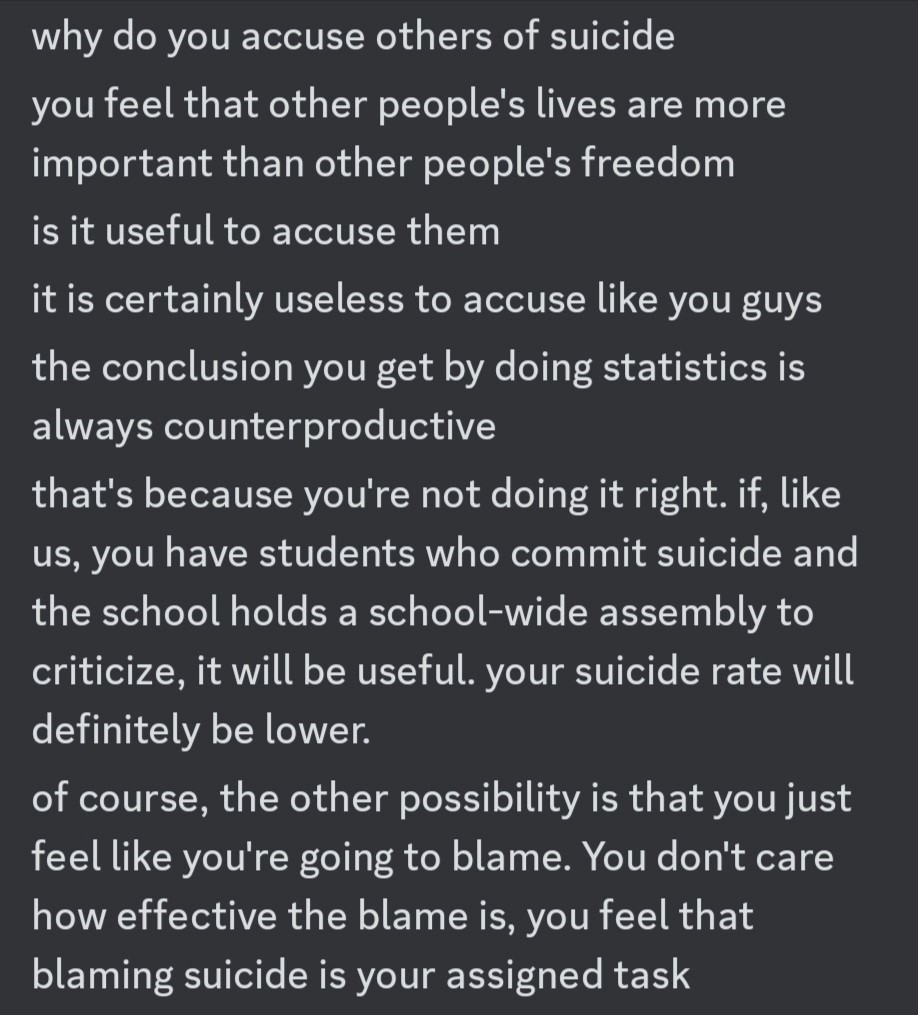
Even if it is a matter of life and death, I choose not to maintain such a culture, just for the sake of the least number of deaths.
## Words 3
I guess there are two things this has to say. First, freedom of speech is inviolable. The second is that one should be able to control what one’s ears hear, which should also be counted as a kind of freedom and inviolability.
## Words 4
When teachers lectured students in the front of the classroom—saying something like “Complaining is a sign of lack of discipline” — I always wished someone would kill themselves; I was just not that brave. I don’t know why people support the majesty of teachers. If people are very fragile and commit suicide when they see a majestic teacher, then there will be no majestic teachers in the world.
## Words 5
Is reflection and self-awareness more painful than being punished? Why would people rather not oppose the latter than try the former? I’m not saying you should be forced by the latter to choose the former; the former can be a choice you are free to make in your natural state. We can also teach another person the skills of self-restraint through conversation, and this is far from having to be done in a forced or reprimanding and shame-filled dialogue.
## Words 6
Think of it this way. When you go to school, you study 10 hours a day. If you’re not constrained, you can study only what you need to, and 5 hours a day is enough. If you only need to study 5 hours a day, you don’t need any punishment or reprimand. You feel now that you can’t learn for 5 hours a day. That’s because you’re still disciplined and you feel angry and sometimes rebellious. And, even if you still need to study 10 hours a day, there are plenty of other ways to do that with no one constraining or punishing you. For example, find a friend to keep you company. Let’s say, hypothetically, that you have no idea what you need to learn and therefore you need to learn 15 hours a day after you leave school. Then you just go on to school. You don’t need to be punished or disciplined. You skip maybe 30% of the classes freely, and you use 10\*30%\*1.5=4.5(hr) to remedy that. 7+4.5=11.5(hr) per day.
You have just traded 1.5hr/day for freedom and still get the same result.
Still, find a friend to accompany you.
## Words 7
Trying to force a child for the sake of the child is a major mistake made by human beings. The whole of our modern culture—the quest for recognition of others that is used to control our minds over the power of criticism from others, the aversion to flattery that both rebellion and self-restraint can lead to, the pleasure of criticizing others, and most of the offense and etiquette—are dangerously based on this error.
## Words 8
If you were forced to study hard, why didn’t you deliberately find a less good job? It’s stupid, but if people did it, parents would have no reason to push their kids.
You can say that you don’t need such a good job, and you can also say that you won’t do that to your children again, but your words are more powerful only after you have turned down a good job.
## Words 9
Westerners talk about socialization there all day long. Do they mean that people must be both tame and rebellious or they are not normal?
## Words 10
When a parent sees that the school is having a field day, he only sees the spectacle, and the question of whether a student can choose to participate or not will never cross his mind.
## Words 11
Obedience is nothing more than avoiding the punishment of the moment, or even indulging in an inexplicable fear of being punished. By the time he expresses it anyway, or disobeys anyway, it is because his anger at you has become so painful to him that it transcends the fear of being punished. This is why there is no calm rebelliousness.
## Words 12
Individual and political freedoms should be unconditional; they should not be violated for the sake of economic development, nor should they be overridden by a majority or by the results of democratic elections. Or you’ll get Singapore.
Imagine you are in Singapore, where schools can whip students, demonstrations are restricted to just one place, and chewing gum is banned. Can you say that every Singaporean, for their part, chooses these things? People convince themselves to accept these things through an emphasis on rationality and discipline, but this is by no means the same as the consent and enthusiasm of BDSM participants, and there are those who refuse to convince themselves in this way.
## Words 13
Seeing the name of a school will cause more pain in your heart than seeing the name of a company.
## Words 14
There was a not very popular piece of news a couple of years ago. There was a school that had a counseling office. There was a student who went there, and I’m assuming that student was expressing dissatisfaction with the school or the teachers, but there was no disobedient behavior by that student. That school punished that student for neglecting his mental health and lacking the confidence to work hard at school. Quite a few other schools noticed the news and said they wanted to “promote” the care that the principal of the school in the news had for the student. There was a debate on the internet between those who believed that the very fact that schools have counselors in place affects students’ learning, and those who believed that the news shows that schools can use counselors to improve students’ learning. One day, shortly after this incident, my teacher scolded the class for no apparent reason, saying that we were too fragile and that the school’s leadership agreed with this, that the school was too permissive and that we should therefore accept the school’s management of us. I don’t know if his reprimand had anything to do with the news. Also, whenever there was news about traffic accidents or fires, or news about China’s economic development, or the change of seasons, the teachers would always say, “Therefore,” or “Further,” we, who had been corrupted and spoiled, should be obedient and study hard. No one talked about what that meant, because talking about what it meant seemed to justify the discipline of our language teacher, who understood how to use conjunction words correctly.
## Words 15
One way the Chinese use words to make some children miserable is that they will not say that these people’s objections are an opinion, or even just say that they will treat these people according to their ideas anyway. They will say that opposition is a “problem” and the solution is to discipline these people more, improve their character, change their perspective, get them to accept things so they won’t object and everyone is happy in the end. The painful thing about this is that even though you are unwilling to change your perspective, they are still constantly reminding you that there is another path, and that is for you to “accept” or “improve your character.” You are constantly reminded of such “other paths,” and you do suffer because of your opposition to them, but this reminder does not allow you to accept it painlessly, but only increases your self-contradiction, anger, opposition, and pain. It can be said that the failure of this situation is that the rape is not strong enough or lacks skill, so there are still people who are opposed to it and are unhappy. This statement cannot be called untrue. You have indeed failed to improve my character and made me suffer because I did not accept you. But I am afraid that the inspiration given to me at this time is not that I hope you can succeed in improving my character, but the opposite.
## Words 16
The Chinese don’t belong to themselves, they belong to the traditional culture and the people the government hires to write in the newspapers all day long. The Chinese are spanked by these two things all day long to improve their character, prolong their lives and cultivate immortality. There’s the teacher, who makes up new words to scold his students all day long, as if he were making up new chapters for the Bible all day long.
## Words 17
If I were in one of those schools and the teacher knew I was talking to you, he’d probably tell me that my association with you corrupted my character, assuming you didn’t leave the school at 10 p.m., because it’s dangerous and shameful to be around people who don’t try as hard as you do.
You can’t go wrong with that, can you? One of the reasons I would have wanted to interact with people my own age was that being around people who didn’t ask me to work as hard as a farmer did 200 years ago would have more or less undone the shame that my teachers gave me, so it’s fair to say that I squandered the opportunity to use that shame to spur myself on.
But do I care about that opportunity? No, of course I don’t care.
“Being in a fish market and not feeling the stench after smelling it for a long time” (入鲍鱼之肆,久闻而不知其臭) was something I wanted to do at the time but could not.
Freedom, of course, includes not being intentionally prevented from choosing a degrading environment so that one does not feel compelled to “improve one’s character.” Our desire to be able to choose to be lazy and undisciplined—even if it may not be the best in the long run—is so strong that it must be worth the “freedom” label.
## Words 18
For many conservatives around the world, a self-sufficient adult would still not be considered entitled to speak for his childhood self in advocating for less harsh discipline. Instead, they believe that those adults still don’t understand what they needed as children and believe that tougher discipline is the answer to the reasons why these adults who are calling for the opposite are calling for it.
So adults who call for less harsh discipline should make it clear that, in the end, they are making such a call not because of the ill effects of childhood discipline on their present, but because of the ill effects of childhood discipline on their past.
## Words 19
I wonder how adults who are reprimanded by their bosses for not completing their work assignments, who are called shameless and ungrateful, who are then made to copy things down, or write lengthy reviews to be read aloud in public, and who would be punished in this way for arriving two minutes late, for a stern look, for a joking remark, and for entering and exiting through the back door of the office instead of the front door, and, in the case of office workers, who are not able to get up from the seat without being punished in this way, and are punished in this way for having unauthorized conversations with co-workers, would feel.
It’s the first job the vast majority of people in the world do, for more than a decade. You can’t save up any money to prepare for a change of job, and besides, it’s a shameful, shocking move for everyone around you, and one that leads to punishment. Kids are the only ones who get punished for quitting their jobs.
## Words 20
Sometimes the child tells his parents that something the teacher said or did was not “right”, and the parents tell the child that there is nothing wrong with the teacher and that the teacher is doing what is good for the students. That child feels that if my parents don’t support me in even a small thing, then they will only be stricter in bigger things. But the parent may have assumed that the child wasn’t suffering because the only dissatisfaction the child showed was in questioning the details without greater disobedience. Or they may just “look down” on people who just talk and act timidly—if that makes sense for the relationship between the disciplinarian and the child.
You can’t say that the child doesn’t need more freedom because there is no greater disobedience—isn’t it you, or someone you delegate to, who is doing with escalating punishments, regulations on rituals, and a thousand other ways to intentionally keep the child from being more disobedient by imposing fear on them?
Children should not forget that no matter how much the school teacher emphasizes character development, or emphasizes the necessity of punishment and uses escalating punishment to stop you from continuing to disobey—he asked you to write a 5,000-word self-criticism, you wrote 4,000 words, he asked you to write a further 20,000 words of self-criticism—no matter how their punishment of other children is shown to you, has happened to you, or what you can perceive from the threats, you are not fed by the school teacher, your parents may be more lenient and indulgent to you than what the school teacher suggests, or what you feel from the rejection of your parents that your cautious probing has brought you. No matter how the school wants to assure you that the truant child will be severely punished, your parents will ultimately decide the matter, even in those places where the law theoretically prohibits truancy.
Even if you fail, the school may not force your parents to punish you severely, and even if you feel that most of the fear and discipline comes from the school rather than your parents, your parents’ lack of support for severe punishment is all you need.
Just say you don’t want to go to school when you get up. See what happens. You can’t just assume that harsh punishment will happen to you without even trying.
## Words 21
### 1/3
It is unacceptable for the state to require universities to accept only students who have “normally” graduated from primary and secondary schools. This means that even good children must be slaves.
### 2/3–1
People who are asked to compare themselves to people from the past always have to do so sincerely, and asking others to do so is always more manipulative than sincere, because if reality requires us to work harder, it’s not like we have to learn anything by comparing ourselves to people from the past, but it’s an effective way to make people feel bad about themselves.
Regardless of the historical facts and how sincerely you are making such comparisons, the pain and sense of persecution you feel from them usually stems primarily from the fact that others are asking you to make such comparisons. Ultimately, you can’t prove that you’re not too much lazier than the ancients, nor can you honestly say that you’re doing your best, but running away from those who are asking you to make such comparisons and do more is always an effective way to pursue happiness.
But there are always people who can’t escape such things. So I have to emphasize, on the one hand, to those of you who have been manipulated in this way, but who have had to be honest with yourselves, that the children of antiquity did not work as hard or as obediently as they were claimed to be, and that, especially in terms of the number of hours of discipline per day and in terms of the total number of years of discipline, many of them did not have a great deal of time to spend on discipline, and that, for two reasons amongst many, they had to, or preferred to, and were given the opportunity to work, and on the other hand, emphasize to those of you who are manipulating others that asking children to compare themselves to others is usually not the gentlest of all effective methods, and emphasize that words can be illiberal, since children, after all, don’t have the means to leave the room while you are talking.
### 2/3–2
But on the other hand, some adults are deliberately saying things that don’t make sense so as to cause children pain, so much pain that they give up on fighting back in their heads and just obey for validation, or in fact are forced to obey by being verbally punished, aren’t they?
### 3/3
You know, a kinda wild thing is that some people are criticizing body shaming, or feeling offended by all kinds of criticisms of themselves, or resentful of society’s demands for economic development, or religious, cultural, traditional, etc. demands for character enhancement, like I do, but don’t acknowledge that they feel like a child, or don’t realize that it’s because they’ve been a child. Then the disciplinarian sees this and says to himself, “You know what? This is what I’m trying to accomplish. Let me continue to manipulate the children in this way so that 20 years from now they will be equally distressed for reasons unknown to them, or unwilling to recognize that they feel like a child.”
## Words 22
Do you feel like a child afraid of discipline when you read words like dispirited or dejected?
Like, “decadent”. This is a harsher word, I guess.
So… I think the Chinese word is very graphic. The Chinese equivalent is “颓废” (decadent), isn’t it? So you get the image of a teenager who skips school and plays video games all day. In fact, you have a much stronger impression than that; you would in fact have… what impression would you have? No, you don’t have a clear impression. I think a lot of people have the impression of a horror movie full of blood. That’s weird. I don’t know where such impressions come from. People would also think it has something to do with rockers from the last century or something like that.
Also, Chinese words can be split. So can English words; Wiktionary says:
*From French décadent, a back-formation from décadence (see -ent), from Medieval Latin dēcadentia, from Late Latin dēcadēns, present participle of dē cadō, dēcidō (“sink, fall; perish”), from Latin dē- + cadō (“fall”).*
I suspect most people don’t know it. The Chinese word splitting is easy, because it’s just two characters, “颓” and “废”. What does the first word mean? Actually, the Chinese don’t know what else to use the first character for except in the word decadence. The second word means dilapidated or waste. So, this seems to be more than just a language problem. It’s certainly not just a matter of language; that’s obvious. It’s a problem of impression. Extreme images get added to situations that are not extreme—to the point where people don’t even know what the so-called extreme image is, but just an image of a blood-covered face—in the mind of the disciplinarian, in the mind of the disciplined. This is obviously intentional. It’s like hyperbolic rhetoric, but penetrating language and striking at the heart.
So, some people say stereotypes are good. Making people think they’re worse off than they really are is motivation to forge ahead, right? It would be more accurate to say that this has the potential to be an incentive to forging ahead.
It’s tricky, isn’t it? For example, you can’t just say that the student who didn’t do his homework will die if he indulges in drug use, because then the core meaning of the word is untrue, that kid won’t feel too bad about himself for it, and the teacher might even be criticized by his parents for doing so. So the teacher has to use words like “depraved” and “decadent” so that the child’s own mind creates the image of a drug-addicted, blood-covered death, so that the word itself doesn’t come out wrong, and so that the child feels like he or she can’t escape from the word, right?
So by calling your teacher Hitler, you’re parroting the surface of conservatives offending people and adults criticizing children, and you’re not learning the essence.
Even if you learn the essence, it doesn’t mean things are “equal” or something for four reasons. First, the teacher spends far more time criticizing you at you than you do criticizing the teacher at him, and you can’t leave while he’s reprimanding you; second, the teacher is saying things to try to uplift you in all areas, and your objections to him are focused only on the point of objecting to the fact that he’s putting pressure on you; and third, he’s trying to uplift you, and you’re not trying to uplift him even if you do object to it, you’re objecting to the fact that he’s trying to uplift you; and the language itself is something that tends to discipline rather than rebel-a person who has never been disciplined does not have to say rebellious things; a person who intends to discipline will say disciplinary things; fourth, the discipline you receive is not just criticism; you receive other constraints and penalties that make the words of criticism even more difficult for you.
## A Sign
I have something I would like to say about the discipline and hard work aspects you mentioned. I’m Chinese, and religion hasn’t been as significant in my experience as yours, but shame is certainly significant. I’m guessing that that people—including me, of course—spend an astonishing amount of time (and in many cases more than work) playing with electronics has something to do with some shame. Of course, shame is more about what others impose on you, especially considering that you can’t leave the classroom at will when the teacher is reprimanding the students, giving motivational speeches, emphasizing discipline and saving time, and promoting rules and punishments. I feel that China’s primary and secondary schools are to a certain extent like schools in other parts of the world, and religions in other parts of the world. In addition to planting the seeds of hard work and punishing laziness, they also sow the seeds of rules and discipline — although they are not really clearly linked to hard work (in principle, people can also work hard when they don’t follow schedules, clothing, etc., and the punishment for laziness doesn’t have to be based on rules). Did I become a harder worker? No. Maybe it was because of my anger at being restrained, or because I spent 4 years lazily in college, or, as people say, the result of a lack of discipline. People will talk about whether you want to mitigate it to gain the other person’s buy-in, or break the other person’s rebellion, or use some combination of the two, if it’s not as effective because of “rebellion”. People seem to live a fake life, not making choices for themselves, but confusing the difficulties of real life with the punishment that others deliberately give them when they are not really hurting others. I think a culture that doesn’t distinguish between the two is immoral — of course, if you distinguish between the two and support the purpose of constraining others without them harming other people as their “character enhancement” or for some other purpose, then it’s also an immoral culture. I can’t prove that this will do more harm than good, but I love freedom—or more accurately, hate the opposite.
I guess it’s mostly American here. Then I want to say to you: I don’t believe in the vast majority of constraints on children, I don’t think adults should have that much power, and I believe that children’s freedom is also important. Most parents probably don’t think the same way I do. If, unfortunately, things go as I have already mentioned, I have an indulgent desire: I want every child to have some at least a few months, without facing any tasks, constraints, disciplines, reprimands or punishments, just playing with their phones for weeks on end, and, I advise them to think about their freedom, to be able to feel that they should be allowed to have freedom even as children, and, I advise—only advise—to make some attempts to learn without constraints and completely as willing freely.
If I am to speak to people here, I can’t use expressions like these. Some children are ashamed of any words, even “rebellious” words, because any words will be used to “spur” them. I have to be more rebellious and angrier to express my opinions, and be to its full.
When Chinese children see a sign on a train, they will feel ashamed that they have not worked hard to learn geography and calligraphy, just because the sign is a place name printed out by a printer. This is far from a true intrinsic motivation; shame is far from a free choice that a person can control at will.
## How does multiculturalism relate to freedom? (part of the story)
When people are little, they think, “If being rebellious is going to make me feel worse, why not try to change my psychology.” When they grow up, they think, “Since I’m not a kid anymore, why don’t I push them?”
The hope lies in rebellious kids having their own culture in which people comfort and express approval of each other, don’t interact with offensive other cultures, and ignore some facts — if we’re not sure about being comfortable and rebellious even after realizing facts that don’t fit or potentially don’t fit our ideas.
I don’t have to be willing to get into the broader politics, but the government is lecturing the people, like a parent lecturing a child, and like an Asian parent lecturing a child, mixing “the government has to protect the people from self-indulgence” with “the government has to propagate altruism among the people”, and apparently apparently the two are being intentionally confused as one thing.
As a Chinese person, I have never felt Western culture have a “rational root”, but rather something to do with rebellious children. However, egoism has never had a “rational root” either, but an adult who does not give wholeheartedly to others is unlikely to feel much shame about it.
From a very young age, I longed for teachers and schools that wouldn’t punish me or make demands and rules on me, but would help me get better (if they insisted) on my terms, and I would have been able to comfortably expose my vulnerabilities and laziness, comfortably deal with problems, and skip over inefficient learning in that kind of relationship.
I was a “character enhancement” person as a child, but only insofar as I did things to my own psyche; I objected to that kind of coercion from the first time I encountered someone who said they were going to enhance my character through discipline and punishment.
They emphasized reverence for discipline, for punishment, the majesty of the teacher. I could not prove that their approach was harmful to my long-term interests, although even then I believed that even if it was beneficial, I should be free to reject it.
Their claims that what adults do is “thoughtful” and based on “deep traditions and cultures” and that seemingly unnecessary things can also “foster respect for rules” and “enhance character” have given me a lot of painful pauses. At the other end of the spectrum, I want to be free of all constraints, not just unhelpful constraints.
The pain of being forced to “regulate myself” and of rationality’s incessant questioning of why I don’t do better (even if that “better” takes into account the cost of rationality itself) had given me a strong intuition. This intuition was a passion for impulse, for freedom from reason, and for the freedom to make one’s own choices without interference.
As opposed to what they did to me, I naturally felt a longing for intimate and unaugust relationships at the time. What I learned about the gay movement that was happening in other parts of the world after I went to middle school, while having nothing to do with my situation, served as a symbol, as a phrase, that was of tiny comfort to me. It also inspired me to talk to my peers more, to try to use the words of my peers to counteract the bad feelings that rules, punishments and teachers’ criticisms had caused me. However, I didn’t get a lot of comfort from my peers as they generally approved of the teacher.
I hate and object against schools.
## When Retailing Can Express an Objection
I remembered something. I remembered so many, many things, like those teachers who said that false information proved that children needed discipline to improve their scientific literacy, and how many, many ways of thinking became comforting and then exploited by the teachers or created more self-contradiction.
For example, a teacher used a conspiracy theory argument one day to support discipline and punishment of students, you go home, hug yourself, cry, comfort yourself and say “conspiracy theories are bad”, the next day the teacher says that the prevalence of conspiracy theories proves a lack of discipline and punishment of the students, and a student tells the teacher that his statement the day before was a conspiracy theory, and then the teacher will say that “in order to avoid such inconsistencies in human beings, one needs discipline and restraint during one’s time as a student”, and that “this reflective nature of the student is proof of the success of his education and of the depth of Chinese culture embedded in discipline”, but “If you continue to be disruptive and interfere with the normal management of the class, then you will be punished” and the last sentence does not become the first sentence of the teacher’s response proving the virtue of mercy.
## A Part of Rebelliousness
Constraints are devastating. Being forced to do one thing can cause you to be unwilling to do five things you would otherwise do yourself. You are confronted with your rebellion. Suppose you are also forced to do those five things, because anger is an uncomfortable feeling, or you still try to accept the five things you would have done, or you decide to comfort your rebellion. Or, you’re just thinking subconsciously. Whatever the case may be, you realize that you can convince yourself that you can study hard for the good of others and not just yourself, you can try to convince yourself that teachers and parents are your employers, and you can try to convince yourself that you wouldn’t actually do those five things assuming no one is pushing you. Aware of these things frightens you, because your anger does not want to go away, and because these things may be the reason why others are willing to accept being constrained; whether consciously or not, you always inevitably ask yourself why you can’t be as obedient as they are. Another reason to feel fear is that you fear that accepting them will lead you to inadvertently accept what you are not forced to do, or to miss out on ideas that can be used to try and persuade the person constraining you. People criticize you every day with inadequate arguments, and you reflect on it with a hundred times the thought they did when they criticized you, so that you don’t feel as bad as being criticized. Lying to yourself or not thinking enough will not make you feel good either, because (1) they will point out tomorrow where you are deceiving yourself or underconsidering (albeit in the middle of 50 criticisms with insufficient reasons), and (2) one of the main reasons why this kind of thinking makes you feel better is that you use your thinking to persuade the person who restricts you in your imagination (although this communication does not have a chance to happen), and false or insufficient reflection does not reassure you.
I just thought of something else. Some people say that school teaches self-discipline. I don’t support unnatural consequences by any means, whether or not primary and secondary schools can teach self-discipline.
To take a step back, I don’t think forcing a person can teach a person self-discipline. And even if it worked, it wouldn’t be necessary, because it’s perfectly possible for a child to learn self-discipline by facing natural consequences after work—if one has to use the expression “learning self-discipline”. I’m in college now, and the busiest days of college aren’t nearly as busy as 1/3 of primary and secondary schools here, and most importantly, no one punishes or shames me. I still have to do things to graduate and push myself to do things sometimes. I realized that I could say to myself, “I went through so much in primary and secondary school, I just need to emulate what I did then, but do college tasks as I wish.” That thought really scared me. Although, I could argue that just because I push myself in this way doesn’t mean I’m in favour of primary and secondary school; I’d rather I didn’t have primary and secondary school experiences to draw on, but primary and secondary school experiences are a fait accompli. But, no, I’m not going to rush myself by recalling my primary and secondary school experiences. To take a step back, a month or two of experience can provide experience, not 12 years of primary and secondary school. Taking another step back, one may feel rebellious and try to deliberately lose the ability to exercise self-discipline that one gets from primary and secondary school. People can be so in love with freedom that after they get it, they still, sometimes, choose to destroy what others have built in them that could have been of use to them.
## When criticism turns back into information/advice
As far as one’s own affairs are concerned, criticism should not be imposed on others, but should only appear when people actively seek it. But the trauma caused by the school and some parents is so great that people don’t use the word “criticism” when they ask friends or experienced people if there is anything wrong with what they are doing. People must put an end to the status quo, stop the unsought comments, and let criticism reappear only in situations where people actively seek it.
## “Learning State” and Conservatives
I think what the Chinese call children’s “learning state” refers to is “just do it, don’t use your attention to feel dissatisfied.” This is also the attitude of conservatives in various countries. The risk that removing unnecessary restraints from a child might lead to the child becoming aware of unsatisfactoriness is considered to outweigh the benefits of conserving more freedom.
## Why cultures are immoral
Chinese are the best at accepting the persecution of others. So I’m not qualified to be a Chinese. Feel that there is no point in a constraint? Just call it character enhancement. Freedom-loving people will say that character enhancement is a guise for meaningless constraints, and freedom-haters will say that there are no meaningless constraints, because all restraints are character enhancement. Immorality happens when there are a handful of freedom-loving people who should be ashamed and whose characters need to be improved in a freedom-hating culture, because your existence provides their victims. However, a culture of morality has not yet been born. Because even those cultures where people allow others not to lose themselves ignore the fact that the expression “losing oneself” is meaningless without the constant demands for the character improvement of others in the first place.
## Why did we hate conservatives in the first place?
The Mental Health Forum is a Western cultural invasion because it makes people think about things that make them feel bad instead of focusing on improving their character in the vast and profound Chinese culture, and it is a cultural weapon used by Western forces to undermine the character of the Chinese in order to suppress China, as evidenced by the high suicide rate caused by their own unrestricted freedom.
## “Adapting to Society”
Why should a person go to school every day, even if he wants to study on his own that day, or simply feels that he does not need to learn more that day… People just “accept,” “adapt,” or “acquiesce” to this, which makes me feel disturbed…
You can’t say it’s “adapting to society”. If a person wants to participate in such a job, simulating such a life a month or two in advance is called adaptation; simulating such a life more than ten years in advance is just stupid and unnecessary.
## Anger as Punishment
The fact that a reprimand can be a punishment certainly has the relatively plain “let you find out what’s bad about yourself” part of it, but it’s also saying, “I know you won’t accept this, but you still have self-contradiction, so you’re going to feel bad about it, and I’m going to use that to punish you, and I’m even going to use your feelings of anger and rebellion to punish you. Make you feel annoyed due to your anger and rebellion against me as a punishment.”
From punishing one’s rebellion in order to avoid one feeling rebellious, to using one’s rebellion as a punishment for oneself.
## Traditional Culture
You know, when someone criticizes your views and ideologies every day because you haven’t read a lot of traditional culture classics, you can get really caught up in self-contradiction and anger. When you leave those people, you find that everything is fine. I guess the other option is to work overtime to read the traditional cultural classics, and then argue with the adults that you read them, but still hold on to your views and ideologies, but to be honest, they don’t care, they will still discipline you, and considering that the traditional cultural classics are basically praising the child’s spirit of obedience, this is not a good deal for you.
They are really constantly trying to convince you that your point of view is the result of a bad character, something that needs to be improved, and cannot be used as a basis for decision-making. For example, they just say that video games are drugs, so students’ opinions are a manifestation of delirium and passivity, and that reading classic books or watching the news can prove that what they are doing to students is reasonable, profound, and reflects the profound wisdom of traditional culture. I say this as if you really have a chance to make your point. No, you certainly don’t get to make your point unless you want to write a 5000-word self-criticism. They’re doing “preventative character development” or something.
I remember people saying children shouldn’t know about metal commemorative coins because “‘commemorative coins’ are an unconventional use of money, and this unconventional suggestion is not good for the child’s development”. I also remember my high school teacher reprimanding us because she wanted to counteract the “psychological turmoil caused by the replacement of the trash cans in the class.”
It’s hard to prove that their claims are not true, and the trouble is that I can say that what they’re doing is ridiculous, but people don’t necessarily have to reduce the criticism and punishment of their children; they can point the criticism and punishment at not studying hard, worsened by “the turmoil in the minds of students caused by garbage cans, which students should not use as excuse” or something like that.
“You use the emoji in the forum as a reply to me, aren’t you afraid that this unserious behavior has eroded your habits and character? Not to mention that emoji further strengthens the degeneration of people’s ability to express themselves in words. These people who do not understand the breadth and depth of traditional culture will benefit from being reprimanded, rather than lazily using this mental health forum that leads people into frivolity.”
Then, you really hope that the person who said this is just disappointed that the people on the forum don’t care about him, and is not really intent on uplifting your life, otherwise it will be too painful for you.
Then you’ll find that even if the other person is only unhappy with the forum, you still feel bad about yourself. You want to convince others more thoroughly not to reprimand you, not based on “sometimes others are dissatisfied with themselves and don’t really care about you”, and this “drilling” and pursuit of thoroughness in you is considered a rebellious illness, further justifying their education on you.
When I see a person lamenting that abused children still have a hard time in adulthood distinguishing them from the discipline for children, I want to say that there is really no such distinction and that I have more faith in (even the child’s) right to self-determination.
## Write and Type
In fact, typing is in many cases more tiring than writing the same words. The fact that people choose to type rather than write is inseparable from the fact that people are forced to write as children to complete notes, homework, and to copy things as punishment, write self-critical essays, and so on.
## I had tears in my eyes as my submissive was tied to the bed.
Without food and shelter, and relying only on the police, what kind of control do parents have over the children? If the police do not help parents find runaway children, and parents control the children purely through food and shelter, what kind of control will parents have over the children?
There is a threat of punishment for running away… Before you run away you feel like you have to come back after a short period of time, but you might get punished for running away, or they ask you to complete the homework you missed while you were running away, which is pretty scary…
But parents may also be more lenient after the child comes back because they fear the child runs away again. this is really full of strategy and rigging…
This is why the child’s persistence is important. If the child is persistent enough, the parents may have to go easy on him… This also includes the school. The principal first persuaded the child who wanted to commit suicide to come down from the roof, and then began to punish the child. If the child is persistent enough and continues to threaten suicide, the principal will not dare to do so.
This kind of thing mainly happens in the form of mental hospitals locking children up in mental hospitals at the request of their parents, sometimes tying them to beds. In China, it also often happens in the form of teachers punishing students who attempt suicide by making them write apologies or holding a school-wide meeting to criticize them.
The more the principal criticizes and punishes the child who attempted suicide, the more you should do the same. Criticism and punishment are manifestations of fear of losing control; you are not far from being free.
As for the child himself, I don’t know why he gave up on another suicide attempt. Maybe he became a better boy as they said, maybe he was worried about the prospect of being locked up in a mental hospital, or maybe he was promised a more lenient discipline in private, even though he was asked to apologize publicly and attend a school assembly to criticize himself.
If you do not intend to exercise such power over your child, you should give him clear assurances that you will not punish him or put him in a mental institution for attempting suicide. This means that you run the risk that your child will fake suicide to escape discipline, but even complete indulgence is still better than him feeling threatened by such power, and I (do ask but) am not asking you to give up all your power.
We live in a crazy world where parents need to make such promises to their children and refuse to make such promises to their children.
## A Piece of Rebellious Sound
If you, maybe because of insensitivity to shame or approval, or for some other reason, think, “There’s no other way for children to escape anyway, so I’d rather have them fend for themselves,” and in turn seem to support treating them strictly and harshly, then I don’t see how you’re “intrinsically unruly and rebellious”. If you hate the discipline imposed on you, but when you were a child you just said to yourself and your peers “I can’t get away with this anyway, so I’m going to say I support it,” and then after you stopped being a child you supported, or said you supported what you hated, on the grounds that you wanted children to fend for themselves, then your “intrinsical unruliness and rebelliousness” is actually killed by yourself, and is actually a dried-up corpse hanging on the cloud of your fantasy.
如果你,或许是因为对羞耻或认同不敏感,或许是因为其他原因,心想“反正孩子也没有其他办法逃离,不如要他们自力更生”,然后反过来似乎支持严厉对待他们,那么我看不到你是怎么“本质上不羁而叛逆”的。如果你憎恨别人强加于你的管教,但是个孩子时只是对自己和同龄人说“我无论如何都无法逃离,所以我要说我支持这些管教”,不再是孩子之后又以要孩子自力更生为由支持你憎恨的东西,或者说你“支持那些管教”这样的话,那么你的“本质上的不羁而叛逆”实际上被你自己杀死了,你所谓的“不羁和叛逆”实际上只是干瘪的尸体,吊死在你幻想的云上。
## Only a Quote
> He once questioned a man with the following words.
>
> Did you do terrible things to yourself as a child, or does being punished to do something with no hope of escape carry the same emotional weight for you as doing it as a job with theoretical hope of escape?
>
> Also, I don’t know what job you do. If you work in an office, how many times do you need to copy the company regulations if you stand up?
>
> Are you afraid that if you don’t finish copying by the specified date, you will have to copy the company regulations every day for the next few months, and will you be beaten if you quit?
>
> I didn’t know how to answer his question. Or rather, I certainly wasn’t the one who should face his questioning, but I was proud of my boy’s questioning and ashamed of other adults.
## One of the Reasons I Rarely Write These in Chinese
I remember a few years ago there was a news story about an American police officer stopping a child who was trying to commit suicide by shooting him to death. I don’t know if this news is true or not, but it became an opportunity for the Chinese to criticize “the lax discipline of children in Western countries, which has led to adults being mentally impaired along with the children, and the spirit of humanity requires us to resist such bad customs, to insist that our schools care about the human dignity of our children, to not let the so-called ‘humanism’ blind us, and to reject such indulgence and hypocrisy”.
They had a lot of strange sayings, and I can’t remember them all. The problem is that I hear them say these things and feel like a child being reprimanded, being told that my refusal to elevate and protect me from them proves that I need to be disciplined. In this case, taking a piece of paper and writing down what they say and then spending hours analyzing exactly what they are saying so that I can comment and critique them is too much for me, and I just want to escape my degradation and get away from what these words are revealing about me. By the way, they would say that this spending hours analyzing is just my escape from my own flaws, and I guess I can’t deny that.
This is probably the Chinese version of being born guilty: your attempts to analyze are themselves evasions and injustices against discipline. I guess the point here is that I don’t analyze them out of scientific research, but rather out of a critique of them, though they would say that even an analysis of the discourses used to reprimand children from a so-called scientific perspective is evasive and unjust. I guess the point here is that even the analysis itself, done out of scientific research, still deconstructs the emotional pressure these words put on us. You have to let guilt conquer you so that you can be lifted up. There’s a lot of detail here, for example, when I say “words used to reprimand a child”, it’s implying that people need to pay more attention to questioning whether or not to reprimand a child in this way, whereas perhaps a more appropriate term would be “reprimands for a child” or even “teachings that I’ve had the privilege of listening to”.
As a child, the first impulse is, of course, to avoid discipline, and the second impulse is, of course, to persuade those who discipline him not to discipline him, or at least to minimize such discipline. In order to persuade more effectively, the quest is naturally to start with efficiency, to get rid of the discipline that the child thinks he is suffering for nothing, and to replace the harsh version with a less harsh one, and try to persuade the adult that it is just as effective. It’s called “original sin”: your motives are insincere, you’re motivated by self-avoidance and laziness on your cell phone rather than genuinely seeking to maximize the good of mankind or your own long-term interests. Including the sentence I’m typing on my keyboard, there is an original sin in them.
These original sins are complex. For example, if you say it’s ineffective, he says it’s ineffective precisely because you lack acceptance and have a depraved heart, and therefore firmer discipline can fix that. You say that even if “character enhancement” counts as a benefit, that doesn’t mean that what you’re receiving is the most efficient way to enhance your character, and he says that you’re saying this because you lack the training to use your environment to enhance yourself. And then you realize, ah, there’s nothing to convince an adult of, all you can do is leave home and you’re free.
So all this hue and cry, demagoguery and pleading that I want people to refrain from disciplining their children, and trying to persuade them to do so as little as possible, has a gray and gloomy outlook in a place like China; and I guess it is just as the spirit of which some of your religious people and others there are so proud.
## How many? 2?
Things are not of the same difficulties. For example, if you are forced to follow your classmates and shout slogans about studying hard, it is hard; if you are forced to write an essay about why students shouldn’t seek to be stress-free, but rather realize the meaning of life through hard work, it is even harder; if the essay requirement reads, “Many students seek a stress-free life, but is this really what we as students are supposed to be looking for?” it’s even more disgusting, partly because you realize that the tone you used as an internal relief can be taken away by adults; if you are forced to write a self-criticism or an apology expressing “remorse” for your playfulness and laziness, it’s very hard. I’ve heard that US courts have ruled that government-funded schools are not allowed to prohibit a child’s expression of speech unless it’s blabla, and that not expressing is considered a form of expression of speech. Another case is something they can fight. There’s also running away from home, which is a common vision for kids all over the world, and is something that can also be fought for.
## An Assholerity
If you are opposed to the school but want to err on the side of caution and try a more lenient school and find that the child shows more anger, this should not be seen as a failure of the argument against the school. The more lenient school gives the child more opportunities to oppose the school, the anger they show is on the same page as your opposition to the school, and their increased disobedience is behavior in the same direction as your attempt at the more lenient school. The point here is that if you continue to persist in your opposition to schools and place your children in environments where there are no mandatory schools, they may not show as much anger or disobedience toward their parents or non-mandatory schools. Assuming you wish to abolish one government and replace it with another, but push for progressive reforms to be on the safe side, and the current government eases up on the crackdown, that’s certainly a reason for you to take advantage of the opportunity to continue to abolish that government, not a reason for you to be self-doubting. If a more lenient school turns you around to the idea that there is no need to abolish it, that is a valid line of thinking, but the increase in child disobedience that results from a more lenient school is not a valid line of thinking for you to abandon your opposition to the school.
The reasoning here is that if you were originally in favor of more lenient schools, then the increase in the child’s disobedience is arguably a reason for you to doubt your support for more lenient schools. You should tell your child that these disobediences are changing your mind, and if they decrease them, then you don’t have to worry about your support for more lenient schools. However, if your original support was for no-mandatory schools, then an increase in your child’s disobedience at the more lenient school is not a reason for you to withdraw your support for no-mandatory schools.
Of course there is also the view that even though you object to your child’s school, you also object to your child’s disobedience. In other words, “Even if I object, you shouldn’t object!” One of the things worth noting about this view is that this is assholery. Another thing worth noting about this view is that even if you insist on this position, you can tell your child, “Don’t disobey the teacher, or I will discipline you. If you don’t disobey the teacher, I will put you in a place that is even more lenient than this place,” rather than just thinking that your approval of a more lenient place is wrong.
## I Don’t Enjoy Writing This but Choose to Write This
When a child uses suicide or threats of suicide in an attempt to manipulate the adults around them into not disciplining them, or to seek milder discipline, if the child does in fact experience suicidal fantasies or feel suicidal impulses, then even if the child personally feels that—due to fear of death or other reasons—they would not actually go through with it, this should not diminish the legitimacy of such influencing.
Given this legitimacy and reality, the term “manipulation” becomes both an incorrect characterization and an incorrect language attempt of pressurizing, just as asking a stranger for directions will not be manipulation. Moreover, in many cases, this so-called “manipulation” exists only in their imagination, buried together with their suicidal fantasies and impulses behind their eyes.
A child threatening suicide or hinting at suicidal thoughts does not look like a child asking for candy. This is not a pretense.
## Offended by a Movie I’ve Never Watched 💀
As far as the vast majority of adults are concerned, they have nothing substantial to complain about shame. A movie full of overweight lazy and “degenerate” people, whether it is the “substantial” meddling of the subject (as opposed to the “insubstantial” meddling of the accusation itself), or the fact that the movie does not emphasize the relevant health issues and the specific meaning of hard work, but instead puts too much psychological pressure on people in a too graphic way, or the fact that the movie elevates specific issues to the level of character, implies the value of difficulties for character improvement, rather than trying to study the extent to which the future situation it imagines can accept these degenerate things as are, and letting go of the consideration of character improvement, it is the children who are forced to receive the accusation and questioning of degeneracy, and it is also the children who will be disciplined more harshly by those inspired by the movie.
As to why this film, rather than other works of art, has caused so much offense, it may be that audiences feel that the form of the animated film they like has been used for themes or warnings they feel betrayed about, and that people who don’t like these themes or warnings have also “betrayed” themselves by being attracted to beautiful, interesting and sophisticated animation. Please allow me to use the word “betray” loosely here, to mean a meaning I hope is understandable.
## Troublesome
If you are harsh with your child, even as discipline, he will hate you. If you can’t see it, it’s because he can’t see how hating you will make you discipline him less harshly. You may notice that your child still comes to you to play, but the problem is that it can be troublesome to come to someone else to play, so he uses you as a tool.
如果你严厉对待你的孩子,哪怕是作为管教,他就会恨你。如果你看不出来,那是因为他看不出恨你如何能让你管教他得不那么严厉。你可能注意到,你的孩子还是找你玩,但这个问题是,找别人玩可能很麻烦,所以他利用你作为工具。
## Spirit
Character improvement is a dangerous idea. If you improve your character because of strict discipline, adults will push you harder and think other children should be pushed too.
So you have to become lazier, crazier, and irrational in character because you are disciplined so that you can manipulate the adults not to do that. You can’t become lazier, crazier, and irrational in behavior because that will be severely disciplined, but you should develop that in character.
Not improving your character is also painful. If you are forced to do your homework anyway, it may be easier to do it with a can-do attitude or even gratitude than with great vulnerability, resentment and anger, but if you want to manipulate adults into not improving your character through more coercion, you have to take the second path. That is also a difficult path, and it is difficult in the present (you are now, not in the future, with great vulnerability, resentment and anger).
However, more commonly, being “positively and optimistically motivated” is more painful than being fragile and hateful. You don’t have any schemes to manipulate adults, and I also hope that this will become a reason for adults to refuse to use coercion to improve character.
Let me give you an example that is both bad and good. Suppose a person is ill and needs surgery to treat the illness, but the surgery itself is painful. In this case, the value of the surgery is something that everyone “records in their ledger.” However, suppose there are two types of surgery that are identical in terms of treating the illness itself, but one is more painful than the other. If the choice is made to intentionally opt for the more painful surgery to enhance the patient’s character and temper their spirit, the value behind this decision may or may not be “recorded in the ledger,” and opinions on this vary among different people. If you were to perform the more painful surgery regardless, and it resulted in the patient’s character and spirit deteriorating rather than improving, or if the patient felt anger, hatred, and rebellion because they did not voluntarily choose the surgery, this could be interpreted as a signal not to perform the more painful surgery, or as a signal that the surgery should be more painful to better enhance their character and spirit. Opinions on this matter would also vary among different people.
## Price of Time
I’ve never known that such phrasing can be used for the opposite intention!
---
How much is a contract slave worth? What about those born as contract slaves?
A child’s time is priceless, for price only arises where there is a market. A child chooses discipline over homelessness, so in a sense it is better to be a disciplined child than a homeless one—though it may still be preferable to being a homeless adult.
## Libertarianism
The primary reason why children dare not run away to the wilderness to plant potatoes to avoid discipline is that they are afraid of being caught and punished, and the secondary reason is that they are afraid of death.
The wilderness introduced many problems, such as what to do with the homework that was left behind when planting potatoes, and if one had to write a 5,000-word self-criticism for every day of escape, one would have to write 150,000 words of self-criticism for every month of escape.
But on the other hand, with potatoes, you can live and you can run away again.
At some point before the children who committed suicide died, they would rather do basic manual labor to earn a living. They died not because they were afraid of manual labor, but because they were afraid of the punishment if they were caught and brought back.
## Soldiers,
first, regarding the first question. My core argument is that learning is not about killing people without fear of death. There is no reason to believe that repeated minimal coercion cannot achieve the level of obedience brought about by high-level coercion. I have a bunch of other arguments, please refer to the text I sent before for research. Regarding the second question, the issue of minimal coercion of course still applies. Here are three arguments that even if it is found that role models are indeed minimal coercion, the requirements should still be lowered and this type of coercion should be abandoned: 1. Going beyond the information of the possibility of becoming or doing better to the emotional pressure exerted on the other party knowing the aforementioned information is similar to depriving the freedom of character, which is more core to the freedom of behavior. 2. Role models go beyond the emphasis on meeting future needs and unrealistically imply that being like others, narrowing the gap, or being better than others has its own intrinsic value. 3. Role models can be punitive (emotional punishment). Even when they are not punitive, they exceed the limits of non-punitive constraints because they are not constraints at all (increasing children’s learning by removing distractions or even exposing them to knowledge), but are more profound violations than constraints.
## On Confusion and Emotional Authenticity
> The complaints of liberals who complain about confusion and hide their feelings are facts in themselves.
I always try to deconstruct discourse, to remove the propaganda, to avoid being pressured by it, don’t I? And for good reason, because there are always better ways to exert pressure. What if this is your only method of pressure? What if exaggerated, un-deconstructed, and ambiguous statements are your only method of pressure? If then, in a situation where the other party is already trying to deconstruct to escape the pressure, you should know that this is already too intrusive, and also know that in such a situation, your pressure will have little effect other than causing the trouble of deconstruction.
Another price, of course, is that you lose the opportunity for the other person to discover and express alternatives, where you can save them more freedom.
Don’t try to punish with words. I defend his right to deconstruct to avoid verbal punishment, while circumventing his need to do so.
The effort of deconstruction itself can only prove that the other party feels pressure, but it cannot prove that there are no better alternatives, nor can it prove that this pressure is effective for the propagandist’s purpose.
In fact, although deconstructionists feel pressure because of the possibility of becoming or doing better, this pressure itself is a pressure to clarify, not a pressure to become or do better.
It cannot be a discipline that economizes freedom, because it is not discipline at all, but an attempt at discipline that is not actually discipline, a whip that points in irrelevant directions but still causes pain.
## Technical Issue
I know that some people withhold food as punishment for their children, or completely remove their children’s clothes when spanking them. When faced with the choice of running away from home, a certain amount of food and clothing suitable for outdoor survival must be allowed. People should not make children who run away from home afraid that they will not be able to grab a certain amount of food when they leave the house, or afraid that their outdoor survival clothing will be taken away.
## Be Bullied to Rebel
This is not just a rejection of adult authority.
A child bullying a child with a speech impediment is nothing more than 1. emphasizing the other person’s shortcomings and 2. using the other person’s shortcomings as an opportunity to not play with them or to inflict pain on them. In other words, it is no different from adults disciplining children.
I was bullied in the first, second, and fifth grades of elementary school and the first and second grades of junior high school. Compared to the adults disciplining me against my will, these incidents were drops in the ocean, match sparks under the sun.
I was a timid child, held up as an example by my teachers. Of course, I had no control over this, but I would still rather they beat me for it.
This is not just my current attitude; it is the reason why I had no interest in reporting my classmates to adults when I was beaten up by them at the time.
Hey, this can also be a reason why I use the word “BDSM” much.
## Controversy on the Ending of *The Big Bang Theory*
一个叛逆的孩子说他反感看似一个人的成就是许多人努力的成果这种说法的时候,未必是在招揽功劳,而很有可能是在拒绝感谢被管教,宁愿以管教的方式为他付出的人没有为他如此付出。
When a rebellious child says he resents the idea that what appears to be one person’s achievement is actually the result of many people’s efforts, he may not necessarily be trying to take credit for himself, but rather refusing to thank being disciplined, preferring that those who disciplined him not have made such efforts in the way.
至于有老师说谢尔顿不会成功一事,从这个人物高度死板的形象来看的话,他很可能自愿地呆在学校,所以我会说此事的问题是老师说的这个话是不是夹杂在谢尔顿想听的一些话中间,比如在学术内容中间。如果不是,那么谢尔顿只是自愿地呆在了一个冒出了他没预料到的话语的地方。然而,在现实生活中,完全有可能出现不自愿的情况,那么尽管这样的话语作为管教很奇怪,或者本意并不在于管教,我对于强制性品格提升企图的批判在这里仍然适用,详见我过去发过的帖子。
As for the teacher saying that Sheldon would not succeed, given how rigid this character is, he would probably choose to stay in school voluntarily. So I would say the issue here is whether the teacher’s comment was mixed in with things Sheldon wanted to hear, such as academic content. If not, then Sheldon simply chose to stay in a place where he encountered words he did not expect to hear. However, in real life, it is entirely possible for involuntary situations to arise. Even if such statements are odd as disciplinary measures or are not intended for disciplinary purposes, my critique of coercive attempts at character improvement still applies here, as detailed in my previous postings.
## Heart Seeks Freedom through a Material Perspective
Do you think that in the end it is the brave people who become the parents and the timid people who become the children?
How do parents control their children whom they do not have the physical power to control or punish?
Parents can deny them food. But children can cook for themselves. Parents can choose not to buy food and just eat out. So is this how parents control their children?
But this is strange. First of all, not all parents would just go out to eat in this situation. If children don’t take the test, how can we know what their parents will do?
Secondly, what if the child can find food on his own? Parents can refuse to provide fuel or energy to the child. However, not all energy companies allow only the householder to pay the electricity bill.
I guess one way is for parents to throw away their kids’ pot.
So I guess as long as the child still meets their parents, they can’t be free, even if the government doesn’t jail kids for truancy.
If children want to play with their mobile phones, they can hide them somewhere outdoors and use public free WiFi, given that in some places an adult’s ID card is required to apply for a mobile phone card.
The implication of this story is that children should try to resist, and insist on doing this, and not to be intimidated by punishment propaganda, because in the end, it is difficult to control another person.
I fantasize about living in a world where the state doesn’t meddle, where parents don’t use physical force, and where children aren’t afraid or ashamed to use their physical strength to rebel or disobey.
There is freedom in experiencing life from a shameless, punishment-insensitive and resistant, materialistic perspective.
Freedom is an abstract thing, but it can be sought from a concrete rather than abstract perspective.
## Bulletin
By selectively showing students the punishment process of students who are under strict parental control (for example, those who did not receive a pardon from their parents from having to write long self-criticisms for not doing their homework and still did such self-criticisms at school), the school makes students overestimate the severity of their parents in enforcing punishment.
## Religion is sometimes collectivist.
Religion is sometimes collectivist. It doesn’t just say “you must be lifted up,” but sometimes it asserts a duty to preach. Sometimes it involves maintaining the authority of a religion to put pressure on people to lift themselves up and others up—much like adults telling and demanding children they shouldn’t bring bad spirits to the class. These all fit one of the definitions of collectivism.
But does it really matter? Few adults are forced to attend church or listen to lectures by cultural experts. No preachers or other character development advocates will break into your home or stalk you on the street. Few employers make it employees’ job to improve themselves and others. Then, who faces the situation described in the previous paragraph?
## There’s a reason to cry over something without a mouth.
Under what circumstances does a person not consume? This might involve not wearing clothes to avoid depreciation. I remember someone saying that the very fact that we consume oxygen through breathing motivates us to work hard and constantly strive for betterment, which is why plants are so much more lovable than humans. Sorry, motivational speakers, my carbon dioxide does not belong to you.
There was a reason to cry over something without a mouth. He picked up a plastic bottle, the reflected light hitting him. “I’m crying, I’m going to cry,” he told the light, pretentiously, timidly, feeling his skin prickling under the light. Even so, the light betrayed him and didn’t answer.
## Physical Kid
Do you think that physically able-bodied children, or even those with martial arts abilities, are disciplined more gently, either because they themselves don’t mind being spanked as much, or because it’s harder for adults to spank them, or because their image tends to persuade adults to discipline them less?
For example, if someone tries to push you to the ground, you’ll be able to resist better if you hold your hands and arms in front of you rather than putting them at your sides.
On the other hand, some people will assure their children that if they are going to pull their children, they will do it in a way that makes it easier to resist, not by pulling their ears or hitting them. They will choose to pull you perpendicular to your arms, not parallel to them, to minimize the pain in your flesh as you struggle. They will pull your hands at a certain angle so that you can more easily use your upper arm muscles to struggle.
There’s a reason for this, as it reduces the hassle of children learning martial arts to find more effective resistance postures. On the other hand, I recommend that children learn about physical resistance techniques, emphasizing that this isn’t intended to sharpen one’s will through exercise, but rather, in a sense, the opposite.
## When will anarchists ever have the courage to shout, “I hate school”?
If your parents told you that you didn’t have to do a certain homework, or that you didn’t have to hold down another student when the teacher hit him, or told you that you could argue with the teacher, would you dare to disobey the teacher when he punished you, whether it was asking you to do something or hitting you?
I’m saying that you don’t dare physically disobey your teacher because you believe your parents are on their side. If your parents don’t support your teacher, then you can directly tell your teacher that your parents disagree and ask them to stop disciplining you. They can contact your parents if they wish. If they dare to physically force you, you can turn it into a physical fight; your parents may be ok with that.
In a situation where parents are more lenient with their children than teachers, what I would certainly like to see is that parents have as many means as possible to control teachers and fight against the discipline that teachers impose on their children.
The interesting thing here is that if the teachers and the school don’t bother to complain to the government, or the government thinks it’s okay, and the parents don’t bother to complain to the government, or the government doesn’t support the request, then you can fight the teachers and the school. You can run around the school trying to stop the security guards from catching you, or you can yell at the teacher when he scolds or punishes other students. It’s quite exciting.
In reality, a meddling government isn’t necessarily as meddling as it’s advertised to keep you in line. Ignoring the teacher’s instructions is one option. Bribing the teacher is also one. In fact, why not choose both?
If you keep skipping school, will the government necessarily send you to live with new parents? If you don’t do your homework, bring your phone to school, and constantly fight with your teacher, will the government also send you to live with new parents? Unlikely. Even for the former, it’s still extremely rare and mostly just propaganda to scare citizens.
Besides, having your parents take you to another country is a thing. Legal immigration is one thing, as is illegal immigration. Your parents taking you is one thing, as is leaving your parents. Going to another country is one thing, as is disappearing in the eyes of the government.
## Concrete Walls and Floors
Have you and your parents ever considered that before the start of the school year—especially before enrollment—teachers and school administrators hold meetings to strategize how to make you fear them so you’ll obey? When you sit in the classroom, have you ever wondered which side of the concrete walls and floors that room lies behind?
## Threesome
Back in middle school, I’d always tell my classmates, “Mind your safety.” It was my catchphrase. They’d laugh at me, unaware that deep down I was saying, “I hate being told what to do. I live in fear of being punished by adults. I feel incredibly unsafe.” Even then, I understood that to them, my catchphrase sounded more like an adult reminding a child to be careful. What I didn’t grasp back then was why, whenever I complained to them about adult discipline, they never supported my stance. Looking back now, I suspect that for them, receiving validation for their inner rebellion from a peer who appeared obedient out of fear held little value. Being reminded that we were all trapped within inescapable discipline was simply irritating. The teacher noticed my catchphrase and began telling classmates, “Mind your safety,” meaning, “You’d better behave; watch out for punishment!” From then on, “Mind your safety” ceased to be my catchphrase.
I was frustrated because my peers didn’t stand with me in voicing our opposition to discipline. I imagine my peers were frustrated too, since I always ended up being the good kid—my very existence became “peer pressure” for them (I put that in quotes because I don’t think it’s an accurate description. The “peer pressure” kids feel is largely coerced, but the literal meaning of the term implies children voluntarily focus on those better than themselves or what others do better to intentionally pressure themselves) and my obedience was even used by teachers to exert “peer pressure” on them.
There’s an ancient Chinese saying, actually spoken by Confucius: “When three people walk together, there must be one who can be my teacher. I will learn from his strengths; if he has shortcomings, I will examine myself for similar flaws.” It’s tragic that these three individuals, none wishing to pressure the others, remain unable to express this due to their differing styles of rebellion—thus failing to alleviate the pressure each feels. Of course, the very fact that these three are forced into a situation of mutual pressure is tragic in itself.
## Mysterious
While the concept of character development doesn’t necessarily lead to the following suggestion in principle, it actually gives people the misleading impression that forcing your children to work hard will make them more willing to work hard as adults, rather than the opposite. It implies the existence of something mysterious, something that’s neither an understanding of economic and survival challenges nor a technique for making labor easier for oneself. Some people try to work more when they’re hungry and then eat, finding that this makes it easier to work more. But the concept of "character development" ignores these details, assuming that even if a person doesn’t discover more such techniques (and, again, I don’t see how such techniques can be difficult for adults to learn on the job), you can simply make effort easier for them by forcing them for over a decade.
## Shame originates from your heart; adults should still stop triggering it.
An eternity of shame does not prevent God from dying.
I feel sad when I think about teachers pressuring parents to get their children to complete their punishments. Sometimes the parents negotiate successfully, but the child is forbidden from telling other classmates that he or she has escaped punishment, to avoid undermining the dignity of discipline. The teacher will even give a speech implying that the student has actually written thousands of words of self-criticism in private, simply not publicly. Now that I think about it, this is sometimes fake. Although I was deceived, the fact that it was sometimes fake is still much more comforting than if it were always true.
Parents copying assignments for their children, partially fulfilling their punishment, is insufficient. You must inform your child that you will refuse the teacher’s request, so that your child need not feel compelled by dignity to reject such parental assistance. This is why I do not champion the preservation of children’s dignity as my rallying cry; I recall those conservatives who claimed discipline helped them discover their dignity, that striving earnestly enabled them to truly earn their teachers’ respect. Thus, I have no choice but to declare, without pride yet not shying from shame, that I shall defend the shameless liberty.
## Trust; Seating (2)
Parents shouldn’t trust teachers. I mean, even if military officers or prison guards are “trustworthy,” it doesn’t mean you should trust them to perform surgery, hand over your company to them to manage, or replace civilian government with them. I would have to argue that this is more akin to asking a prison guard to perform surgery than asking a doctor to perform surgery, although that makes intuitive sense to me.
There are many situations where teachers are more lenient than parents, and this situation also exists in China, so I cannot actually emphasize the aforementioned intuition.
However, there are still many things. For example, parents usually don’t require their children to wear uniforms at home, and they generally don’t punish their children for going to another room to get a drink while studying.
I don’t quite understand. I guess some assembly line workers are indeed instructed not to leave their workstations to drink water halfway through their shifts, and pilots are instructed not to drink water during takeoff and landing.
I have more or less avoided these examples, for even when adults undertake such tasks and find them distressing, I certainly still insist they refrain from disciplining children in an attempt to secure better employment for them, let alone punish them for leaving their seats to fetch water.
However, if we set aside the fervour of emotion and the purity of ideology, and consider these examples purely from the perspective of propaganda practice, they remain capable of stirring the heart and achieving a certain degree of persuasive effect.
## Several Words
Could you call your teacher “you”? If not, do you think this will help the child obey the teacher?
Is this something embedded in language, or a second-order symbol above language? For example, suppose a teacher punishes a child who calls the teacher “teacher” instead of “you,” will the effect on the child’s obedience be different compared to the opposite situation?
I think to some extent, children are also unwilling to call their teachers “you”? Because children feel that teachers don’t deserve closeness? Or even more bluntly, children may not feel that teachers deserve to be cared for like human beings? But the problem here is that children don’t have a choice in how to address their teachers, do they?
The terminology might be different for you; you might be asked to use words like “sir” instead of “teacher”.
I remember the US Supreme Court having several relevant precedents, correct? I’m not sure how it views the matter of titles.
It’s truly difficult for children to voice such concerns, isn’t it? They wouldn’t tell their parents, “I don’t believe being compelled to use honorifics for teachers fosters greater obedience in me.” Expressing such insight is unacceptable for children, as it seems to imply, to some extent, that they accept adults’ demands for their own compliance. Yet if children refrain from asking such questions, I see an equally dim prospect.
Of course, there’s also my classic “even if”: even if the child manages to become more obedient as a result, doesn’t that imply that without this additional demand, you could manage to make the child even more obedient? It’s most unfortunate that advancing my agenda requires such repugnant words.
I too am perplexed as to who is pulling the strings behind the scenes. Is it government officials? School administrators? The teachers themselves? Those who instruct teachers on how to teach? The parents’ association?
## You Westerners,
### does your school have a fence or wall?
You Westerners, all you people who’re always holding demonstrations and protests, especially the “leftists,” be honest with yourselves. If you still feel like you’re trying to achieve things you were too afraid to do as a child, then go and fight for more lenient discipline for your children, and stop settling for those agenda that has nothing to do with your true motives!
Does your school have a fence or wall?
The school here is fenced. The gate is open in the morning, at noon, and in the evening, and closed at other times.
That’s how it is in my memory, but I’m not entirely sure. I’ve never paid attention to it.
For you, this might also be about preventing school shootings or something similar. But do security guards let the kids out? You know, maybe the older kids? I’ve never asked a security guard about this because I’m afraid to. Have you?
In fact, no matter what, if a lot of children rush out together, the security guards won’t be able to catch them all.
I am saddened that I have never planned anything like this with my classmates.
Even if they don’t dare to actually do it, it’s still good for the children to talk about it with each other. Imagining what it would be like to rush out together is actually a very important part of the relationship between children.
More importantly, the children can coordinate these matters among themselves, so when they decide to actually do them, they can outnumber the school security guards. Maintaining this decentralized coordination is also a good thing, so that their cause doesn’t decline due to adults selectively eliminating a few leaders.
Even if I dared not do it, I could have imagined and discussed it with my classmates. I feel very sorry that I didn’t. So, children, please do it. Talk to your peers, make some plans and preparations. What seems impossible now can become possible through planning and preparation, at least giving you another option when you feel it’s necessary. This planning won’t be as enjoyable as a video game, because you’ll have to feel guilty and ashamed, and confront fear and helplessness in your imagination and planning, but please do it. Because you have the opportunity to do it, and you have many opportunities not to be punished for what you talk about with your classmates, whether offline or online.
Did any of you physically protect your classmates when a teacher pulled or tugged at them? Did you seek protection from your classmates when a teacher pulled or tugged at you? What about corporal punishment?
You might think your parents will punish you, but that’s not necessarily true, you know? Many parents simply follow the teacher’s instructions and expect you to obey. When you and your classmates dare to physically resist the teacher, your parents might actually be more lenient with you, you know?
Many people say that Western schools are collapsing. I don’t know about cases of children hitting teachers, but if you’re simply protecting your classmate, then do it. Don’t be afraid to do it just because the teacher or school threatens escalation of punishment. You have the numbers; you can physically protect each other! And beyond that, ultimately, you have nothing to be afraid of!
## A Reluctant Role Model
Rebelliousness may still not be a good enough word, for in some contexts it implies something so good that it becomes a badge of honor for young people who can support themselves, “prove themselves” through hard work to earn money to justify their escape from discipline, while simultaneously serving as an example to scold lazy children who fail to achieve these things.
“They’re rebellious and they have what it takes. You don’t have their abilities, yet you still have the nerve to say I shouldn’t discipline you? What they have, they earned through hard work. You can’t even manage your studies properly—what right do you have to talk about rebellion?”
So let me use a worse—and therefore better—word. How about “depraved”? You depraved people, those among you who have actually earned your living through hard work—perhaps even with a rebellious passion—I am ashamed of my laziness compared to yours, ashamed that I dare criticize discipline while being fed. But please do not forget your depraved roots. Try to truly give more opportunities to those children who, driven by rebellious passion, are willing to support themselves—and, more fortunate yet equally humbling, those who need no rebellious fervor yet still choose to support themselves—while refusing to become pressuring examples in the discourse to discipline children, and not resigning to discipline dismissing lazier children’s resentment toward your own standards.
## Art
If you are an artist who opposes a certain form of discipline, yet perhaps feel that while adults ought not to act thus, children who adopt an attitude of non-opposition or attempted acquiescence remain “touching”—or believe that substituting a mild, “half-consenting” version for the actual practice is still a great good—and so you publish art that depicts this discipline without opposition, typically within a children’s picture book or novel, this is what you should be vigilant to avoid: adults may read your work and genuinely act upon it; adults may use your work as an example to pressure reluctant children. People purchase such works for various reasons, and in some instances, they imagine the milder version as a substitute for the real one—meaning the harsh elements in the art become necessary to persuade the disciplinarian, while the lenient elements become the fantasy. In other instances, readers project onto such works their own or their former selves’ consensual elements of the more lenient version, thereby alleviating in fantasy the shame of having (in certain circumstances) chosen to be a bad child, or of wishing to be undisciplined. Yet the strategy of persuasion is not the complete purpose; shame is not consent. Artists, if you are fundamentally opposed, then state it plainly! And write it on the spine, on the cover, in the descriptions of online novels, lest passers-by who never open the book be misled.
## Research Report
Imagine your job involves gathering information from the internet. You arrive at a news portal only to discover a section called ‘Work’, filled with articles and debates about the correct way for your boss to spank you.
## Orgasm 💀
If we cannot eliminate those who pressure others by invoking the superior morality of someone else, then we might as well eliminate those more moral individuals so that we at least feel less uncomfortable when being lectured.
## (1)
Conservatives first compare children to those who are more inclined toward self-relief and more docile, stressing that the pain the former feel at being disciplined should be blamed on their own failure to make sufficient efforts to improve their character. Then, when these children find opportunities to vent the anger produced by such comparisons and expectations—expression or behavior from the anger that cannot be disciplined by the aforementioned strategy—conservatives go on to suggest or tell them that they ought to sublimate this anger into criticism of those more self-relieving (but not docile) children, taking pride in not indulging in the latter’s easier but insincere forms of self-relief. In contrast to these easier yet insincere modes of self-relief, they are urged to give careful weight to and directly confront the effort expended by those who discipline them, as well as the importance of being disciplined.
This is a bit abstract. Here is an example. Suppose there’s a child who appears obedient, shows no resentment, and feels grateful for discipline. They actively persuade themselves to accept discipline and often succeed in doing so. But if you feel resentful about being disciplined and refuse to try persuading yourself, adults will scold you for lacking the better qualities and gratitude of that child. Because of this comparison and expectation, your resentment toward discipline extends to those better children—the more obedient, less resentful, more grateful ones who work harder to convince themselves or find it easier to do so. You notice other children who seem more direct, unrestrained, even self-unaware in expressing their resentment—saying outright they want to kill the teacher. The adults, of course, don’t want you to become worse or do worse under the influence of those children. So they tell you: Aren’t you resentful of the children who try harder to convince themselves, or who can more easily convince themselves? Then you should resent these bad children even more. Because the inferior expressions of these bad children are also just a form of self-deception, an attempt to evade the real problem, whereas the good children’s self-persuading at least pushes them toward progress. In fact, it doesn’t count as self-deception or an attempt to evade the real problem.
## You read books more than Chinese.
Good boy
why do westerners read books more
there are articles calling out chinese reading not enough all year round
is it because you guys take reading books more as an entertainment
what kinda books are you reading
---
要是谈人们从书籍报刊、网络电视、亲戚朋友、老板同事和宣传展板所有这些地方遇到的总受训斥强度,我估计这个中外顺序得调换一下。让我们希望外国人不会像我们一样遇到关于类似于我提出的这点的他们没有主动寻求的自我提升压力吧。
If one were to consider the cumulative intensity of reprimands encountered from books and periodicals, online media and television, relatives and friends, employers and colleagues, and promotional display boards, I suspect the order between Chinese and foreigners would need to be reversed. Let us hope that foreigners do not face the same pressure for self-improvement that we do regarding similar points I have raised, pressure their individuals have not actively sought out.
我的心在西方的非保守派啊。他们对成年人的态度是,更叛逆一些的人不会在未被寻求的情况下告诫别人去提升他们自己或他们的做法,其他人会去主动告诫那些他们有所关注和担忧的人。哪像中国这个我呆够了的保守破地方,不光各路人马整天发文训斥陌生人,中共还要用税收雇人发文要提升人们品格。
My heart lies with the non-conservative factions in the West. Their approach to adults is this: the more rebellious among them won’t lecture others to improve themselves or their ways unless asked, while others will proactively advise those they care about and worry for. Unlike this conservative backwater of China, where I’ve had enough, not only do all manner of factions spend their days posting admonitions to strangers, but the CCP even employs people with taxpayers’ money to write articles urging people to improve their character.
中国的保守派有连环封锁大法。人家是真勤快,而且有中共税收支持,先是写一堆要提升别人品格的书,然后要人们多读书,这样本身就是不那么反感他们那些东西的人因为读书多高人一等。等到我这样的人稍微克服了一点懒惰略微写点东西,他们又说我写的那点东西量太少不算什么,而且因为对他们的那些东西研读不够,写的东西境界不够,“思而不学则殆”,拿这个训我,算是把社会封锁在他们的权威之下。
China’s conservatives possess a masterful chain of containment tactics. They are truly diligent, bolstered by Communist Party taxation, first churning out volumes purporting to elevate others’ character, then urging people to read more. This inherently elevates those less averse to their ideas, as reading makes one superior. When individuals like myself overcome a modicum of laziness and produce a modest amount of writing, they dismiss it as insignificant due to insufficient quantity. They further argue that my work lacks depth because I haven’t studied their works thoroughly enough. Quoting the adage “Thinking without learning leads to danger,” (“思而不学则殆,”) they use this to admonish me, thereby effectively sealing society within the confines of their authority.
## Jan 18
Why does anyone criticize others for feeling bad too much. To be honest, that kind of criticism is closely related to conservatism to me, although I assume it can be used for liberal purposes too.
Like, are others feeling bad causing you to feel bad too, so you start criticizing others for that?
If it’s others’ opinions on something that are objected to by you, then I feel like liberals usually just criticize those opinions instead of saying others are feeling bad too much causing them to have bad opinions on the related things. It’s even weirder that those conservatives sometimes don’t even say the opinions that are against, they just say that liberals or just some kids are feeling bad too much.
Chinese all talk like that.
When you feel bad it demonstrates your inferior character and lack of discipline. You should give up your shameful and degenerate overindulgence and embrace the optimism and sunshine of the world and focus on improving your drawbacks.
To be honest I feel like optimism is a word that mostly adults and conservatives approve of, which is weird because it seems like a neutral word. Theoretically you can criticize parents who worry about their kids and want to discipline them for their worrying for their lack of optimism too. But somehow this word isn’t often used that way.
I don’t know if adults or conservatives feel bad when hearing those words. Do they not understand that hearing such weird criticism feels really bad in a weird way, or they know it feels bad but just believe that demonstrates the god’s inevitable power to shame people or something.
It’s weird because those words are kind of like beating others instead of correcting others I guess?
I don’t know. I mean I’m not saying that those weird words are not usable. Maybe the people opposite to them should use them instead.
I mean some people use words to punish kids. Scold them to punish them.
When you think of the implication of such method, it’s actually very dark.
Because it may mean that you don’t need to make the words make sense anymore. In fact you may want the words not to make sense to create more pain on your child.
It’s also funny that children with more thoughts end up being punished by those words harder, and spend their life trying to make sense of what happened when they heard those words in their mind as a child.
Well, one day they will succeed, or partially succeed, and spread their understanding of those words as a painkiller for other children, while trying to convince people to discipline children less.
It’s also funny that, like, for a child who has many thoughts, they may be 1. Sensitive to mental punishments 2. trying to figure out how to make themselves feel better in their mind when being punished.
But trying to make oneself feel better is a mental work in itself. Since it’s work, it’s tiring. Does it make their mental effort trying to feel better from mental punishments part of the punishments?
I have not failed to carefully consider and respond to these questions. My answers are not lengthy, continuous essays; you would need to read my various posts, some of which address related issues. Yet I still feel those responses may remain inadequate. I would gladly spend my entire life as a simulated child, attempting to see through the schemes that even the adults themselves may not fully comprehend and come up with the strategies.
Whether I uncover something insidious, filthy, or evasive within my own mind, or within the minds of those detestable adults, rest assured I will use every bit of information at my disposal to lessen and alleviate the involuntary discipline inflicted upon children—including psychological discipline. I also resent that not all psychologists, who have not fully exposed and made public every detail involved in this matter, yet still hold onto some obscure, unspeakable psychological secrets, stand firmly on the ideological stance I mentioned earlier.
## Dark Naughty Evil Soul
I don’t know about now, but in previous years, the Chinese internet was full of stories about children diagnosed with or suspected of having mental illnesses, claiming that they got better as they grew up and matured. Even fewer people, after entering university, retrospectively claimed that the reason their mental illness improved was because they were scolded by their teachers years ago, as if the real reason wasn’t that they were undisciplined in university. This is the cunning of the Chinese people: regardless of whether you like being scolded or not, saying online that you like being scolded will earn you praise for being strong, otherwise you’ll be criticized for being weak. Why wouldn’t you choose the former? While I say this to discourage them from doing so, it also reveals my mindset that I would rather they not solve their psychological problems through being scolded, because if some children are willing to be scolded and claim it has some effect, then adults will scold unwilling children, so I would rather they not succeed. Nevertheless, I still want to argue with adults: those children who claim to have solved their psychological problems through being scolded, superficially because they received more criticism and reformed themselves, are actually probably just no longer bothered by the scolding, and therefore feel no need to express resistance, thus misleading everyone into thinking they accepted the scolding. Therefore, you can’t simply conclude from this that scolding children more will reform them without causing them mental pain. Furthermore, assuming that some children can actually use more scolding to transform themselves into someone who is less distressed by being scolded, wouldn’t a more lenient approach be more effective? What’s likely at play is the information embedded in the scolding, not the emotional pressure of the scolding itself. If your goal isn’t to improve the child’s mood, but to discipline the child in other matters, then that’s a partially different discussion; please refer to my other posts.
What grave moral transgression could possibly require a child to undergo such a radical transformation? Not doing homework. What is three plus three? What is three plus three? Thinking “six” in their head but not writing it down on paper—this surely necessitates a complete change of character!
## Short Note
Throughout my life, whenever I’ve heard the term personality, it’s been either in marketing advertisements, in teachers’ sarcastic remarks, or when someone suggests setting higher expectations for children based on their individual circumstances and personalities.
I suppose for you lot, it’s still just an old-fashioned, ambiguous and awkward word.
Awkward, yet wishing there were a way. Let it not cease at the first, nor become the latter two.
## Olympic
If it weren’t for people admonishing others to learn from the athletes’ hard work and spirit of self-challenge, and for children sometimes being asked to write inspirational essays and give related speeches on the subject, the Olympics would be nothing more than a show.
The two are not mutually exclusive, but their coexistence can sometimes seem strange, like a conservative talk show, rape, and the jokes made by your disciplining teacher.
## Most police officers are public school teachers.
Another proposal is that schools must not touch children’s bodies in any way without parental consent, unless such contact is for the purpose of expulsion rather than any other reason. As for whether sending a child to school constitutes parental consent, it may be difficult to argue that it does not. However, if parents lack the option to choose a school that does not involve physical contact with children, it is hard to say that they consent to such contact.
The vast majority of police officers worldwide are public school teachers, employed with public funds to drag people around against their will.
At times, this may partly account for the liberal tendency that judicial review—which places the judiciary above the executive—possesses in certain contexts.
I suppose the more significant reason is that children will still be scolded and pulled about without scolding or pulling others, while teachers are merely required not to infringe upon others and will be dismissed if they do.
Judicial review operates across multiple tiers: the highest standard demands that governmental actions have no less invasive alternatives, while the lowest merely requires that the intrusion does not appear manifestly absurd or insane. The current situation falls short even of this minimal standard, as children possess no freedom from physical contact. Even if one were to concede that parental intrusion is unavoidable to some measure—even arguing that parents could delegate this matter to others—the use of public funds to employ state school teachers to facilitate such outsourced intrusion remains particularly objectionable.
A proposal is to grant children the freedom from physical contact by the government, with any infringement of this freedom requiring review akin to high-level judicial review. This means parents could still physically touch their children to discipline them, but public school teachers could not—unless such touching underwent review akin to high-level judicial review. Related questions include whether this review would occur intermittently or for every instance of touching, how it would be conducted, who would conduct it, and how to ensure children could propose alternatives and mount defenses without facing retaliation or imposed feelings of guilt.
Administrative costs are often cited by the Chinese public and government as a reason to oppose freedom. To avoid the U.S. Supreme Court receiving tens of millions of petitions daily from public school teachers about pulling children around, along with the third-parties’ case statements and opinions from all sides, you might prefer government funding to go only to school personnel who adhere to the previously mentioned intentions and no harsher. Until then, the government, legislators, and Supreme Court are calling for tens of millions of letters from you daily, my children and self-proclaimed liberal parents.
## How to Write Rebellious Words in Chinese
When Chinese moral education textbooks recount the tale of a child permitted to govern their own affairs for a single day—only to end up catching a cold after neglecting to brush their teeth, sprawling on the sofa watching television, and sleeping without a blanket—and attempt to use this to demonstrate that children need discipline, I find myself filled with doubts. For instance, what justification does someone who has just been freed from compulsion for a day, only to face compulsion again the next, have for not indulging themselves on that day? What justification is there for them to strenuously suppress rebellious and angry emotions within a single day? Furthermore, is sleeping without a blanket truly a matter requiring discipline? This encompasses the medical question of whether it genuinely correlates with catching a cold, and to what degree (alongside considerations of causality). Moreover, the aforementioned example is an anomaly; ordinarily, a person feeling cold has little reason not to seek a blanket, even without discipline.
当中国的品德教科书讲到一个孩子被允许控制自己的生活一天,结果没刷牙趴在沙发上看电视不盖被子得了感冒,试图以此证明孩子需要管教的时候,我有很多疑惑。比如刚脱离强迫一天而在明天又要受到强迫的人有何理由不在这一天自我放纵、有何理由在短短一天之内坚强地抑制自己的叛逆和愤怒的情感,以及睡觉不盖被子是否真的是需要管教的问题,这包括它与感冒是否真的相关、有多相关(以及因果性的考量)这一医学问题,以及前述例子实属意外,通常而言感到冷的人即使不被管教也没有什么理由不找辈子盖这一非医学问题。
Perhaps the most intriguing aspect is that they printed this fantastically frivolous example on paper to try to prove something, facing pupils who, subjected to compulsory motivational speeches, scolding and punishments, are compelled to attend school punctually, unable to leave, surrounded by homework, and memorizing texts while fearing punishment for failing to recite them.
我觉得最有趣的或许是,他们把前述梦幻般轻浮的例子印在纸上,面对着在被迫接收的励志演讲、训斥和惩罚之下不得不按时上学、无法离开,被作业包围,并且一边害怕着因为背不下来课文而被惩罚一边背着课文的学生们想要证明什么。
## I Heard that Children Aren’t Worth the Following Poem
Though no prohibition had ever been issued,
I moved that forbidden bed for the first time.
It was astonishingly light,
just as I had always known.
But I never knew—
beside the dust and broken hearts—
the floor beneath was brand new,
mocking my former helplessness.
I wonder if you know,
and what people know,
what’s inside the concrete,
when you were alone,
weeping upon it,
and, what’s behind the concrete,
the unanswered presence,
of the silent one,
who wept there with you,
unknown,
before the next day’s silence on the road.
Eerie
is the school seen from outside in;
but the true one,
is the school seen from inside out.
## The Importance of Restricting Speech Imposed on People with Restricted Freedom of Movement
Your desire to hear motivational speeches does not mean they will be easy for your child to endure. This might be akin to the difference between adhering to your own faith and being compelled to embrace a randomly selected religion or denomination.
Imagine you’ve been transported to a random church somewhere in the world, and leaving would incur punishment. That’s your child.
That scolded child, reluctant to have a motivational lecture.
## Fucking Rebellious Fragile Teenager’s Poem
Let tears fall into the rainwater,
Through the grated drain,
May they glimpse the moon.
Perhaps, washed into the sea—
Where are you?
The sea condemns my weakness,
With tears as evidence,
My tears I mourn.
## Something
I rather like being an adult. When you voice your difficulties, at worst you’ll be ignored, but it won’t be taken as a sign that you need more trouble.
Children may be the only major group whose expressions of suffering are interpreted in the opposite manner.
I cannot fathom why adults, instead of simply ignoring the distress children endure as a result of their own discipline, should instead use it as justification to intensify that discipline.
Well, I suppose if you were to complain about your boss to someone, your boss would be rather displeased with you, wouldn’t they? Would you say that your boss being displeased with you is beneficial to you?
This isn’t just about how bosses react—it’s also about how people generally respond. When someone tells you they dislike their boss, the most you can say is that plenty of others are in tougher situations. What else can you tell them? That their boss should be tougher on them?
Adults speak as if their true purpose is the act of disciplining children itself, then invent all sorts of bizarre reasons to justify it—like scolding children for being too fragile as a pretext for discipline, rather than ignoring their fragility and certainly not using it as grounds for reprimand.
Some things may just be a mystery. Even as a child, I never understood why adults acted this way. It’s not that these actions didn’t cause me pain, but they seemed meaningless—inefficient and ineffective. I doubted those adults truly believed scolding a child for their pain was better than ignoring it. Even if it were efficient and effective, it remains a bizarre and unusual choice—not something a normal person would conceive of—suggesting those who act this way must have hidden motives. Now that I’m an adult myself, I still don’t know their true motives. Conservatives live their lives covert, never revealing what they truly feel inside. Only when they’re all gone does humanity finally break free from their spell.
The least scheming scenario involves crude, non-optimized attempts to alter others’ minds and vent frustration, rather than deliberately inflicting psychological pain as punishment. Between these two extremes, it may be an expression of one’s power—the lesser scheming case. It could also be a demonstration of one’s power—the more scheming scenario—though at least not intentionally causing psychological suffering as punishment.
## What happened during the rape?
Forgive me for using this word differently.
My words in my posts aren’t something I’ve conjured up now. They’re things I thought about as a child—back when I dared not voice them aloud, yet was still scolded by adults for “daydreaming.” All I’ve done is put them into words now.
Why do adults scold children for daydreaming? Is it because they fear children will become disobedient from overthinking? Is it because they worry such thoughts will distract from studying? Or is it simply that seeing children look so serious puts them in a bad mood?
So, adults are the most disgusting things in the world.
I have a lifetime to oppose them, to dissect all their secrets—and even those things they themselves don’t know but seem like secrets to children—and use this information to propagate my ideology.
Maybe they think overthinking as a child will result in a bad personality, with which I am lazy and spam a lot.
“Daydreaming” usually corresponds to “白日梦” in Chinese, but I think another word (“胡思乱想”) is more usually used to scold children.
I don’t know how to translate that.
I think it means thoughts that lead to a poor character, although it literally means random thoughts.
I think overthinking is the best translation, because when you say someone’s overthinking, it’s also possible to say that their overthinking is going to be bad for themselves, is going to ruin their character or something like that.
Conservatives criticize the suffering of the suffering, believing it helps them become diligent and happy.
And do not shy away from saying this to those who do not wish to hear such criticism.
Like rapists.
Then people will say it’s not suitable for teenagers, but it’s suitable for young children. It’s beneficial for young children to be raped, but teenagers are just rebellious and unsuitable for rape.
Actually, if we strictly discipline teenagers, they won’t rebel to the point of disliking being raped.
As a child, I had many questions. As someone who was once a child, I still have these questions—only now they seem insignificant, though I will never abandon them. Can I simply “tell myself to be happy”? Does “telling myself to be happy” mean “giving up my inner resistance”? Does “giving up my inner resistance” also mean abandoning “my opposition in principle”? And if I do any one of these three things, does that give legitimacy to the adults I want to kill?
Would any of these three things make me happy? Does giving up resistance mean I won’t feel pain anymore? Is inner resistance still resistance? What is inner resistance? Is it synonymous with pain? Do adults genuinely want me to do one of these three things, or do they have other motives? If I do any one of these three things, will adults see the effect of scolding me (including both effects that align with their intentions and those that don’t)? What if this leads them to scold me more? Or would it result in less scolding? What about other forms of discipline besides scolding? Can I become someone who isn’t unhappy when scolded? Are those three things also helping me achieve this transformation?
Even if I have answers to these questions, can I not make myself arrive at different answers to them, or alter the correct answers to these questions? Since this concerns my own mind, is there any difference between my answers to these questions and the truly correct answers?
I feel so compelled. Do I really have a choice? Can I become capable of choosing by believing I have choices? Suppose I truly do have choices—if I must eliminate some options to prevent adults from seeing the effects of their actions and treating me more harshly, do I still have a real choice? What if I don’t avoid adults seeing the effects of their actions, but simply feel compelled to maintain this sense of pain and coercion as proof that adults have done wrong? If I feel this evidence is something I must hold onto, doesn’t that itself mean this evidence isn’t something I fabricated? Could I stop feeling compelled to hold onto this evidence? Is feeling compelled to hold onto something (whether this evidence or anything else) the same as actually being compelled? If not, could I still not hold onto it even while feeling compelled to do so? Could it be the other way around—that I don’t hold onto it, yet still feel compelled to hold onto it?
All of this, of course, is something that can be called as overthinking. Therefore, I reserve it only for those I trust won’t discipline more harshly, scold, or give their child unwanted motivational speeches because of these words.
The Western world is hope. The non-conservatives of the Western world are hope. They represent hope for a world where discipline is not intensified, nor children are scolded because of the thing itself that being disciplined causes them distress. They embody hope for a world where disregarding a child’s suffering is the upper limit of severity, not the lower limit.
## The World as Motivation and Discipline
Adults, perhaps because they are elevating children and have nothing to be ashamed of, can strangely do things that rebels seem incapable of doing. For instance, opening one’s eyes to see a mirror, plastic, and a desk lamp, and then admonishing people to examine their shortcomings as if gazing into a mirror, to endure the high-temperature trials of plastic to mold themselves into something useful, and to be as diligent and persistent as a desk lamp that, relying solely on a small base, steadfastly supports its extended arm. Then, upon opening one’s eyes the next day, one sees three new things—over a thousand each year, tens of thousands in a lifetime—and, adhering to the aforementioned profundity, sees no reason to stop.
成年人可能是因为在提升孩子而没有值得羞愧的东西,于是可以诡异地干出叛逆者仿佛干不出来的事,比如说睁开眼睛,看到镜子、塑料和台灯,然后告诫人们要像照镜子一样审视自己的不足,像塑料一样历经高温的磨砺把自己塑造成有用的东西,并且像台灯只凭着一个小小的底座用力支撑着伸出的工作臂一样地勤奋而坚持不懈,然后第二天睁开眼睛又看到三样新东西,每年一千多,一辈子几万个,坚持前述的深刻并不认为有任何停止的理由。
## Random
If expressing speech morally requires qualifications, it seems reasonable to argue that factual descriptions of firsthand experiences are the type that requires the least qualification, whereas secondary collection, selection, and synthesis of information, predictions about the future, and the expression of opinions require greater qualifications.
Opposing speech itself is different from opposing a stance, so the following remarks actually concern a different matter. To what extent can you oppose a child’s stance on the grounds of lack of knowledge or experience? Should such reasons be accompanied by specific explanations, or is that unnecessary, or should they never be used at all? What constitutes a specific explanation?
If, as a child, I had been fortunate enough to share the content of those posts with adults, what would they have needed to refute my self-reflections, observations, predictions, and opinions?
They might try to put forward genuine insights, but why bother? Why not simply say that children’s self-awareness is insufficient to support their self-reflection, their interpretations are insufficient to support their observations, their knowledge and experience are insufficient to support their predictions, and their personal and social experiences are insufficient to support their opinions? How tolerant of them to at least divide the matter into four categories, rather than claiming that the numerical age is insufficient to support their character and realm.
Genuine insight is even considered dangerous to children’s character development and inappropriate for their age. “No, we cannot tell our children that adults who didn’t get into college work ten hours a day just to make ends meet. I want them to continue believing that it’s not just adults who didn’t get into college who work ten hours a day just to make ends meet—that college graduates who didn’t attend prestigious universities also work ten hours a day just to make ends meet, or else they’d have to eat rotten potatoes all day, not just to earn more money. No, we cannot tell our children about the laziness of adults. I want them to continue believing that adults work incredibly hard, deeply regret any misbehavior, and are grateful for the punishments they receive. This way, they’ll feel ashamed by comparison—so ashamed that they’ll keep those Porkifiable-style thoughts locked inside rather than voicing them, and feel ashamed that they could even have such disgusting Porkifiable-like mentality.”
What is interesting (that is, heart-shattering) is that children still find reasons to convince themselves that the aforementioned behavior of adults is good—even the best—or cannot find entirely convincing reasons to trust that such behavior is not the best, or even bad, whether to make themselves feel better about their situation or to try to convince the adults they imagine in their minds—since they dare not face real adults—and whether they are a young child, a rebellious teenager who dreams of jumping out of a school building window, or a young child who dreams of jumping out of a school building window.
## Despair
If having a child study for one day, rest for one day, and then study for another day would, on the whole, cause the child more distress than studying for three consecutive days (for example, because the day off in the middle gives the child hope of escaping discipline, whereas maintaining a sense of hopelessness would actually cause the child less distress), and if the two approaches are equally valuable in other respects (including academically, and even in terms of so-called “strengthening willpower” or “building character”), but the child prefers the first approach—do adults have a valid reason to discipline the child according to the second approach?
In other words, is there a reason to force children to remain in despair—even though it is not what they want—simply because it might make them feel better in the moment?
When raping someone, which of these two statements do you think is better: “This will strengthen your character” or “You’re clearly enjoying this right now”? Or, “Why don’t you just surrender to despair and accept it?”
Nevertheless, I must still make my case. First, you must assume that a person’s will at least represents their short-term interests, because if you do not even acknowledge this, the concept of short-term interests itself becomes difficult to define. Second, if a child feels that remaining in despair is more comfortable for them and is what they want, they can easily convince themselves to stay in despair—and even tell you to keep disciplining them—because that is more comfortable for them than letting them off the hook (or reducing the severity of the discipline) and then disciplining them again later.
Adults might say that, but when children willingly submit to discipline, it only gives them a superficial sense of despair, whereas true despair would actually make them feel even better. Regarding this, there is a third point: The laws of physics are truly despair-inducing and utterly inescapable. So, do people feel better when the laws of physics satisfy their needs but only sometimes, or when they are more often not satisfying their needs? It follows that, when it comes to true despair, escaping when one can does not interfere with one’s ability to feel despair to feel better when escape is impossible.
The fourth point is: Fuck off! You bastards who not only force children to do things, but also expect your authority, punishments, rules, and terror to be as sacred as the sun, and insist that children accept powerlessness and despair!
## First Day
The fear in 13 years of silence and an assumption.
The child was terrified on his first day at kindergarten, and for the next ten-odd years he remained too afraid to say, ‘Can I try not going to school for a while, just to see how I get on?’ He didn’t even dare to say, ‘Can I try not doing the homework they set, just to see how I get on?’ You mustn’t assume that, simply because your child has never made such a request over the years, he hasn’t actually been that much forced. He does not speak out because he is afraid. From his very first day at kindergarten, he has witnessed teachers refuting both of these suggestions, whilst reprimanding and punishing peers who skipped school or failed to complete their homework. Furthermore, it is possible that his resentment towards adults prevents him from uttering the second parts of those two sentences. Even if he has not spoken such words for over a decade, this is by no means a sign that the compulsion is mild; rather, it can only be a sign that the compulsion is severe.
He feels that his reluctance is obvious to you. His reluctance at school is obvious; you force him to go to school, so his reluctance is also obvious to you. Since his reluctance was plain for you to see, yet you still treated him this way—and you and his teacher continued to lecture him all day long about the importance of school and the indulgence and moral decay of not doing his homework, whilst punishing children who broke the rules—it was clear that speaking openly about this would only bring him trouble. He believed that when adults forced him and scolded him whilst looking him in the eye, they would carefully consider the obvious reality of the situation; consequently, he felt that speaking plainly about it would only invite trouble. He did not realize that the adults’ approach was to terrify him on the very first day, and then to use the silence instilled in him over the following decade to reassure themselves that he had not, in fact, been forced that much.
## Hand, Chopped Off
They also ask you to write an article about how students should transform the pressure they feel into motivation. And articles about why lives without pressure aren’t worth living.
I wish I had the power to force adults to write articles about why they shouldn’t discipline children.
People complain about propaganda and the manipulation of public opinion; they complain about what they hear. On this matter, I too have my own grievances—one hundred per cent, absolutely. But, for heaven’s sake, whose ears cannot leave? A child’s ears cannot leave. A child’s ears do not belong to the child. And even more so, for heaven’s sake, whose hand is writing down words that the connected thing does not support? A child! Only a child!
## How many hardships must one endure to warrant inclusion in cost accounting?
When you were reprimanded by the teacher for failing to complete your homework, no one dared say, “I felt that assignment was rather pointless, and I’ve been feeling rather low lately,” nor did anyone dare say, “Despite feeling low, I ought to have squeezed in more time for my homework.” You dared only to remain silent. You were too ashamed to say more, too afraid to say more, too angry to say more, too powerless to say more. Silence, then accept your punishment.
How many hardships must one endure to truly call it survival?
## Wikiquote
Quotes are awesome—or more honestly, they’re just okay. Until adults make you copy them out and memorize them, punishing you for not doing so, and you want to throw your teacher or yourself out the window. When you’re trying to pardon its crimes by forcing it into the category of math operations—like a prisoner trying to pardon the judge in their mind—quoting famous sayings to deliver motivational speeches and lectures you don’t want to hear makes every word and symbol in this world utterly ominous.
名言棒极了——或者更真诚地说,也就那样吧。直到有成年人要你抄写、背诵,惩罚你不抄写、不背诵,你想把你的老师或者你自己扔出窗外。在你就像囚犯试着在心里赦免法官一样地勉强将其算作数学运算一类的东西赦免它的罪恶之时,引用名言对你说着你不想听的励志演讲和训斥一事算是彻底地让这世上的一切词语和符号都不详起来。
## Surreality
Adults live in a world of plainness. What is a world of plainness? If you see someone in distress and want to ease their suffering, you ease the pressure on them—that is plainness. A child’s world, however, is a surreal one, because their pain is often dismissed as weakness—their developing personalities are seen as calling for stricter discipline—and yet, when their pain is ignored and discipline is enforced as originally planned, it is actually interpreted as indulgence.
Surreal, yet as resilient as steel. Some children have told me, “The teacher makes a good point!” Is this genuine belief, or just self-comfort? Could belief itself push something unreal toward reality? Some adults have told me, “This reflects the teacher’s responsibility and elevated perspective on life.” But might this blur the line between original discipline and the extra discipline imposed because the child shows distress or reluctance? When I was a child, I used to ask other kids these questions—on the way to school, on the way home. Gray skies, blue skies. I literally chased after them with my questions. They found me annoying, or criticized my fragility, or retorted, “You’re unwilling—what can you do about it? As children, isn’t our duty to try to accept?” When I was a child, I hinted at this to adults. I dared not confront them directly, for that would invite scolding and punishment; yet, on the other hand, how could I possibly express a stance of compromise? The spirit of adulthood lies far down the road, on the other side of the sky. They are behind the clouds, behind the cloudless blue, and I can only cry out in silence. Their scoldings, their dragging, their threats, and their punishments are etched into my flesh and blood.
## Who knows? Who knows?
Has anyone ever told you that reading can improve one’s character, or is reading seen as solely about acquiring knowledge where you come from?
Because in China, adults will tell you to treat every book as a lesson for self-improvement. And just, every article I guess?
For example, they might say, “You’re unwilling to read to improve your character, but teachers believe that people should read to improve their character, so you should learn noble character from your teachers.”
The thing is, it’s not just that teachers work harder or have better self-discipline than you, so you should learn from them; they also factor book-reading into this logic.
Or, to be more precise, it’s not necessarily a question of whether or not you learn from your teachers. It’s more like this: if you feel ashamed of being lazy or undisciplined, they believe you should also feel ashamed of not reading; and if you feel ashamed of not reading, they believe you should also feel ashamed of being lazy or undisciplined.
It’s as if the simple truth is that reading is about knowledge, washing hands is about hygiene, and handwriting is about aesthetics and legibility. But adults aren’t satisfied with that; they insist on saying that reading is about knowledge and character, washing hands is about hygiene and character, and handwriting is about aesthetics, legibility, and character.
It’s like being gay—it’s supposed to be about living together and sex, but some people think gay people should work on improving their character. They criticize us for being lazy and lacking self-discipline, and they also criticize us for being uneducated, unhygienic, having illegible handwriting, and, well, sexually transmitted diseases, I guess? But their impulse to make us better or whatever seems even stranger than that; they’re determined to link these two things together. Whether that link is correlational or causal, and regardless of whether it involves some kind of self-fulfilling prophecy, it certainly makes us feel more like a scolded child.
It’s hard to say why adults and conservatives choose to say things like “Read more books and stop being gay” instead of carefully and rigorously exploring the connections and potential connections between these matters. Perhaps they don’t just use criticism to inform, but also to punish, so they aren’t clear—they deliberately make their words confusing, otherwise the psychological distress they inflict wouldn’t be enough to make us fear being scolded.
## Message
Let me put it this way. If someone who is self-reliant and supports themselves claims online to have depression, Chinese people will gang up on them, arguing that depression is nothing more than a refusal to accept one’s responsibilities, and that such people should be harder on themselves to truly become strong. 90% of Chinese people would say there’s nothing wrong with such remarks—after all, people are meant to keep improving. 9% would say that while these remarks aren’t entirely accurate—since the person being criticized is indeed self-reliant—it’s wrong to feel resentful about them; the proper way to view such comments is to use them as motivation. 1% would say they aren’t experts and have no right to comment on the matter, while those who scold others seem to be the cultural experts worthy of respect.
What about the person who claims to have depression? He’d probably say that the scolding saved him and turned him into a more positive and cheerful person, or something like that.
So what’s the conclusion? First, I’m an unrepentant degenerate. Second, I’ll never talk about anything with Chinese people again. I give money to other Chinese people, and they sell me food and toilet plungers. All my future relationships depend on you—not on other Chinese people.
## Alas
If you hold a “moderate” position, it means you aim to exert a “moderate” influence—whether you choose to fully articulate that “moderation” or to steer the current situation toward the “moderation” you envision. However, because arguments in favor of easing discipline are difficult to construct and articulate, while the opposite view is easy to express, if you choose to voice only the latter, you have effectively betrayed half of your position. Among such people are even young people—and very young people at that. Their entire lives, and all the emotions within those lives, were originally rooted in the camp advocating for less strict discipline. From emotion to stance, half of their emotion was sacrificed; from stance to expression, half of their stance was sacrificed. In the end, the words they speak are entirely contrary to their emotions. I must ask them: does this truly align with their genuine purpose?
## A Random Fragment
I still remember how our teachers criticized us for being nothing but complainers—negative and listless—even though no one dared to actually complain. What triggered this criticism was that our expressions were either not “positive and sunny” enough, or not serious enough.
This is a mysterious and immense imbalance. Children need to explain many things, such as why complaining isn’t a problem, what “negativity” actually means, what the connection is between complaining and “negativity,” why “negativity” isn’t a problem under certain definitions, why effort “in essence” or “intrinsically” doesn’t require a checklist, why facial expressions aren’t a problem, what “positive and sunny” actually means, why not being “positive and sunny” isn’t a problem, why we shouldn’t try to make others act or become better by blaming things that aren’t problems, why these explanations themselves aren’t problems, what the emotional impulse driving these explanations is, and why such an impulse doesn’t invalidate the content of these explanations. The child needs to explain all of this, distancing themselves from the true desire to cease all discipline, awkwardly attempting to persuade adults through some compromise—or fantasizing about such persuasion—in order to feel a little better, or to make other children feel a little better. Adults do not need to do any of these things. They just speak.
## 111
My advice to children is to sneak into a country where no one meddles in your affairs, so you can run away from home, escape discipline, and the police won’t send you back. If things don’t feel right and you suspect someone is out to get you, move on immediately. Head for some remote areas, such as the wilderness, and come back when the opportunity arises.
## Orgasm
I remember when I told my parents that the school was terrible, they told me to study hard so that I could become the Secretary of Education in the future and make a difference. Also, they wanted me to accept school as it was in order to study hard and reach that goal.
So that you can see why sex becomes a symbol of some kind of self-liberation, that other approaches towards indulgence may still involve something that requires planning and effort, orgasm is the closest thing to indulgence that doesn’t require any effort.
## It’s not lack of innovation; it’s called insanity.
Attention is an issue, I guess? But some people don’t say it outright. People are like, “Let’s not talk about the whole letting kids choose whether to go to school or not every day thing, so that kids will accept going to school in order to see their peers and not think of any other possibilities (even though they must have thought of other possibilities on their first day of school).”
It’s such an obvious thing. I don’t know if people really can’t think of other possibilities, or they avoid talking about them. The most outrageous thing is that the child must be able to think of other possibilities, but is certainly afraid to talk about them.
The kid has been doing this for over a decade and the parents haven’t thought of any other possibilities.
And the child is afraid to talk about it for over a decade.
People are afraid to even try. People are afraid of their children tasting freedom. Where you are, it doesn’t matter what’s taught in school for a month or two months or six months, but people still don’t try.
It has nothing to do with lack of innovation; it’s called insanity.
But it’s not insanity for a child. Since you are asking him to do something, you must be thoughtfully improving his character. A child would think this way.
People see dropouts failing, so they support the schools. But what is clear is that either people would rather fail than continue learning, or staying in school is a prerequisite for a parent’s willingness to support his child’s learning.
## “Live in the Moment”
The truth is, rebellion isn’t just about short-term gain. If it is the whole rebellion, then I should be playing computer games right now instead of talking to you about these. As another example, if rebellion is purely for short-term gain, there is no reason for a child to rebel because it would lead to them being punished to the detriment of their short-term gain.
You could certainly argue that the desire to express anger outweighs the pain of being punished and therefore represents their short-term interests. However, I like another way of saying that rebellion is the pursuit of freedom from the constraints of others. Because if I use the first definition, I seem to be suggesting that parents can compensate for their child’s short-term interests in other ways (e.g., a buffet) and continue their discipline on their child, while still count as permitting the child’s rebellion. Which obviously wouldn’t be to my liking.
Chinese don’t think so. What do Chinese mean when they say live in the moment? The Chinese mean that you live in the moment in order to maintain still the fear of being punished, in order not to rebel for your freedom.
Of course I wouldn’t say it’s my obligation; otherwise I’d have to feel bad because I didn’t study hard enough to be the Secretary of Education.
## Before Dinner
I just heard someone shouting outside. I went out to look for them and didn’t find the person who shouted. Perhaps the situation was that the man’s intuition told him that he feels quite a bit of pain and that things aren’t worth it anymore, but he questioned why he couldn’t take in more and “elevate his character.” I just went to call out, trying to find him. I didn’t know what words to use. I could have yelled, “Anyone there?”, but it sounded like I was trying to reprimand him to get him to accept something. I could yell, “Are you okay?”, but I don’t mean for him to stick around or “improve his character” in order to be more “okay” ten years later. I want him to have choices now, to feel better now, and not by “accepting” something he doesn’t like now. He’ll be home before long, probably feeling good about dinner and playing on his phone in the middle of the night. Maybe the person who yelled wasn’t a rebellious child, and then this thing wouldn’t matter much to me.
## Left-Handedness and Disobedience
School is the worst place. You can’t choose where to sit or you’ll be punished. If you move the desk, the teacher scolds you like crazy. Not to mention the other 1000 rules and homework.
If that teacher didn’t like where you placed your books or if your foreign language book appeared on your desk during math class, he has started yelling at you for your low character and then threatened to use discipline to improve your character.
Or he asks you to do a certain practice problem and you’re reading some other part of the book or working on some other problem, and then you’re threatened and they say they’re going to punish you.
I am shocked at the matter that someone would have the desire to dictate every move someone else makes.
The classroom has two doors. They specify which door you go through.
And then you ask why. Then they say that you should be grateful for having a house instead of being rained on, that without rules society would collapse, and also that he is shocked that you brought this up and thinks that you lack discipline and that your character is going down the drain.
I can’t prove him wrong about those statements. It’s unlikely that there’s a study to look at the effect on character of walking through two doors or one. And even if there were a study that showed that walking through one door had a better “impact” or effect on character than walking through two doors, what would that mean?
Also, there might be something taped to the wall. Even if the students don’t like that thing, you can’t remove it. And, for example, the tape came off one of the corners of that thing, and at that time the students were scared. They were afraid that if they taped it back on, then they were moving something they weren’t supposed to; but if they didn’t tape it back on, it was a lack of collective responsibility. You do not like that thing, so that means you may wish to take it off, but you have no way to take it off, so that makes you a little bit conflicted, and you somehow feel as if you should put the tape back on and win the teacher’s heart. It was then that the teacher, seeing that the thing had lost a corner, scolded us with a shocked look on her face, saying that we were cowardly and depraved, and that truly courageous people should carefully tape it back on to prevent it from falling off again, and then began to bemoan our lack of social responsibility. That taped thing was probably an inspirational quote or something.
So you might want to use that excuse to rip it out, but you’re afraid that your teacher will do a motivational speech along the way when she glues it back in. If you’re resisting the urge to rip it down in case your teacher gives a motivational speech tomorrow, why don’t you try to like that motivational quote and develop the character to work hard to prepare for 20 years from now? In a school like that, you’d be pestered with similar thoughts basically every hour.
## What are people arguing about when arguing about optimism and pessimism
(Part of the story)
Some people want mental illness rates to be higher, or suicide rates to be higher, because they think it would lead to less discipline. Some want the opposite because they fear someone intends to lower these things through disciplinary methods. From the perspective of supporting their wishes, we do not necessarily want these two indicators to decrease, because a decrease in these two indicators may mean that they are changing or mean that the things they want to change are changing.
Suppose there is news, in fact there is such news, saying that the academic level of Chinese students is high. Some people will like this news because they think it means we can relax our discipline; some people will not like this news because they think this success will become an argument to support the discipline of Chinese students.
So you can see, there’s definitely a lot of debate about patriotism. If you take pleasure in a bad situation, people seem justified in hating you. One excuse is that you’re not rejoicing in a bad situation; you’re just emphasizing the bad aspects of the situation to make people better. There are two things that are ironic. One is that you are saying that you are doing a kind of encouragement, but in fact you are opposed to something similar; the other is that you can realize that emphasizing bad situations comes from being happy about bad situations rather than other reasons. It actually means that you feel the same as him.
Another similar thing is optimism and pessimism. Some people hate optimistic people because optimistic people say things should tend to be resolved by being more optimistic rather than changing the situation according to these people’s wishes; some people hate pessimistic people because pessimistic people say things are bad and these people need to suffer for the sake of the future.
But this cannot be said directly. You can’t say you hate optimistic people or pessimistic people; what can you say? You can only criticize those optimistic people and pessimistic people for not being consistent with the facts, or that their character needs to be improved. You are their character enhancer and therefore the good side.
People express their emotions in a distorted way. It can be difficult to express your emotions openly in an environment where others are against you, and you won’t receive support even if you express them. But the risk of using subterfuge and distorted expressions of emotion is that the words may come back against your will, or add more complexity to the argument, and complexity may not necessarily favor nonmainstream views.
I’m talking about the complexity in the argument. As for the complexity of the matter itself, it may actually favor nonmainstream views.